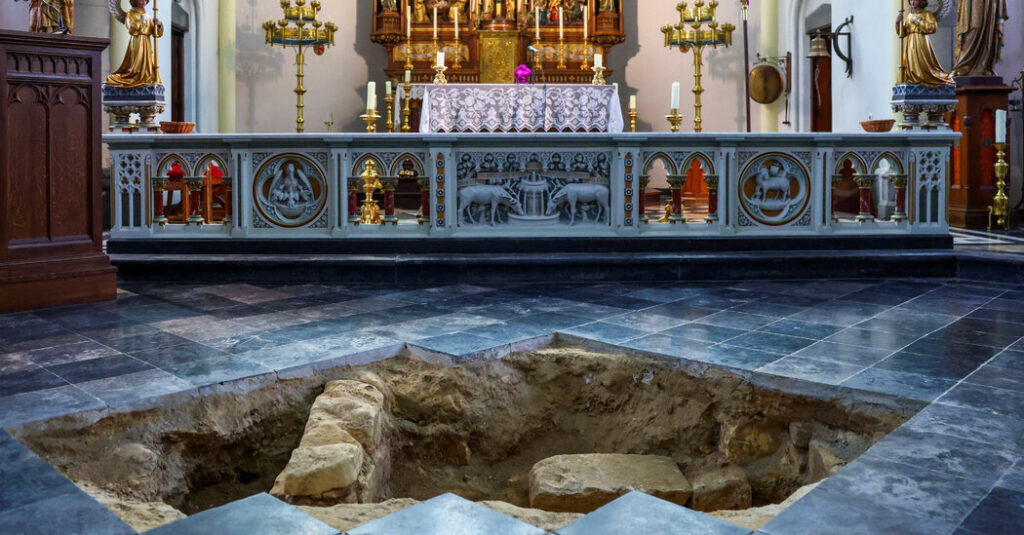
The postcard-perfect Dutch village of Wolder was set aflutter this year when local volunteers made a thrilling discovery in St. Peter and Paul’s Church, which for centuries was rumored to be the final resting place of the fourth musketeer from Alexandre Dumas’s famous story.
There was a skeleton under the heavy gray stones of the chapel floor.
Expectations were immediately high. Surely the bones belonged to Charles de Batz de Castelmore, also known as Count d’Artagnan, who served under King Louis XIV as captain of the Musketeers of the Guard, and was dramatized, fictionalized and immortalized in Dumas’s “The Three Musketeers.” In the story, he is the fourth musketeer and the main character, joining his friends Athos, Porthos and Aramis as a comrade in arms. The man’s swashbuckling fame lives to this day, making his grave a point of avid historical interest.
That’s why a group of community members set out to see if they could find d’Artagnan earlier this year. Jos Valke, the deacon of the church, and other locals formed a nonprofit group that started with metal detectors, located the old church foundation, and eventually looked underneath some loose floor stones.
By February, they unearthed a skull. In March, they announced that they had located what might be d’Artagnan’s skeleton, and that tests would be needed to confirm his identity.
“Now we’re waiting,” Mr. Valke said. “Anxiously waiting,” explaining that he expects results within the next few weeks.
The remains — a man’s bones, buried with a 17th-century coin and a musket ball — have been sent to a Dutch university for investigation. Carbon dating, DNA testing and other analyses are underway, Mr. Valke said. A hole remains in the church floor, covered by a plywood platform and a rug to allow Mass to proceed. And this place and Maastricht, the larger city it is part of, are holding their breath.
Already, the discovery has drawn a deluge of unaccustomed attention to the village, population 1,500. International media including the BBC, CNN and even Smithsonian Magazine have run articles. American and French tourists have stopped by the church to see the site, Mr. Valke said. The university where the bones are being analyzed had to take four weeks to build a secure room to do the analysis, he added, afraid that people were visiting the campus to try to see them, and that the skeleton might be stolen.
That university, the Saxion University of Applied Sciences, declined to confirm or deny that. It did confirm that it was involved in the investigation into the skeleton, but referred all other questions to the municipality.
Mr. Valke and his colleagues think that if the bones turn out to belong to d’Artagnan, this could be merely the start of a new chapter for Wolder, which sits on the outskirts of Maastricht and just on the Dutch side of the border between the Netherlands and Belgium.
A local tour operator is exploring the possibility of bus tours out to the church from downtown Maastricht. Bulent Ozdemir, who owns the Shell gas station at the end of the church’s small lane, wonders if bike routes might add their little village as a stop.
“It was a surprise,” Mr. Ozdemir said, standing behind his counter on a sunny May morning. “They’re very excited in Wolder.”
Broader Maastricht is also enthusiastic. Camille Oostwegel Sr., who owned several local luxury hotels before passing the business to his son, serves as squadron leader for the local branch of the modern-day Musketeers, an international organization that holds events and keeps alive musketeer lore. One of his hotels is in a nearby castle that served as a hospital during the 1673 siege of Maastricht in the Franco-Dutch war, in which d’Artagnan died. It serves a special d’Artagnan beer, which is made with Champagne yeast.
“He is a French hero — a very important hero of course,” said an effusive Mr. Oostwegel. The find is “the talk of the town.”
Quincy Van Burg works at Grand Cafe Nieuw Bruin, a spot for poffertjes — Dutch mini-pancakes — that opens to the sidewalk of Maastricht’s busiest tourist square. He said John Tana, a local recording artist, has put out a song to celebrate the discovery, called “Eine veur al,” or “one for all” in Dutch.
Maastricht is already flooded with tourists, so Mr. Van Burg and other service workers don’t expect it to be a game changer for business there.
But Wolder — perched on the hill above the city, and home to bright green fields, red brick buildings and tidy tile roofs — does not share in that bustle. The walking map sold at the Maastricht city shop sticks to the city’s core. Even a more extended foldout version cuts off Wolder’s streets, stopping just shy of d’Artagnanlaan (named, obviously, for our hero).
Already, the parish has long talked up its possible tie to the famous musketeer. At the entrance to the sanctuary, a statue of a proud-looking d’Artagnan in a royal blue sash and a jaunty hat stares bravely skyward from a display shelf in the corner, nestled just below a life-size, realistically painted crucifix. Maastricht — and specifically Wolder, for the purists — is often the final stop on the Route d’Artagnan, a hiking, riding and biking route that commemorates the musketeer’s life.
Yet it is not at all clear whether the results will be conclusive.
D’Artagnan has known descendants but the French nobility often had extramarital affairs, so it is at least possible that they are not biologically related to the musketeer, Mr. Valke points out. Given that, Mr. Valke argues that it will be hard to rule out his identity if the DNA does not match.
Still, municipal leaders say proving a DNA connection could be a step in the identification process.
“Verifying genealogical connections to d’Artagnan is an essential part of this process,” the local authorities said in an emailed statement.
Mr. Valke is hopeful, suggesting that the church and village might eventually plan a museum, and that people could come by the “thousands.” The church is not usually open during the day, he said. When he does open its doors at 3 p.m. these days, people drop by, but “not to pray.”
Still, he said he doesn’t want to get too far ahead of himself. “We try to do this step by step,” he said.
Koba Ryckewaert contributed reporting.
Jeanna Smialek is the Brussels bureau chief for The Times.
The post Are These the Bones of the Fourth Musketeer? This Dutch Village Hopes So. appeared first on New York Times.