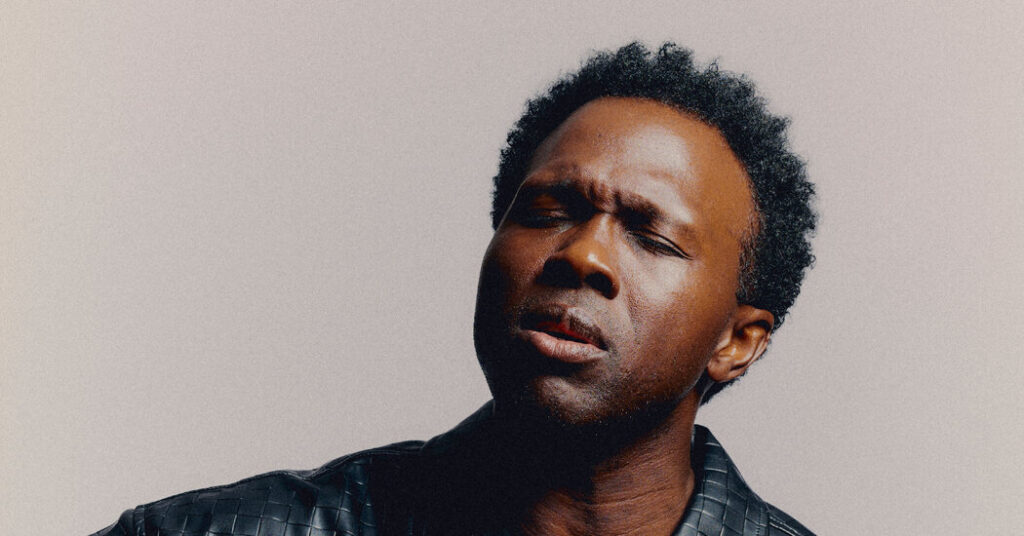
Joshua Henry can hear you crying. The wallop of his rich baritone has been having that effect on Broadway audiences this season, helping to make the revival of “Ragtime” a must-see show. As Coalhouse Walker Jr., a charismatic Black pianist, Henry conveys a range of emotions with his voice — delight, heartbreak, rage — while somehow maintaining an astonishing vocal clarity that prompts gasps, sobs and mid-performance ovations.
Henry doesn’t take any of it lightly.
“With this role, I have to rise to the occasion every night,” Henry said of Coalhouse, one of the Black Americans whose story in “Ragtime” is interwoven with those of affluent well-to-do white suburbanites and Jewish immigrants in pursuit of the American dream at the turn of the 20th century. Coalhouse sings about a lost love, his dreams for his newborn son, and then tragically, of inequities and justice denied. “I can’t come in at 90 percent and think I will live up to this material. It’s as heavy as a dream, this show, but it’s filled with so much promise.”
Henry, 41, has been on a wild ride with “Ragtime.” After spending two decades sharpening his leading man tools — and building a devoted fan base — in musicals like “The Scottsboro Boys,” “Carousel” and “Violet,” he appears to be closer than ever to winning his first Tony Award. Earlier this month he received his fourth Tony nomination, and many in the industry consider him to be the front-runner for best leading actor in a musical.
The buzz is louder this time around. “It’s hard to describe the feeling, but I know I’m doing what I dreamed I was going to do,” he said in an interview this week. “I’m sharing with audiences and they’re being touched. I can’t ask for a better moment.”
The production has been a recurring topic in theater circles since it opened last summer at Lincoln Center Theater. The entire cast has won praise, but Henry has been the standout. In her review for The New York Times, Laura Collins-Hughes wrote that Henry’s “acting, like his singing, seems to emanate from his very core.” Jesse Green, a New York Times culture correspondent, named him one of 13 actors to see onstage no matter what.
While Henry appreciates the accolades, he is quick to dismiss personal glory. He casually referred to awards as “shiny things,” when we discussed the heightened attention in his dressing room in late April. What drives him, then, becomes a more interesting question, specifically with regard to this role. In addition to meticulous technique, the character of Coalhouse demands something that’s harder to prepare for: a willingness to absorb racial threats, grief and discrimination. What seeds were planted in Henry that yielded not only his disciplined approach to his craft but also his absence of fear? Nature, nurture or some hard-earned hybrid of both?
‘A Genuinely Divine Instrument’
“Ragtime,” the actor said, has been his greatest challenge, vocally and emotionally. He feels as if he can sing anything now. “I sing so much that my foundation is strong. I understand my gear shifts. You know what —” he hesitated before continuing. “Yeah, I’m going to say it: I feel like I have mastered the voice. But that’s not a stopping point. If you feel that you have gotten close to mastery, it’s because you have stayed a student.”
To power through the mammoth score for “Ragtime” — Lynn Ahrens, Stephen Flaherty and Terrence McNally’s 1998 adaptation of E.L. Doctorow’s novel — while maintaining a resonant baritone, Henry has a tried-and-true routine: hydration (he drinks at least a gallon of water a day), sleep, a workout regimen, physical therapy, massages. He also believes in plasticity: “Every show is a different type of training,” he said. “You can’t put the same 10 exercises on it.”
When preparing for the role and songs like the call-to-justice anthem “Make Them Hear You,” he picked up his guitar, which has remained lodged in his hands since he was 11. “Whatever I am doing, I always work it out on guitar first,” he told me. Ragtime isn’t “the type of singing I started out singing, so I need to get it in my voice first. Then I can layer characteristics, details on top.”
The show’s director, Lear deBessonet, who also cast Henry in her 2022 Broadway revival of “Into the Woods,” used the word “Olympian” to describe his appetite for improvement. “With revivals, casting is everything,” she said. “You need the actor who can reveal the part. I felt Joshua was the person who could hold the very profound depth of Coalhouse’s grief, rage, joy, charisma, love. Emotionally, he could follow that arc, and his voice is just a genuinely divine instrument. He could give the music its full, radiant due.”
There was a hitch, though. A while back, Henry had told deBessonet that he wanted to focus on new works. Aside from a stint in “Waitress,” Henry’s last three Broadway credits had been revivals (“Into the Woods,” “Carousel” and “Shuffle Along”). He is also developing an original musical, “The Conversation,” with Julia Harriman and Nick Green.
But “Ragtime” carried deeper resonance for him. He has vivid memories of being a student at the University of Miami, listening to the original cast recording with Brian Stokes Mitchell, whom he lovingly refers to as “my friend, Stokes.” Mitchell originated the role of Coalhouse when the show debuted on Broadway in 1998, and it had become a dream role. “Ragtime” would be the exception.
Despite his success in the role and his many career highs, Henry has a tendency to point out the lows. In confessional-style videos posted on social media, Henry often reflects on failure, self-doubt and missed opportunities — like not being part of the original Broadway cast of “Hamilton” after years of workshopping the show alongside its creator Lin-Manuel Miranda. (Though he eventually starred as Aaron Burr when that musical opened productions in Chicago and Los Angeles.)
This is why he takes little for granted, and is constantly honing his craft. Miranda, who has tapped Henry for other projects — the musical “In the Heights,” the “Tick, Tick … Boom!” movie, the “Warriors” concept album he created with Eisa Davis — remains a friend and preacher of Henry’s industriousness. He insisted that my inquiry into what fuels Henry’s drive was actually needless. The answer is inscribed on the man’s genetic code: “immigrant parents, immigrant parents, immigrant parents,” Miranda laughed.
“That’s something we share,” Miranda, whose parents are from Puerto Rico, added. “I can’t remember a time when my parents didn’t have multiple jobs, and I get that same sense from Josh. His parents made miracles happen to get him to school. We’re not just going anywhere to get good at something, we’re going because people, because our families invested in us.”
A Window Into Coalhouse
Indeed, Henry’s parents immigrated to Canada from Jamaica, and the ease with which he glides into the accent during our conversations suggests a lifetime of mimicking his parents’ voices, in addition to their diligence. Also carried over from the Greater Antilles was a deep faith: The church was his first playground for working out his singing talent, the first place he learned about the transcendence that a voice, trained or not, could elicit. Psalms and Bible verses still roll melodically off his tongue.
That spiritual connection was an early window into Coalhouse. The character, Henry reminded me, is a believer. In a line of dialogue, he says: “The Good Lord looked down and saw me lonely and loveless and He thought to Himself: ‘Enough is enough. I’m putting Sarah in Coalhouse’s life.’”
“Those words are not of Coalhouse’s own strength,” Henry explained. “Something larger saw fit to bless him. And if so much of him rests on this line of faith, when does Coalhouse lose it? When is it challenged?”
Faith also helped Henry to bond with his co-star Nichelle Lewis, who plays Sarah, Coalhouse’s lost love. “Our backgrounds are similar in the way that they are grounded by faith and energized by a sense of ‘This is my purpose. This is what I am called to do.’”
Before they met in rehearsals for a New York City Center gala production in late 2024 that preceded the Broadway run, Lewis did not know who Henry was, but said she realized later that he’d been singing to her for years: Henry’s 2021 album, “Grow,” was in her morning playlist. (The album was a return to some of Henry’s earliest inspirations outside the church. “Stevie Wonder is up there,” he told me. “And Peabo Bryson. Honestly, if you don’t know Peabo, you don’t know me.”)
When “Ragtime” closes this summer, other projects will take its place, but it will also allow him to spend more time with his wife, Cathryn — his college sweetheart whom he repeatedly championed during our conversations — and their three young sons. Henry said the boys are just getting to the age when they understand what he does for a living, and why he’s not home at night.
Domestic sacrifice comes with a life in theater. For Henry, tapping into that pain intensifies his work, particularly in songs like “Wheels of a Dream,” a ballad of hope that Coalhouse and Sarah sing about their son:
With the promise of happiness
and the freedom he’ll live to know
he’ll travel with head held high
just as far as his heart can go
and he will ride
our son will ride
on the wheels of a dream.
But Coalhouse and Sarah’s road to happiness is marred by the racism of low-level thugs and high-ranking officials. Eight times a week, Coalhouse is robbed, threatened and called a racial slur — violence that can stick to an actor’s body long after the curtain call.
“In real life, the times I’ve been called the N-word, hard R, I was stunned,” Henry said. “Coming from a Jamaican background, we think of ourselves as kings and queens, so my reaction is like Coalhouse’s: ‘Oohh, there’s a misunderstanding here. You don’t know me. I am not going to get the courtesy I deserve.’”
Both Coalhouse and Henry know the power of self-possession, especially when it has been hard won. Conviction like that may take a lifetime to build, and Henry still has a lot of life ahead of him to deepen it. When he stops to take stock of how far he has come, though, he knows his 11-year-old self would be in awe.
“I used to tell my brother that all we needed was a bathroom, a fridge, and a room with instruments all around so we could make music all day. I am living that dream,” Henry said. “‘Ragtime’ is awesome and it’s giving me a spotlight, and I come back in between scenes to pick up the guitar because I’m always doing things to get my creativity out. I made promises to my younger self that if I ever saw a moment like this, I’d stay hungry.”
The post The Singer Bringing Broadway to Its Feet Every Night appeared first on New York Times.