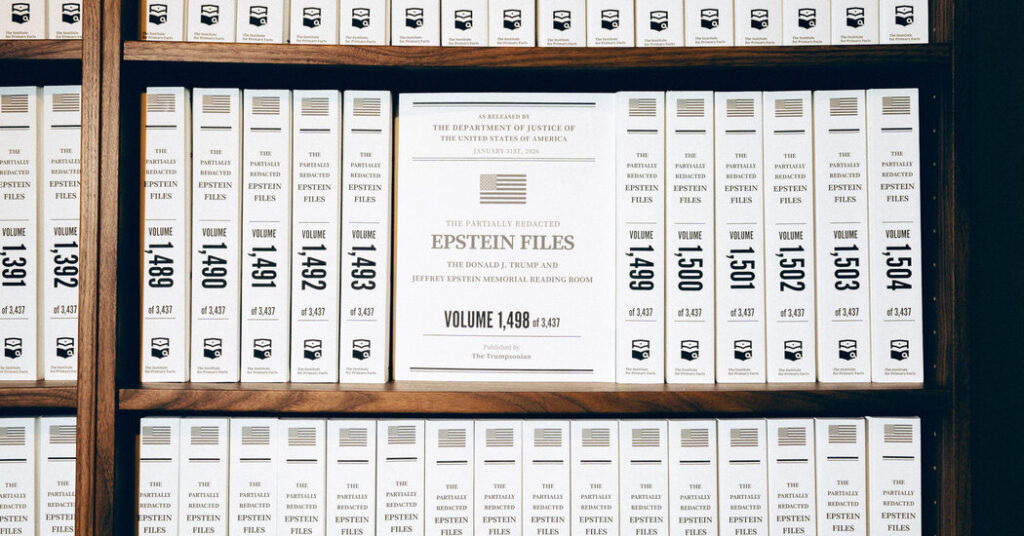
It may be the most unlikely new tourist attraction in New York: a generic TriBeCa gallery space, dotted with a few small plants and wingback chairs, and arrayed with tall green curtains.
But for the next week or so, that space will be lined with millions of law enforcement documents related to the investigation of Jeffrey Epstein, the notorious sex offender, a case that has both fascinated and repulsed many Americans.
Since opening on Friday, the exhibition has attracted a steady stream of visitors to 101 Reade Street, just blocks from where Epstein was found dead inside his cell in 2019 while awaiting trial. The files, printed and bound, take up 3,437 volumes, each about two inches thick; all told, they weigh more than eight tons, according to David Garrett, one of the exhibition’s backers.
While the project’s name — the Donald J. Trump and Jeffrey Epstein Memorial Reading Room — is purposefully provocative, Garrett said that one of its primary goals was to break through the online static of looking at the some 3.5 million documents, photographs and videos released by the Department of Justice in late January.
“When I’m looking at my phone and I see a cat video and an ICE raid and my aunt’s birthday cake and evidence of the worst crime in 250 years of American history, and it’s all kind of in the same feed, it all sort of takes the same weight,” he said in an interview last week, adding, “You lose context.”
In December, Garrett — a Michigan-based entrepreneur who has worked in the luxury wine industry — helped form a nonprofit, the Institute for Primary Facts, which he says aims to fight the Trump administration and is producing a series of pop-up art projects under the banner of “the Trumpsonian.”
As such, the exhibition on Reade Street has joined a collection of other satirical works aimed at calling attention to the president’s association with Epstein, including sculptures placed on the National Mall depicting the two men holding hands and in an iconic pose from the film “Titanic.”
The name of the president appears thousands of times in the files released by the Justice Department; he has denied any wrongdoing. Epstein, a wealthy financier with deep ties to the rich and powerful, was alleged to have sexually abused and trafficked hundreds of young women and girls.
An investigation by The New York Times late last year concluded that Trump and Epstein once had a close friendship, often bonding over a pursuit of women. The president told New York magazine in 2002 that Epstein was a “terrific guy,” but later said he ended the friendship in the mid-2000s after Epstein “hired away” spa attendants from his Mar-a-Lago estate.
Authorship of the statues in Washington has been claimed by an anonymous group of artists called the Secret Handshake. The Primary Facts group is more public-facing, and it’s privately funded. The Reade Street project cost in “the low six figures,” according to Garrett.
Admission is free but limited: The group has only allowed a few dozen visitors every hour, booked through online reservations, and there are security officers inside and out. Demand has been brisk, with more than 90 percent of the nearly 5,000 available slots claimed by Tuesday, Garrett said.
The bound volumes fill long bookshelves fronted by velvet ropes: Visitors are not allowed to browse through the collection, a decision Garrett said was made out of respect for possible unredacted mentions of victims. The center of the main room, where hundreds of small artificial candles flicker, is devoted to survivors.
Perhaps the rawest section of the exhibition is downstairs, where sparse decoration suggests a traditional library. There, a bulletin board invites visitors to offer up opinions, many of which are frustrated and angry.
“We all need to be more outraged,” one reads. “Where is the justice?” reads another. “Keep prosecuting,” a third reads.
Some are simply bewildered. “How?” one comment reads.
Johnna Zabel, 35, an English as a second language teacher from Brooklyn, visited on Saturday after learning about the exhibition on Instagram. “I just thought it would be very impactful to be able to physically be in a room with that many of the files, just to show how many there really were,” she said.
“It’s overwhelming because they had this evidence for so many years,” she added. “And they didn’t do anything with it.”
Tamara Peterson, 55, echoed that sentiment. “So many people spoke up,” said Peterson, an executive assistant from Brooklyn. “And nobody paid attention to these women.”
The one exception to the no-browsing rule for the volumes is for the victims themselves, including women like Danielle Bensky, who attended a preview of the exhibition last week with Katie Phang, a liberal lawyer and political commentator. Phang posted video of the experience on YouTube.
Bensky, who was 17 and an aspiring dancer when she says Epstein abused her, said she had initially worried that the exhibition would be traumatizing. Instead, she was moved.
“I had expected walking in there and seeing, you know, all sorts of images or all of our stuff plastered everywhere,” Bensky said. “And it was just so not that.”
She added that she was impressed “at the care that they took to ensure that survivors are protected, and honor us,” noting that the message of the exhibition seemed to be “how much is here and needs to be investigated.”
“It kind of knocks the wind out of you,” she said.
Journalists, members of Congress and members of law enforcement have also been invited to leaf though the files, via private appointment, the group says on its website. Beyond Bensky, several other survivors have seen the exhibition, and others are scheduled to do so; a handful of law enforcement officials have asked for appointments, as well.
Garrett said he and his collaborators had spent “too much time yelling at the TV and listening to podcasts and thinking, like, What can we do?” before hitting on the idea of the “reading room.” The group hopes to mount it in other cities, including Washington.
Sitting a few feet from the candles representing Epstein’s victims, Garrett said his personal goal for the project was rooted in being a father to two daughters, ages 15 and 26.
“The reason that there are that many victims is because there was no accountability after the first one and the second one and the hundredth and the 300th and 500th,” he said. “And if there’s no accountability, how do we know it’s not going to happen again?”
Jesse McKinley is a Times reporter covering politics, pop culture, lifestyle and the confluence of all three.
The post Want to See the Epstein Files in Print? Here Are the 3,437 Volumes. appeared first on New York Times.