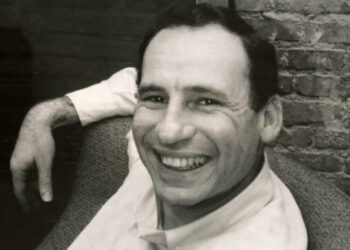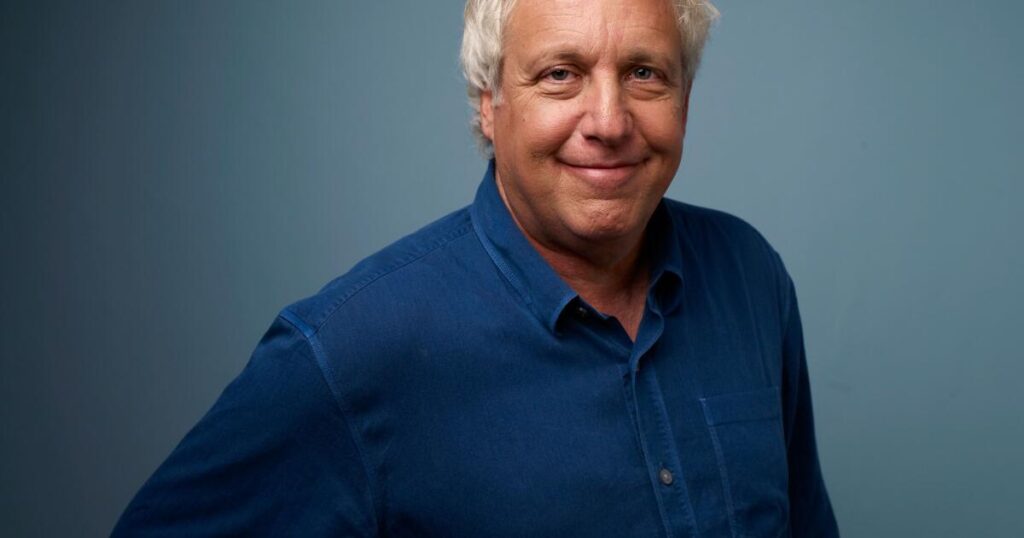
Barry Blaustein, the former “Saturday Night Live” writer behind the beloved Eddie Murphy “Coming to America” films and the acclaimed documentary “Beyond the Mat,” died Tuesday. He was 71.
Blaustein’s death was confirmed by Chapman University’s Dodge College of Film and Media Arts, where he had been a screenwriting professor since 2012. Blaustein battled Parkinson’s disease for the last decade and, according to the Hollywood Reporter, was told last month that he had Stage 4 pancreatic cancer.
“Barry understood what made comedy function better than anyone I know,” Stephen Galloway, the dean of Dodge College, told The Times in an emailed statement. “He knew that it includes darkness as well as light. And yet it was the light that filled his last years. Even as he declined with Parkinson’s, he showed a positivity that always stunned me. He’ll be remembered as a wonderful writer, but an even more wonderful human being.”
Blaustein, alongside his longtime writing partner, David Sheffield, penned classic comedies including the 1988 film “Coming to America” and its 2021 sequel, “Coming 2 America,” 1992’s “Boomerang,” as well as the 1996 film “The Nutty Professor” and its 2000 sequel, “Nutty Professor II: The Klumps.”
Blaustein also directed the 2010 feature film “Peep World,” which he said was shot in 21 days for about $1 million, and 2005’s “The Ringer,” starring Johnny Knoxville and Katherine Heigl.
Although his claim to fame was contributing to numerous comedy projects across decades, it was the 1999 documentary “Beyond the Mat,” a behind-the-scenes chronicle of three famous pro wrestlers, that was Blaustein’s darling.
According to The Times, Imagine Entertainment partners Ron Howard and Brian Grazer and then-President Michael Rosenberg agreed to produce “Beyond the Mat” because they valued their longtime relationship with Blaustein.
Grazer told The Times in 1999 that the comedy writer had “accrued such goodwill with Imagine and was so passionate about the subject matter” that the company decided to back the project “for the relationship with an artist we value.”
“This wasn’t the first time Barry asked me to direct,” said Grazer, referring to the documentary. “And I’ve always said no. I knew Barry as a sheer sketch comedy writer, so when I saw this, I was blown away. I had no idea he had this emotional storytelling side to him.”
The Times called “Beyond the Mat” one of the best films of the year, and it was one of 12 finalists for Academy Award consideration.
Born on Sept. 10, 1954, Barry Wayne Blaustein grew up on Long Island, N.Y. He graduated from W.T. Clarke High School and went on to earn a bachelor of arts degree from New York University before landing an internship at NBC News in New York.
Although he didn’t know he wanted to be a writer from the jump, Blaustein told TTFT podcast in 2021 that he always knew he wanted to be in show business. In the late ’70s, he landed a gig working in Hollywood, but it wasn’t a straight shot to the top. “All the typewriters were stolen; you couldn’t work for a more shady person,” he told the podcast.
Paying his dues ultimately paid off when Blaustein’s boss sent him to lunch with a producer who asked the young hopeful if he could write. He said yes, because he learned to always say yes if you wanted to work in show business. Next thing he knew, he was a writer on “The Mike Douglas Show,” a syndicated daytime program that hosted guests including James Caan, Sonny Bono, Lucille Ball, David Letterman and Bob Hope.
“So I worked on that show, and every job I had has somehow led to another job,” he told TTFT.
In 1980, Blaustein moved on to “Saturday Night Live,” where he was hired for the sketch show’s sixth season. There he met the man who would become his writing partner, Sheffield, as well as Murphy. Together, they produced Murphy’s most famous bits from the show, including Gumby, Buckwheat and Mr. Robinson.
The three had a potent chemistry that would last decades, and Blaustein joked that his more than 40-year partnership with Sheffield and Murphy was the “longest marriage in showbiz history.”
In 1987, the three — plus Arsenio Hall — teamed up for “Coming to America,” in which Murphy played a wealthy African prince who comes to America to escape an arranged marriage and finds his true love. Murphy pitched the project to the writing duo with about 20 pages of handwritten ideas.
“I didn’t realize, maybe it’s because I’m blind or something, but I didn’t realize how sociologically important the film would be,” Blaustein told the TTFT podcast. “The film was beloved, and it’s in the Smithsonian and it was the biggest thrill when I went to the Museum of African American History, and it’s in there in two different places in the museum. And I was like, ‘Oh my God, what a compliment.’”
After a steady run of penning, producing and directing various projects, Blaustein made a career pivot in 2012. He’d recently divorced after 28 years of marriage, his relationship with Hollywood was running on fumes, and he needed a change of pace. He joined Chapman University’s Dodge College of Film and Media Arts, one of the top film schools in the country, and dedicated himself to teaching budding screenwriters.
“He was a hell of a writer,” said screenwriter and former student Brianna Brown in an emailed statement to The Times. “But he was the absolute best teacher. What I learned from him has been monumental creatively. What I learned from him outside the classroom has been transformative. These things I cherish so deeply. Needless to say, his presence quickly became a life changing part of who I am. I’m proud to have bits of these things, bits of the writer he was deeply ingrained in me … his talent, confidence, and humility.
“Beyond his teaching, the person he was has truly shaped me. How I was welcomed into his family. The way he showed his love. The way I always felt it unconditionally … these special parts of him … that will live on through me in anything I ever teach and everything I ever write. He taught me how to live a dream worth living.”
Around 2017, Blaustein was diagnosed with Parkinson’s disease. The veteran writer said that, when he received the diagnosis, the first thing that he thought of was an exchange he’d had with Muhammad Ali, who publicly battled the disease for decades before his death in 2016.
“Don King was on ‘Saturday Night Live’ and invited me to go to the fights in Las Vegas,” he said. “There was a dinner party the night before, and he said, ‘Sit at this table.’ I was with Muhammad Ali, who was in the depths of his Parkinson’s, and I’m talking to him and trying to engage in conversation, and I couldn’t understand what he was saying.”
Blaustein admitted that he thought, “How do I get out of this?”
“And when they diagnosed me with Parkinson’s, I thought, ‘Oh, my God, who’s going to want to talk to me?’ Because I didn’t want to talk to Muhammad Ali, and Muhammad Ali is one of the greatest people that ever lived.”
Blaustein said the condition changed his life and told TFTT podcast that he wrote the 2021 sequel “Coming 2 America” while grappling with the disease. “I’m very proud that I wrote the movie, having Parkinson’s, of course, I didn’t tell the studio, but now they know.”
Blaustein traveled the country speaking for the Parkinson’s Foundation. “You can’t let the disease defeat you, it wants you to stay home, it wants you to go into your shell,” he told a Parkinson’s Foundation podcast in 2022. “That’s not a way to live a life, you’ve got to fight it.”
Blaustein interspersed his wisdom with some humor, “I’ve got disabled parking which is great, ‘I don’t feel like going to your sister’s I’ve got Parkinson’s.’” He said he’d even used it to get bumped up a class at the airport.
Blaustein is survived by his wife, Debra, whom he married in 2021; his children, Corey and Kasey; and his granddaughter, Daisy.
A memorial service will be held at Chapman University.
The post Barry Blaustein, comedy writer known for ‘Saturday Night Live’ and ‘Coming to America,’ dies at 71 appeared first on Los Angeles Times.