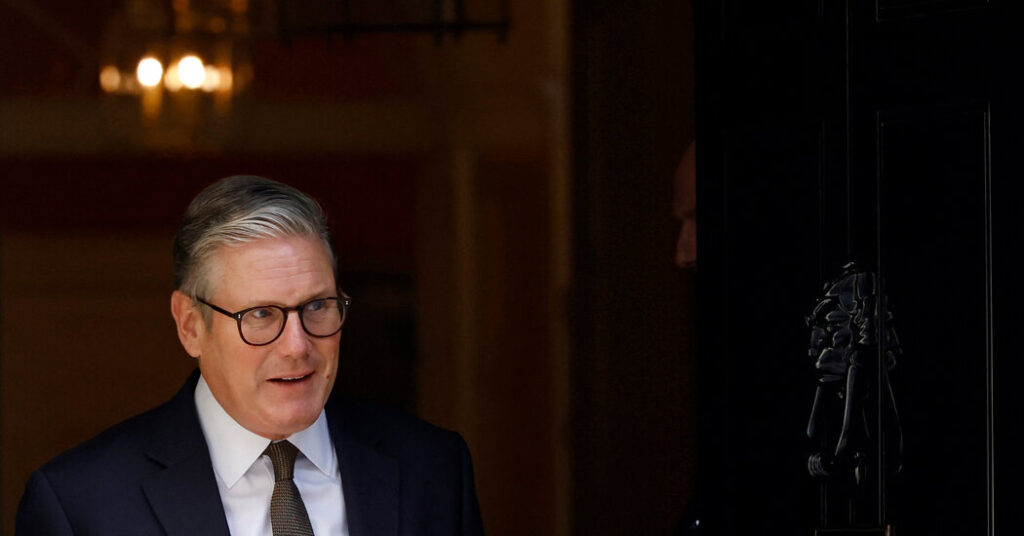
A center-left leader is under siege from party members calling for his resignation. Aides are furiously closing ranks to protect him. The party’s future and the direction of the country are at stake as he digs in, convinced he is the only man for the job, even as his popularity plummets.
For Prime Minister Keir Starmer of Britain, the parallels with former President Joseph R. Biden Jr. may not be welcome, but they are certainly evident. Under fire like Mr. Biden was, he has lashed out at critics within his Labour Party in recent days. He dared them to use a “process for challenging a leader” and insisted that “the country expects us to get on with governing. That is what I am doing.”
That was an echo of Mr. Biden on July 8, 2024, just 11 days after a disastrous debate performance against Donald Trump triggered a torrent of demands from Democrats that he abandon his re-election bid. Appearing on the “Morning Joe” program, Mr. Biden lashed out at the “elites” in his own party.
“They don’t think I should run? Run against me,” Mr. Biden said, sounding angry and bitter. “Go ahead and announce for president. Challenge me at the convention.”
The two men are very different. Mr. Biden was 81 and looking feeble when he finally dropped out just four months before Election Day. Mr. Starmer is 63, with no apparent health issues, and his term is slated to last another three years. Their paths to political peril were by no means the same.
But there are striking similarities in their predicaments, now that Mr. Starmer, too, is mired in a fight for survival against friends and supporters. Faced with threats to their positions of power, the initial instinct of both men appears to have been to downplay the concerns of their supporters and refuse to step aside.
“He’s rapidly becoming Joe Biden because he’s basically in a bunker with his wife saying, ‘It’s all going to be fine,’” Rory Stewart, a former Conservative government minister and a co-host of The Rest Is Politics, said during an episode of that podcast recorded on Friday.
Mr. Stewart added: “There’ll be flatterers around him saying, Keir, come on, you know, you’re much better than these other people. You’ve got to stay because, you know, for the country and for the party.”
In Mr. Biden’s case, the midterm elections of 2022 had gone better than expected, giving him ammunition to claim that Americans had endorsed his agenda. It wasn’t until his stumbling debate performance that his party started questioning his future in a serious way.
For Mr. Starmer, last week’s elections to English municipal councils and to the Scottish and Welsh Parliaments were the final straw. Labour Party members had nervously stuck by the prime minister through scandals, economic misfortune and policy flip-flops. But the massive losses for Labour underscored just how unpopular his government is.
For both men, the friendly fire started as gentle nudges, in private and in public, urging them to think about a gracious move to the exit, and eventually became blunt calls to step aside.
In Mr. Biden’s case, the New York Times editorial board was one of the first out of the gates in June, publishing a scathing editorial the day after his debate with Mr. Trump titled “To Serve His Country, President Biden Should Leave the Race.” Representative Lloyd Doggett of Texas, a Democrat, became the first sitting lawmaker in the president’s party to urge Mr. Biden to “make the painful and difficult decision to withdraw.” A handful of Democratic lawmakers hesitantly joined that call over the next several days.
A week later, George Clooney, the actor and major Democratic donor, wrote in The Times that Mr. Biden must step aside or risk letting Mr. Trump return to the White House, saying that “we can put our heads in the sand and pray for a miracle in November, or we can speak the truth.”
The drumbeat of calls for Mr. Starmer to step aside has been similar over the last several days. Over the weekend, about two dozen Labour backbenchers issued statements saying that the party would be better off with a new leader. On Monday, after Mr. Starmer tried to quell the revolt with a speech in London, things got worse by the hour.
The BBC and other news organizations started tracking the number of Labour lawmakers calling for him to resign. The numbers crept up on the BBC blog — 40, then 44, 55, 70 and over 80 by the end of the day. (There are 403 Labour members of Parliament in total.) On Tuesday, four junior ministers resigned.
For both Mr. Biden and Mr. Starmer, there was plenty of evidence of the damage they were doing to their parties. Public and private polls showed the president was deeply unpopular and was dragging down his party’s chances of winning in 2024. For Mr. Starmer, the election results, and the testimony from Labour candidates about voters expressing their loathing for the prime minister, were hard to miss.
But in both cases, the men surrounded themselves with loyal defenders.
Mr. Biden had Mike Donilon, his pollster and message guru for decades; Steve Ricchetti, the president’s eyes and ears on Capitol Hill; and Jill Biden, the first lady. They closed ranks, insisting that the president was doing fine, medically and politically.
Inside the White House, aides lashed out at reporters who questioned the president’s capabilities and argued that he was still the best chance for Democrats to remain in the White House.
On Tuesday, as Mr. Starmer faced the growing rebellion in his party, he similarly turned to loyalists. Darren Jones, his chief secretary, hit the airwaves, chiding Labour Party doubters who were calling for Mr. Starmer to step down, saying, “It would be better to have that conversation internally as opposed to in public, because it detracts from our work as a government.”
After the prime minister’s cabinet meeting that morning, several of Mr. Starmer’s closest allies came out to buck up their boss. Steve Reed, the housing secretary; Jennifer Chapman, the secretary for international development; and John Healey, the defense secretary, all expressed confidence in his leadership.
But for both Mr. Starmer and Mr. Biden, the most critical booster may have been the one they saw in the mirror. In the middle of their crises, each men claimed that he was the best person to lead his country.
On Monday, under fire for the election results, Mr. Starmer said he took responsibility for the party’s losses, but he also insisted that he would not step down. “I also have a responsibility to deliver the change that we were elected and that we promised this country, and I’ll deliver on that,” he said.
He added: “I had my doubters who said, You can’t lead us to a general election victory after the loss in 2019. It was so bad, it’s not possible. And I proved them wrong. I can prove them wrong again.”
Mr. Biden was even more blunt during his own crisis. After ABC’s George Stephanopoulos asked whether it was worth staying in the presidential race despite his dismal polling, Mr. Biden said: “I don’t think anybody’s more qualified to be president or win this race than me.”
Mr. Biden eventually succumbed to the pressure and agreed to step down for the good of the party. It is not clear whether Mr. Starmer will make the same choice, or if he will be forced out by members of his party through a formal challenge to his leadership.
On the Rest is Politics podcast, Mr. Stewart said the risk for Mr. Starmer and his center-left project was the possibility that clinging to office could make it easier for Nigel Farage, the leader of the right-wing populist Reform U.K. Party and an ally of President Trump, to eventually become prime minister.
“This is again, the Biden critique, right?,” Mr. Stewart said. “The problem with hanging on is you end up with Trump. The problem with hanging on is you’re taking the risk of ending up with Farage.”
Michael D. Shear is the chief U.K. correspondent for The New York Times, covering British politics and culture and diplomacy around the world.
The post The Uncomfortable Parallels Between Starmer and Biden appeared first on New York Times.