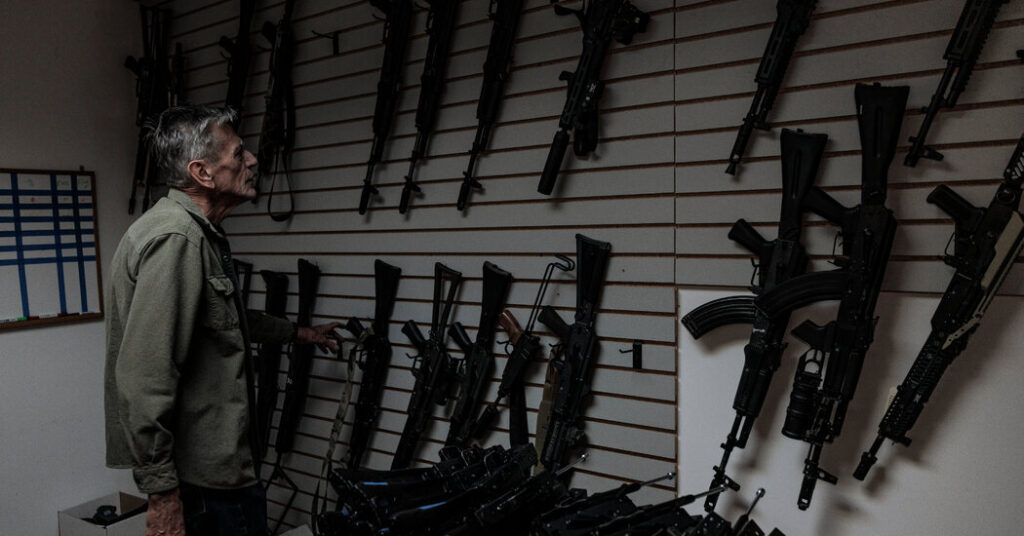
The family of AK-47-type rifles, which have appeared in nearly every conflict zone since their proliferation in the mid-20th century, is perhaps the most recognizable firearm silhouette in history. But civilian versions — once ubiquitous — are disappearing from shelves in the United States.
“All of a sudden there was nothing,” said Jim Fuller, a gunsmith who is considered one of the godfathers of the AK market in the United States, and a go-to source for custom rifles.
The collapse of the AK market shows how the buying habits of the country’s large community of firearms enthusiasts can be shaped by geopolitical forces. The causes of the firearm’s disappearance include tariffs, sanctions, rising ammunition prices related to Russia’s invasion of Ukraine and the soaring popularity of the AR-15.
The AK’s shape may still be iconic, but its new cost is unappealing to many gun buyers. An AK, or Avtomat Kalashnikova, which cost a couple of hundred dollars in the 1980s, can now go for five times more, and is considered by many to be a boutique item.
Overseas firearms manufacturers that supplied AK parts and rifles are now more focused on arming Europeans, fearful of an approaching invasion from Moscow, than on supplying the Americans who once made up a larger portion of their customer base.
“With the tariffs it’s really hard to compete with the U.S.-made products, so that’s why we had to focus more on the European civilian market,” said Jacek Popinski, the chief executive of WBP, a Polish firearms manufacturer that exports AK parts and firearms to the United States.
This has left a dwindling number of importers and manufacturers in the United States trying to maintain the rifle’s status in American gun culture.
The rifle’s path to North America began in 1956, when the world got its first look at this new class of firearm made in Soviet Russia. A Life magazine photographer took a photograph of Jozsef Tibor Fejes, a Hungarian revolutionary, clad in a bowler hat and wielding what would become the rifle of choice for insurgencies and many American gun enthusiasts like Mr. Fuller in years to come.
These early AKs, including the AK-47, preceded the construction and subsequent production of the AKM, which began in 1959. AKMs became the modern model of the AK that spread around the globe, but the term “AK-47” stuck in popular culture.
By the 1980s, when Mr. Fuller was in his mid-20s and starting to take an interest in this strange-looking rifle, the guns were cheap, plentiful and everywhere on the civilian market — largely because they were being manufactured in China, he said.
In 1989, an import ban by the Bush administration after a school shooting in Stockton, Calif., in which the gunman used a Chinese Norinco AK to kill five children, throttled the import of Chinese-made rifles. It was the first of several pieces of legislation that would chip away at the AK market in the United States.
By the early 2000s, AKs from Romanian, Bulgarian, Polish and Russian companies made up a chunk of the market. Rifles imported from Russia remained highly sought after, especially after the Clinton administration’s assault weapons ban expired in 2004. The U.S. wars in Iraq and Afghanistan also bolstered the gun’s popularity, as returning service members often favored AKs because of their prevalence in their own combat experiences.
That changed in 2014 with Moscow’s annexation of Crimea and its proxy war in eastern Ukraine. The U.S. sanctions on Russian companies that followed effectively banned Russian AKs on the U.S. civilian market.
With Russia’s full-scale invasion of Ukraine in its fifth year, the American AK market is a shell of its former self. Skyrocketing ammunition prices also dampened the guns’ popularity as the calibers used by AKs (7.62 by 39 millimeter and 5.45 by 39 millimeter) remained highly sought after by Ukrainian forces.
“With all the wars that are going on right now, particularly Ukraine, this gun is always going to be affected by stuff like that,” Mr. Fuller said.
The most recent data from the National Shooting Sports Foundation shows that more than 30 million “modern sporting rifles,” an umbrella term that includes both the AK and AR-15, have been in circulation in the United States since 1990.
There is no specific figure that provides the exact breakdown of the types of rifles, but industry experts point to the price of an AR-15 and its ammunition, compared with the far more expensive AK and its ammunition, as reasons for the rifle’s decline in U.S. markets. Cheap ammunition prices were once a huge driver of demand for the AK.
“We have definitely seen a substantial downturn in the amount of AKs being sold in the last 12 months,” said Blaine Bunting, the owner of Atlantic Firearms, a firearms company in Maryland that is an industry leader for importing and selling AK parts.
“We saw inflation start to creep up and once the price of 7.62 and 5.56 flipped we started to see things taper off,” he said, referring to the type of ammunition used by an AK and an AR-15. Some U.S. companies have started building their own version of the AK that shoots the same caliber as an AR-15, but those rifles are less reliable because of that cartridge’s characteristics.
In Poland, a former Soviet-bloc country that is now a steadfast member of NATO and a key arms supplier for Ukraine, the country’s history with the AK has allowed its private and nationalized arms companies to have a steady hand in the American AK market.
The Polish state-run arms factory Fabryka Broni, known colloquially as Radom, was one of the earliest manufacturers that Moscow allowed to produce AKs outside its borders. Now, the factory, which once supplied submachine guns to North Korea and AKs to the bodyguards of the Libyan dictator Col. Muammar el-Qaddafi, is trying to navigate a changing U.S. firearms market.
The plant, an hour south of Warsaw, is caught between the times: Cavernous rooms contain antiquated machines that could be operated by hand to produce rifles in case the more modern armory is knocked out in an attack. Polish military officers stroll the corridors, maintaining a watchful eye on the newly made weapons meant for the rank and file.
Radom’s Beryl AKs are considered well made and popular on the U.S. market, but their price has increased.
“Generally speaking, the U.S. firearms market is in a recession,” said Radomir Bałazy, the sales director for Fabryka Broni. “It’s a tough market.”
Despite the dropping demand, Camila Oliveira, 31, an animal control officer and part-time gun store employee in Rhode Island, had set her sights on buying an AK as her first rifle.
The gun’s reliability and accuracy weren’t its selling points, she said; it was its simplicity.
“I can recognize it,” she said.
Ms. Oliveira had saved around $1,200 for an AK but never bought one. She ended up having to spend the money on car repairs.
Thomas Gibbons-Neff is a national correspondent for The Times, covering gun culture and policy.
The post Where Did All the AK-47s Go? appeared first on New York Times.