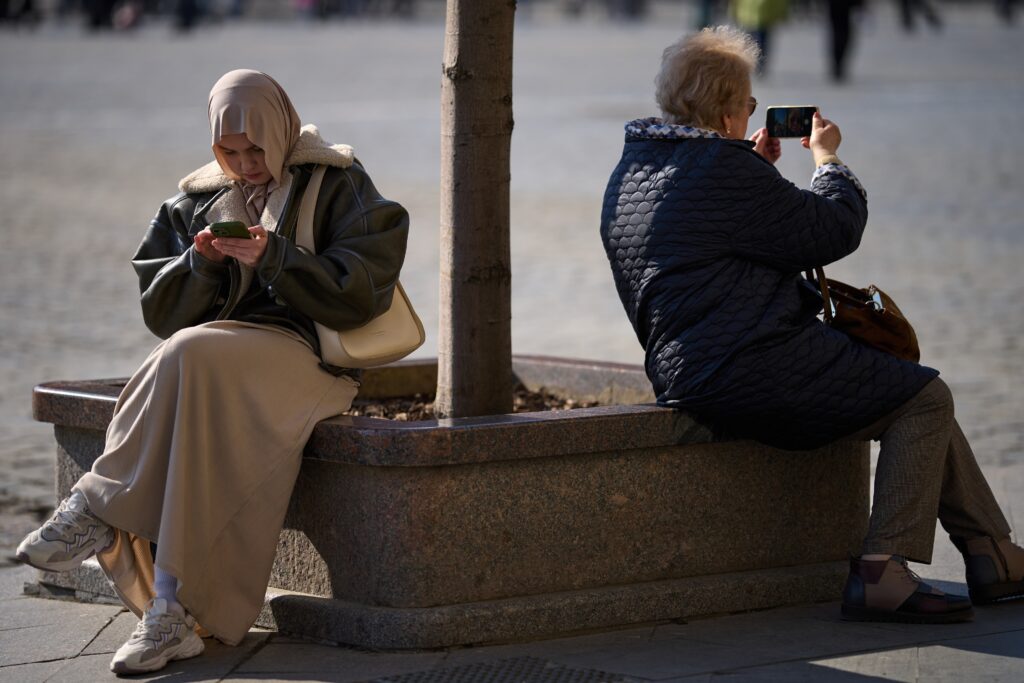
In Moscow, a highly digitized city humming with online services, a three-week internet shutdown this year created a sense of time warp back to the 1990s. People panic-bought radios and pagers, and unfolded paper maps. Public toilets stopped working, paralyzed without bank payments by mobile internet. Taxi and ride-sharing apps were unreachable. Messaging platforms went dead.
In areas close to Ukraine, more vulnerable to drone strikes, residents were cut off from Telegram, the main tool used to communicate air raid alerts.
The shutdown, which spanned most of March, ended as abruptly as it began, with little explanation beyond security concerns as Ukraine extends the reach of its attacks inside Russia. In public remarks, Kremlin spokesman Dmitry Peskov emphasized that it was temporary and for safety.
But in its length and extent, the shutdown offered a glimpse of what daily life could look like if the Kremlin’s apparent, long-running effort to sever Russians from the global internet were to reach a final tipping point, aided by a wave of restrictions that followed soon after.
Last week, residents of Russia’s largest cities woke to find their phones again unable to connect to mobile internet and, in some areas, unable even to make calls or send text messages — restrictions the authorities justified as necessary security measures ahead of Victory Day celebrations over the weekend.
Some Russians, however, are making clear they are too online to give up the internet as they know it and would rather face Ukrainian attacks than go without 5G.
“People are literally saying, ‘Let there be drones, but the internet must work,” Alexander Baunov, a political analyst with the Carnegie Russia Eurasia Center, wrote in recent analysis.
As Ukrainian drones continue to hit oil depots and other targets on Russian soil despite the internet cuts, speculation has grown that the latest restrictions are the next step in a broader crackdown, perhaps accelerated by President Vladimir Putin’s concern for his own safety. The Russian leader, according to a recent report by a European intelligence agency, published by the independent Russian investigative outlet IStories and reported simultaneously by the Financial Times and CNN, has grown increasingly preoccupied with his personal security.
Backlash to the restrictions has set off infighting in the highest echelons of the Russian government, with a faction in the presidential administration arguing that blocking the web could cause the very civic unrest that the security services would be trying to prevent.
The daily intrusion of internet bans has violated the unspoken political bargain long offered by Putin: political passivity in exchange for private autonomy, Baunov writes in his analysis. “They are being asked to trade their rights for the leader’s security.”
The crackdown by Russian authorities on the domestic internet, intensifying this spring, has sown disruption across large parts of Russian society in ways the other effects of the Russian invasion of Ukraine largely have not.
Russia’s internet once appeared on a different trajectory. In the early 2010s, it was a freewheeling exception in an otherwise tightly managed media landscape — a space where dissent circulated, opposition movements organized, and access to Western platforms was largely uninhibited.
After Putin returned for his third term as president in 2012, following wide-scale protests that were made possible in large part thanks to social media, the Kremlin began paying closer attention, and parliament gradually passed a string of restrictive laws.
For years, though, Russia operated on a “blacklist” model — most of the internet stayed open, with only specific sites blocked. During this spring’s shutdowns, however, officials inverted their approach, white-listing only select services to remain online and blocking everything else, more like the internet in Iran — a scenario internet freedom activists had long feared.
By the metrics of Freedom House, a Washington-based pro-democracy organization that tracks freedom on the web, Russia’s internet fell into a “partly free” category from when the group began assessing in 2009 until 2014, after which it was considered “not free.” Basic internet freedoms have since continued to decline, the group found in its latest report on the topic.
In recent months, the daily friction of navigating the restricted Russian internet has become for many people a kind of second job. Want to scroll Instagram, whose parent company has been designated extremist? Use a virtual private network, or VPN, to mask activity. Need to make an encrypted call? Switch to a different VPN. Paying utilities or transferring money from your bank app? Back to the state-surveilled internet.
“I have eight of VPNs because they work one moment, and then don’t the next,” said a Moscow-based teacher, who spoke on the condition of anonymity for fear of retribution. “We don’t live in Iran, after all. People there have long been used to living without proper internet, but we had everything working perfectly. And now, in the 21st century, to go back to something so far behind — it’s just impossible.”
In April, Russian operators pulled the plug on the last remaining way for Russians to pay for Apple ID subscriptions — top-ups via mobile phone bills. The move appeared to be aimed at cutting off a main way that Russians pay for VPN services.
Authorities are also pushing providers to charge users who exceed a monthly 15 GB limit on international traffic — effectively a cap on VPN use over mobile networks that sparked widespread jokes likening it to the Soviet-era ration card system.
“It is a sort of a tax on VPN or generally even a tax on any information from abroad,” said Dmitry Kolezev, an exiled Russian blogger who covers domestic policy.
In mid-April, companies on the whitelist, under pressure from internet regulators, began restricting access to users with active VPNs. Users trying to access popular marketplaces such as Wildberries and Ozon, the social network VK or search giant Yandex were confronted with pop-ups telling them to turn off bypassing tools.
By late April, the marketplaces appeared to have rolled back the blocks after experiencing significant drops in sales, Russian media outlets reported.
Mikhail Klimarev, an internet freedom activist, estimates that about 60 million Russians — roughly 46 percent of internet users in the country — use VPNs. Policing the use of bypassing tools on all of these devices would be costly. Instead, the Russian authorities have taken on a different approach — making VPNs too complicated and expensive to use, aiming to alienate a majority of users who are not tech-savvy enough to play a constant cat-and-mouse game with internet regulator Roskomnadzor.
All of these measures have proved deeply unpopular.
Putin’s approval ratings fell for seven consecutive weeks against the backdrop of the restrictions, even according to state-run polling agencies widely criticized for flattering the Kremlin. Business owners, already squeezed by taxes introduced this year as the government struggles to balance its wartime budget, warn that unreliable connectivity could prove fatal for companies.
Russian influencers who rarely criticize the authorities have spoken out against the bans. Viktoriya Bonya, a former reality show star who resides mainly in Monaco, posted a 20-minute address to Putin that drew more than 30 million views, saying the restrictions are making Russia “impossible to live in.”
She was careful to spare Putin himself, suggesting he “doesn’t know a lot” because those around him are too afraid to tell him the truth, but added that people should not “be scared of their own president.”
Gennady Zyuganov, leader of Russia’s Communist Party, also lambasted the VPN tax proposal, saying it would constitute a “medieval quitrent” or feudal tax, creating a class disparity between those who can afford extra access and those stuck with basic, white-listed services.
The whitelists so far proved to be unreliable. During last week’s blackout, even previously approved websites remained down.
Russians have so far found work-arounds of varying ingenuity. A Russian influencer living in Bali, posted a viral video showing how she stays in touch with her parents back home — calling them via a smart cat feeder with a built-in remote camera. Others have used Google Docs files, which remain accessible, as a makeshift messenger tool.
The shutdown and the war on proxy tools occurred alongside the Kremlin’s second campaign against Telegram — the Dubai-based messenger with about 100 million users in a country of 146 million, which Russia unsuccessfully tried to ban in 2018.
In mid-April, authorities moved to ban Telegram and push users toward Max, a domestic super app modeled on China’s WeChat that internet freedom activists say is built to surveil its users. The rollout has been heavy-handed — residential blocs, schools and workplaces have been ordered to move group chats onto it. Government portals now require Max logins, and all new smartphones must have it preinstalled. Usage levels have been mixed: Mobile retailers reported a surge in sales of cheap Android phones that people use to keep Max off their main devices.
Meanwhile, Telegram audience numbers grew in the last week of April after an initial 30 percent drop, according to Telemetr, suggesting many users have adopted proxies and VPNs. Russia’s fragmented telecom infrastructure — thousands of small providers and dozens of traffic-exchange points — makes the nationwide whitelist harder to implement than in Iran, though authorities are moving to squeeze out smaller operators and consolidate the market.
Kolezev said VPN services have always responded quickly with new work-arounds, and other technologies are being developed. One Russian hardware enthusiast built a pager with Telegram built in, running on a “mesh” network, allowing devices to exchange data directly via Bluetooth and WiFi, completely bypassing internet providers.
“This, is not a one-sided game,” Kolezev said.
Natalia Abbakumova contributed to this report.
The post As the Kremlin throttles internet access, Russians find scrappy work-arounds appeared first on Washington Post.