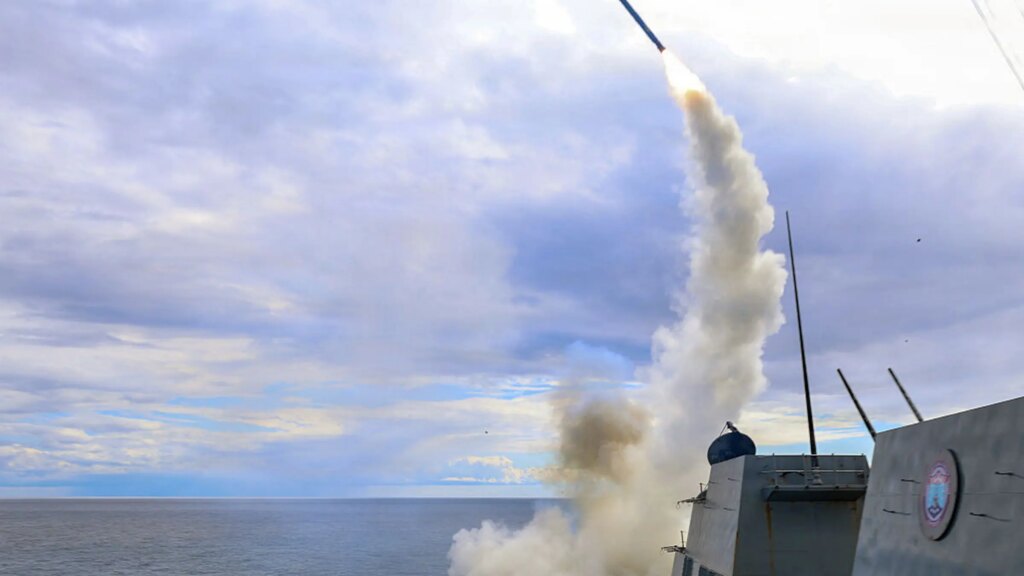
Sen. Mark Kelly, a retired Navy Captain and former astronaut, earned the ire of the Pentagon last week for raising concerns over U.S. weapons stockpiles that have been depleted by the Iran War.
Citing a Department of Defense (DOD) briefing he had received, Kelly told CBS’s “Face the Nation” host Margaret Brennan it could take “years” to replenish stockpiles of Tomahawks, Patriots, and other long-range munitions that have been deployed in the U.S. and Israel’s attack on Iran—a reality that could leave the U.S. vulnerable around the world.
Read more: The U.S. Military Drawdown in Europe Has Only Just Begun
Those comments prompted Defense Secretary Pete Hegseth to launch an investigation into Sen. Kelly’s remarks, accusing him of leaking classified information.
But Mark Cancian, a senior adviser with the Center for Strategic and International Studies (CSIS) Defense and Security, says Kelly is not wrong about these weapons shortages.
“DOD has more money, really, than it can spend on munitions. The problem is time,” he says. “The production rate will increase, but that takes three, four years before production meets demand,” he tells TIME.
And the problem will have ripple effects far beyond the U.S., for allies around the world with whom the U.S. has weapons deals.
“The Gulf States want to replenish their air and missile defense inventories. The Ukrainians want Patriots. The Japanese want Tomahawks and there may be other countries that want to expand their inventories also,” Cancian says. “And for the next couple of years, there just aren’t going to be enough missiles to go around.”
Here’s what ammunition shortages could mean for the U.S. and other allies around the world.
Fears over readiness for war with China
In May 2025, Hegseth flagged China as an “imminent” threat to Taiwan. Trump Administration called on allies in Asia to take a stronger stance against China, and in the past few years, several high-ranking officials have predicted that China could try to invade Taiwan as early as 2027, which could potentially draw the U.S. into conflict with the military superpower.
The Iran War has depleted U.S. munitions stocks to the extent that it will take “one to four years, depending on the munition” to rebuild the inventories, according to Cancian—as long as the U.S. doesn’t enter into any further conflicts.
“And then it will take some years after that to get the inventories to where we want them to be for conflict against China.”
Cancian argues that some munitions have acceptable inventories—”we’re not going to be reduced to throwing rocks at them,” he says—but the missiles most useful in a potential conflict with China over Taiwan would be in short supply.
And the result could leave more U.S. soldiers dead in the event of a war.
“We will have to use short or medium range munitions instead of long range munitions, and that means you have to get in much closer. Makes the platforms much more vulnerable,” Cancian says.
Fewer weapons for Ukraine
Prior to the Iran War, Ukraine was already facing a shortage of U.S.-made Patriot air defense missiles, which are especially effective against Russian ballistic missiles. But, as U.S. forces and American allies in the Gulf used these Patriot air defense systems to shoot down barrages of Iranian drones and missiles, Ukraine is facing a critical shortage.
Earlier this month, the Financial Times reported that new weapons delays announced to Europe by the Pentagon will also affect High Mobility Artillery Rocket System (HIMARS) munitions, which is a highly mobile rocket system used by Ukraine.
Still embattled with Russia, Ukraine is currently working on building its own missile defense system, with President Volodymyr Zelensky telling other European leaders that the continent “should be able to produce everything it needs to defend against everything — all the ballistic attacks and all other weapons — on its own,” in early May.
Limits of production
Even as the Trump Administration allocated $150 billion in additional funding for the Department of Defense (DoD) in the One Big Beautiful Bill passed last year, Cancian says the issue is not money.
Many of the weapons systems in question are constrained by production capacity.
It takes 47 months to build and deliver a Tomahawk, for example, and 48 months for a JASSM (Joint Air-to-Surface Standoff Missile), a long-range cruise missile developed by Lockheed Martin.
The supply issues date back to 2022, when the Ukraine war placed similar strains on stockpiles during the Biden Administration.
Some experts believe the U.S. military industrial base is outdated, relying on World War II production models. While production processes are being reformed, some are advocating that the government pursue low-cost alternatives to high-end weapons systems.
The need for low-cost alternatives to something like Patriot missiles was evident during Iran’s barrage of cheap drones toward the Gulf.
“[T]he United States and the Gulf states have used helicopters with guns, fixed-wing aircraft with guns, and air-to-air missiles to conduct the intercepts. Some of these air-to-air missiles (AIM-120) cost $1 million each. It is better to use one of those than let the drone get through, but that is not a long-term solution,” Cancian wrote in a CSIS report published at the end of April.
The post The U.S. is Facing an Ammunition Shortage Due to the Iran War. Here’s What That Means appeared first on TIME.