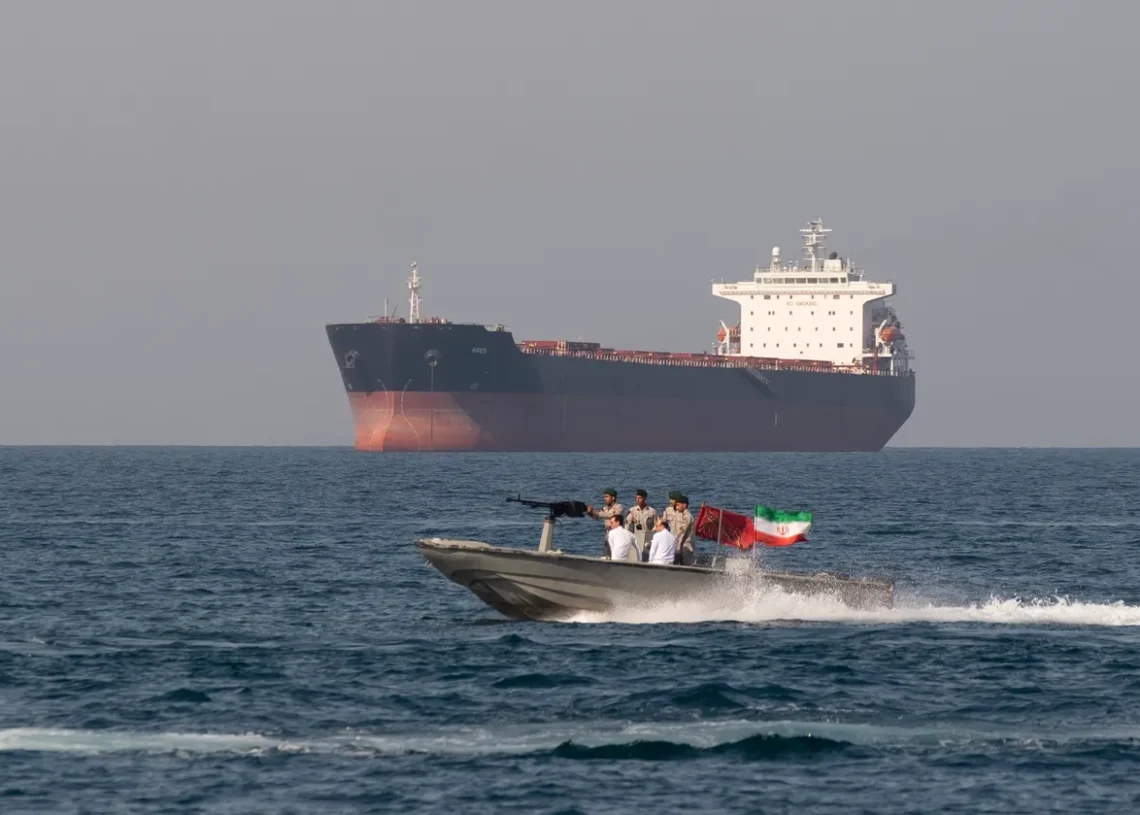
In the Strait of Hormuz, Iran has developed an asymmetrical naval strategy that is crippling the passage of container ships. This “hemostat” uses guerrilla tactics, after Iran’s “traditional” fleet was almost entirely destroyed by US and Israeli attacks. No longer able to rely on specialized military ships, Tehran is using an unconventional force made up of dozens of small military vessels armed with missiles, machine guns, and drones. Quick and nimble, this “mosquito fleet” is capable of assaulting ships carrying tons of cargo.
In mid-April, US president Donald Trump had reassured the public in a post on Truth Social that Iran’s hemostat fleet did not pose a major problem for the US and Israel. “The Iranian Navy lies at the bottom of the sea, completely annihilated: 158 ships,” Trump wrote. “What we didn’t hit are their small numbers of what they call ‘fast attack boats’ because we didn’t consider them a big threat.” Less than 10 days later, on April 22, an Iranian attack conducted with the small vessels led to the seizure of two large container ships leaving the Strait of Hormuz, changing the course of the war.
Enter the Hemostat Fleet
“Iranian fleets of small boats were created during the Iran-Iraq war, with the purpose of disrupting oil tankers in the Persian Gulf that supported the Iraqi war effort,” says Michael Eisenstadt, an analyst at the Washington Institute for Near East Policy where he is director of the Military and Security Studies Program, who compares them to the “US torpedo squadrons that disrupted enemy naval traffic in the Pacific Ocean and Mediterranean Sea during World War II.”
“The effectiveness of Iran’s fleet of small boats comes from their numbers and their use in swarms, which makes them difficult to counter,” Eisenstadt adds. “Iran has over a thousand of these small boats armed with rockets, machine guns, anti-ship missiles, and mines.” In this way, Tehran can pose a serious naval threat even though much of its military fleet has been destroyed.
“As Iran showed in March, it can close the straits by launching only a few dozen drones against oil tankers and cargo ships in the Persian Gulf,” says Eisenstadt, who has also worked as an analyst for the US military in addition to a 26-year career in the US Army as a reserve officer, with missions in Iraq and Israel.
Between the number of vessels at its disposal and the thousands of support drones for air operation, Iran possesses “much more than it needs to effectively force the closure of the strait,” Eisenstadt says. Then there is its proximity to the Strait of Hormuz, which allows Iran to systematize its deterrence against the passage of container ships and oil tankers. “It is therefore important to see the Iranian threat as multidimensional, involving a diverse range of capabilities to exploit its favorable geographic location,” he adds.
A Tactic in the Hands of the Pasdaran
Iran’s “conventional” navy is separate from the navy of the Islamic Revolutionary Guards Corps, also known as the IRGC or the Pasdaran. But a parallel chain of command has allowed Tehran to develop a diverse guerrilla doctrine, even in their respective operational areas of responsibility.
The hemostat fleet is used by the Pasdaran. As the Hudson Institute, a conservative think tank, explains in a report authored by analyst Can Kasapoglu, “most of the Iranian conventional platforms sunk or put out of commission by allied attacks belonged to … Iran’s regular armed forces,” Kasapoglu adds: “In contrast, the Islamic Republic’s Revolutionary Guardians maintain their own asymmetrical naval component, designed specifically for combat operations in the Strait of Hormuz, much of which has remained intact.”
As Eisenstadt explains, “the IRCG navy, which operates in the vicinity of the Strait of Hormuz, is still fully active and has always been the most important organization when it comes to threatening maritime traffic across the Strait.”
In addition to the vessels themselves, Iran has developed a system—from coastal bases and hidden infrastructure to radar and the integration of mines, drones, and civilian vessels—to support them. “This overall architecture is designed to impose friction and attrition rather than to seek or win a decisive naval engagement,” reads the Hudson Institute report, which details the “maritime component being reinforced with a robotic element consisting of unmanned systems,” and some vessels “configured as explosive-laden suicide crafts.”
Creating further instability is the armaments factor. Not to be forgotten, Eisenstadt says, “are the cruise missiles and anti-ship ballistic missiles that, together with the other assets, create a layered network of systems capable of striking targets throughout the Gulf.” Add in Iran’s Shahed drones, which can strike ships in the Gulf while supporting the guerrilla operations of the hemostat fleet, as yet another threat in the Strait of Hormuz.
Guerrilla Warfare at Sea
Amid the threat of US air raids, “Iran keeps many of these boats in reinforced underground tunnels along the Persian Gulf coast, and these tunnels and the boats inside them will likely prove difficult to destroy,” Eisenstadt says.
Iran’s apparent objective in the Strait of Hormuz is to create an increasingly unstable situation. “Strategically, this approach seeks not control but denial,” reads the Hudson Institute report. “It complicates access to key waterways, raises the economic and military costs of intervention, and sustains coercive leverage without escalating into full-scale war.”
And there is another problem: These remaining available systems “constitute a military architecture that resists decisive destruction,” the analysis says. “These assets can be contained, but not fully annihilated.” Experts say it is difficult to eliminate these boats because you have to find where they are hidden.
“It would require a sustained campaign to destroy this fleet,” Eisenstadt says, adding: “So unless the US is willing to land ground forces to conduct raids inside this complex network of tunnels, I don’t think they will be able to destroy these capabilities.”
This story originally appeared on WIRED Italia and has been translated from Italian.
The post Iran Is Using Tiny ‘Mosquito’ Boats to Shut Down the Strait of Hormuz appeared first on Wired.