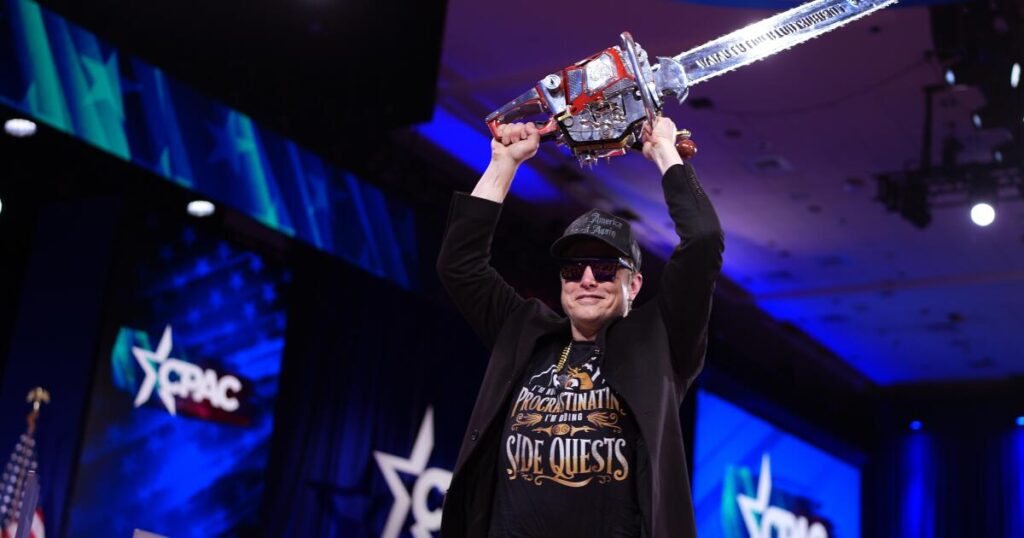
In February 2025, the richest man in modern history raised a chainsaw over his head to wild applause while on stage at the Conservative Political Action Conference. The image of Tesla and SpaceX founder Elon Musk donning a “Dark MAGA” hat, sunglasses indoors and a thick gold chain while wielding the bright red tool handed to him by Argentine President Javier Milei was viral for a news cycle.
“This,” Musk shouted to more applause, “is the chainsaw for bureaucracy. Chainsaw!” At the time, Musk was running the tossed-together Department of Government Efficiency, the executive vehicle through which the United States Agency for International Development was being eliminated. He was the most powerful unelected official in the U.S. government.
The moment became a meme. It was defended. It was denounced. The discourse absorbed it. The cycle moved on. The following month, Secretary of State Marco Rubio announced that 83% of USAID’s contracts had been terminated thanks to the “hardworking staff” of DOGE. USAID was first folded into the State Department. By July it was dissolved entirely.
But more than a year later, the chainsaw is still falling. Just last week, the Centers for Disease Control, for which USAID has been the primary funding partner since 1980, issued a statement on a multi-country hantavirus cluster killing passengers on a cruise ship stranded in the Atlantic. Three are now dead. The investigation is being led by the Africa CDC, South Africa’s National Institute for Communicable Diseases and the World Health Organization. The CDC is only monitoring.
The Lancet now projects that the dismantling of USAID will produce 14 million additional deaths by 2030 — with a plausible range of 8.5 million to 19.7 million — including 4.5 million children under 5. That is approximately 700,000 dead children per year. Roughly one every 45 seconds, around the clock. They will die of diarrhea, pneumonia, malaria and mother-to-child HIV transmission. These are illnesses the U.S. had been preventing for 17 cents per American per day.
USAID’s workforce, once roughly 10,000, has been reduced to fewer than 300. Contracts were terminated abruptly. Food and HIV medications spoiled in warehouses because USAID could no longer fund the supply chain to move them. Data released by PEPFAR, which has invested more than $100 billion in HIV/AIDS prevention worldwide, showed 14 million fewer HIV tests performed globally in 2025 than the year before, a 17% decrease.
The disruptions are not only at the bedside. Brian Honermann, deputy director of public policy at the Foundation for AIDS Research, has warned that the dismantling of PEPFAR’s data systems raises the risk that HIV resurgence “will go unnoticed and undiagnosed.” The Center for Global Development estimates that USAID cuts alone produced between 500,000 and 1 million additional deaths in 2025. The Lancet, in a follow-up its analysis published in February, estimated that combined global aid cuts will yield 9.4 million additional deaths by 2030 even if no further reductions occur.
This week, a Trump administration budget notification obtained by CNN revealed that the dismantling will now consume the programs it has not yet killed. More than $2 billion that Congress initially appropriated for tuberculosis, malaria, HIV/AIDS, maternal-child health, nutrition and global health security is being redirected to pay USAID’s closeout costs: legal fees, pending invoices, asset sales. An additional $1.2 billion in foreign development assistance is being similarly stripped. The Health Security Policy Academy estimates this single redirect will produce 121,000 preventable tuberculosis deaths and 47,600 preventable malaria deaths.
Bill Gates, who pledged $200 billion in May 2025 to combat disease and child mortality, told the Financial Times: “The picture of the world’s richest man killing the world’s poorest children is not a pretty one.” Gates cited a hospital in Gaza province, Mozambique, where USAID-funded prevention of mother-to-child HIV transmission had been canceled after Musk confused the location with Gaza in the Middle East. Musk later acknowledged the error, but the funding was not restored. Children born to those mothers since the cancellation, Gates says, have been infected with HIV.
While Musk’s chainsaw has been retired and DOGE has long been shuttered, its employees spread to the far ends of the government, Health and Human Services Secretary Robert F. Kennedy Jr. has produced an emblem of his own: His first year at the department produced a recognizable “Make America Healthy Again” brand: a phase-out of petroleum-based food dyes, a MAHA Commission report on childhood chronic disease, agency consolidation, and a proposed universal vaccine platform.
But the more durable record may be what he weakened or eliminated — a 25% reduction in the Health and Human Services workforce, suspended CDC vaccine promotion, the purge ofthe vaccine advisory committee, a narrowed childhood vaccine schedule, canceled mRNA and HIV vaccine research (groundbreaking new potential cancer treatments). He paused federal immunization surveillance and promoted a broader politicization of federal public-health science.
The image of Musk shaking his chainsaw is only 15 months old. The reverberation is arriving today: in maternity wards in Mozambique, on a cruise ship in the South Atlantic, in tuberculosis clinics about to lose their funding to legal-fee invoices, and in the Lancet’s projected 14 million dead by 2030. What Musk raised over his head on that stage is still falling.
Robert B. Shpiner is a clinical professor of medicine at UCLA David Geffen School of Medicine, with more than 40 years of ICU experience at Ronald Reagan UCLA Medical Center.
The post Elon Musk’s chainsaw has brought world health crashing down appeared first on Los Angeles Times.