You never know what a chat over coffee will lead to.
Back in January 2016, the composers Missy Mazzoli and Ellen Reid — now among the most prominent working in the United States — ran into each other at a party in Brooklyn, and then met up for coffee. They got to talking about their careers and realized that neither had ever been mentored by a female composer. Then and there, they decided they would try to offer young women studying composition a different experience.
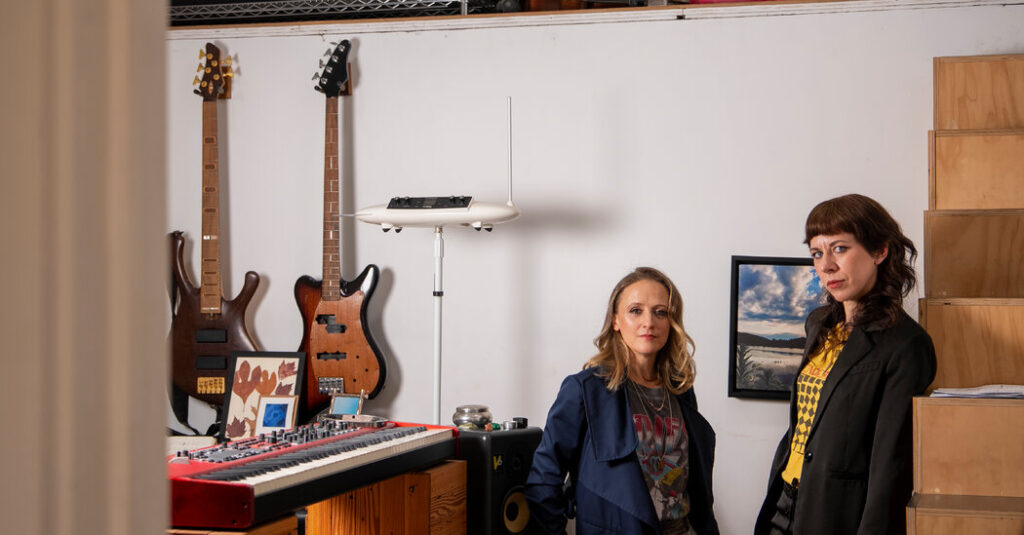
“We took a good hard look at what we wished we had had,” Mazzoli, 45, said in a recent interview at Reid’s loft in Brooklyn. “And I wish that I had had friends who were also writing music, other young women who were interested in music. I grew up playing in bands with a lot of guys, which was great, but it was a very lopsided experience.”
“What we always saw was the dead white guys on posters,” Reid added, “and that didn’t seem that exciting to me.”
Mazzoli recalled that she and Reid asked themselves a few pointed questions:
-
“What can we do to enrich the field as a whole?”
-
“What can we do to make this more diverse, more vital, more alive, more fun?”
For Reid, 43, the answer was: “Reflect the world that we live in and the world that we want to live in and have that be part of the dialogue, and then it becomes our reality.”
The two composers have built enviable résumés. Mazzoli’s opera “Lincoln in the Bardo,” with a libretto by Royce Vavrek, opens at the Metropolitan Opera in October. San Francisco Opera will present the U.S. premiere of her next opera, “The Galloping Cure,” in fall 2027. Reid won the Pulitzer Prize for music in 2019, for her opera “prism,” with a libretto by Roxie Perkins.
Together, based on those discussions, they created Luna Composition Lab, a nonprofit celebrating its 10th anniversary this year. Named for the association of all things lunar with femininity and because “lab” implies experimentation, Luna Lab provides opportunities for female, nonbinary and gender nonconforming students, ages 13 to 18, to develop their abilities as composers through two programs: the Luna Lab fellowship and Adventures in Sound.
The fellowship program matches six young composers each year with an established composer who is also female, nonbinary or gender nonconforming. The composers receive eight months of online individual mentorship — composition lessons and coaching — and the opportunity to develop an original work, which is then workshopped, performed and recorded by professional musicians. The mentors are paid, and the fellows pay nothing. At the end, the fellows attend a festival in New York that features master classes, networking and a concert programmed with their pieces.
The number of applicants has increased over time, with about 60 artists applying in the most recent fellowship round. They need only submit a piece for Reid and Mazzoli to review; some turn in a notated score, and some just a recording. Applicants have a wide range of musical experience, coming from programs like the Juilliard School’s Preparatory Division or a background studying an instrument, not composition.
What Reid and Mazzoli look for is a distinctive voice rather than a particular skill level. “You know it when you see it,” Mazzoli said. “I’m thinking of our alum KiMani Bridges. It was the first piece she’d ever written. She was a flute player. She was, I think, 16 at that time, wrote one piece, submitted it, and we immediately both saw this incredible potential. It was strange, it was beautiful.”
Bridges, now 24, is completing her master’s degree in composition at Juilliard and has composed works for the Louisville Orchestra and other ensembles.
Adventures in Sound, which started in September 2021, is a two-semester group composition course for beginners, developed and taught by the composer Whitney George. Offered online, it takes about 15 students each year, from throughout the United States. It costs $240, but scholarships are available. In the first semester, students are taught notation and basic music theory, and more advanced compositional subjects in the second.
“We’re giving people bread crumbs of things that they can follow to learn, to be curious about them,” Reid said.
“There’s a whole section on being inspired by nature,” Mazzoli added, “which is a common thread with a lot of our students. So there’s Messiaen, but also field recordings.”
In its decade of existence, Luna Lab has grown in every way. Mazzoli and Reid got it off the ground in 2016 with a $10,000 grant from the Cheswatyr Foundation, a nonprofit that supports contemporary music. Its first phase was as a project with Kaufman Music Center in Manhattan. The two, along with Reena Esmail, mentored the first three composers in the fellowship program.
Today, the organization has annual revenue of nearly $500,000 and a staff of four beyond Reid and Mazzoli, who serve as artistic directors. The two founders attribute the growth and stability of the organization in large part to Alyssa Kayser-Hirsh, the executive director.
“She’s the reason we’re able to do this,” Reid said. Kayser-Hirsh, 33, was their program manager at Kaufman, where she initially did administrative work for them on a part-time basis. When Luna Lab left Kaufman — amicably — and became an independent nonprofit, Kayser-Hirsh went with them.
Over the past few years, as the staff has expanded, Kayser-Hirsh’s job has become more focused on fund-raising and strategic planning. Recently, she has been deeply involved with planning Luna Lab@10, a celebration of Luna Composition Lab and the Luna Lab Festival, which was founded in 2017.
The Luna Lab@10 initiatives include more than 70 commissions for 50 Luna Lab alumni that will be co-commissioned, presented and performed by dozens of ensembles and presenters, ranging from the immense Metropolitan Opera to the three-musician Ensemble for These Times in San Francisco.
There will also be two big celebratory concerts. Cal Performances in Berkeley, Calif., is planning to present a program in February 2027 that will include works by Mazzoli and Reid, and world premieres by three Luna Lab alumni. The second concert, in New York in June 2027, will feature performances by the International Contemporary Ensemble and five Luna Lab composers.
Luna Lab is far from the only program for young composers in the United States. Besides conservatory classes, there is the Los Angeles Philharmonic’s Composer Fellowship Program, open to all high-school students from sophomore to senior year, and Wildflower Composers, which provides mentorship to female, transgender, nonbinary and genderqueer early career composers.
What’s different about Luna Lab, Mazzoli said, is its commitment to its alumni. Reid and Mazzoli remain available to former fellows for advice and networking. Yuri Lee, 21, who was in the program from 2018-19, consulted with them about where to go to college, for example. She had studied composition in Juilliard’s Preparatory Division and it was her “dream school” for college. Reid and Mazzoli — and her teachers at Juilliard — encouraged her to attend Princeton University instead, for a well-rounded undergraduate education.
Luna Lab alumni can apply for stipends, from the Toulmin Luna Composition Lab Alumni Fund, that can be applied to creating recordings, producing concerts, purchasing software, creating a website and more. Alumni can apply more than once and can receive a total of $5,000 over time.
The nonprofit also furthers alumni careers through commissions from partner organizations and special projects like 25 for 25: A New Time for Choral Music. For that, the Cincinnati May Festival, celebrating its 150th anniversary, collaborated with Luna Lab to commission 25 works by alumni for 25 different choral ensembles.
About three-quarters of Luna Lab alumni who attend college have studied composition, and virtually all continue to be involved with music. Many have gone on to graduate school in composition. And Mazzoli and Reid say they can foresee a time when alumni will be ready to return as mentors.
For many of the alumni, the Luna Lab fellowship was life-changing. Maya Miro Johnson, 25, a 2017-18 fellow, said that its impact on her life was “incalculable, because I would not be a musician or a composer.” Growing up in a low-income family in Utah, she did have dance and violin lessons as a child but, she said, she was not good at the violin.
Johnson became serious about music in high school, when she took a composition class and, later, private lessons with Devin Maxwell, but still had no idea that she might become a composer. Maxwell encouraged her to apply to Luna Lab. This fall, having received a degree from the Curtis Institute of Music and a master’s degree from Yale University, she is planning to start a Ph.D. in music and multimedia composition at Brown University.
Reid and Mazzoli are well aware that this is a difficult time for organizations that promote diversity, with the federal government actively opposing diversity initiatives in business, the arts and academia. “It’s definitely a challenging moment for a lot of people in the arts,” Reid said. “But we are who we are, and we feel emboldened in this moment.”
They do what they do for Luna Lab, Mazzoli said, “because we love the field.”
“We want the field to continue,” Mazzoli added. “We want it to thrive. We want it to expand. And so bringing in gender diversity, racial diversity, economic income diversity, geographic diversity helps everyone. It helps this field survive and thrive and continue to remain as relevant as we feel it to be when we’re making art.”
The post For 10 Years, They’ve Been Building a Future for Female Composers appeared first on New York Times.