Late at night, after his wife and his two teenage daughters go to bed, Kurt Vile heads down to the recording studio he built in the basement of his house in Philadelphia. He calls it OKV Central — “OKV” stands for Overnite Kurt Vile — and he rolls with the flow from midnight to 3 a.m.
“I get a lot of my KV world and my KV mind together around then,” Vile said as he showed me around the rooms stuffed with analog audio gear, instruments, amplifiers, effects pedals, stacks of cassettes and paperback biographies of his musical heroes. “I’ll be staying up late listening to whatever, you know. Recording loops on the fly. Songs come to me.”
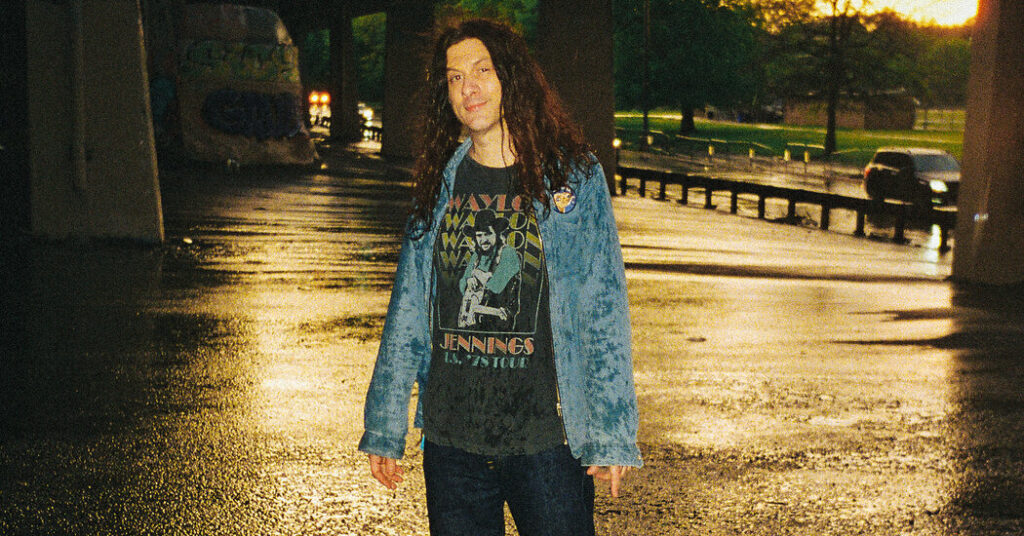
Vile, 46, is the slacker poet of modern indie rock, with a clean guitar sound and conversational lyrics. He is a shy man who, until recently, had a habit of hiding himself from concert audiences behind his long mop of hair. On a warm afternoon in May, he seemed to be doing his best to be outgoing in the hours we spent together.
He started out more than 25 years ago, making bedroom recordings and passing out his homemade CD-Rs to fellow music nerds. In the 2010s, he graduated to professional recording studios, releasing low-key underground hits like “Pretty Pimpin’” and an offbeat album of duets with the Australian singer Courtney Barnett. He earned favorable comparisons to older artists like Neil Young and gained fans among younger artists like Role Model.
Vile’s new album, “Philadelphia’s been good to me” (Verve Records), which comes out May 29, was largely made here in the basement with his band, the Violators. The bassist, Adam Langellotti, set up the equipment, including a vintage mixing board Vile scored from the R.E.M. producer Mitch Easter.
“I’m really coasting at home, self-producing, hanging out with my friends,” he said.
Though not quite a concept album, “Philadelphia’s been good to me” is full of lyrical references to his home city. “I wanted to call out Philly as my town, put it in writing,” Vile said. He grew up in nearby Lansdowne. Except for a stint in Boston, where he followed his girlfriend (now wife) as she attended college, he has spent his adult life here.
In addition to this two-story fieldstone house in the Mt. Airy neighborhood that he shares with his wife, Suzanne Lang, and their daughters, Vile has KV chill zones in a warehouse in nearby Germantown and a rowhouse in Northern Liberties. He has shot several music videos around town, including one for his latest single, “Chance to Bleed,” which was filmed in Fishtown, at the music venue Kung Fu Necktie.
“The older I get,” Vile said, “the more I know every nook and cranny of the city.”
The love flows both ways. The city honored him by declaring Aug. 28, 2013, Kurt Vile Day. The Philadelphia-born street artist Stephen Powers, who goes by ESPO, painted a Kurt Vile mural in Fishtown. (It became a local scandal when someone defaced it.)
The release of his Philadelphia-centric album seemed like a good enough excuse to bump around town together. Vile was dressed in jeans, purple sneakers and a Waylon Jennings T-shirt — his meet-the-press outfit. He had done some laundry the night before so he would have options for a photo shoot scheduled for later that day.
“My quote-unquote style is whatever’s at the top of the pile,” Vile said, letting loose a quick, loud whoop of a laugh.
Around 2 p.m., he suggested we take a ride to Northern Liberties, where he spent his formative years. “Lotta friendly ghosts there,” he said. He mentioned that we could stop in for lunch at one of his favorite places, Honey’s Sit ’n Eat.
He stepped outside, into the sunshine, and slid behind the wheel of his car, a 2012 Prius with road rash and a bumper sticker that reads “Blow up your TV” — a John Prine lyric. These days, he said, he is often behind the wheel of the Prius as he chauffeurs his daughters to their many activities. “What it’s got is a CD player, which is priceless,” Vile said.
He cued up a mix he had burned. The song that came on was “Red Apples” by Smog. “We’re going to take Lincoln Drive to Kelly Drive,” he said, noting that the route would takes us along the Schuylkill River. “That’s the beauty. That gets you set.”
Vile sings about this particular drive on “Zoom 97,” the new album’s opening track. Like a lot of his best songs, it is delivered in a mellow drawl over reverb-soaked guitars and electronic sounds. Hearing it, you feel light enough to float away.
Jump in my whip
My engine whines
Zigzag my way
Down Lincoln Drive
His lyrics have a funny specificity. Elsewhere on the album, on the song “99 BPM,” he sings: “It was 2012, but it felt like 2014.”
We drove past the Philadelphia Museum of Art and the Rocky Balboa statue, toward Spring Garden Street. “Spring Garden,” he said. “This was always my main hub.”
For more than a decade, starting in the early 2000s, Vile and his wife lived in this part of town. He built a fan base while working as a forklift driver for the Philadelphia Brewing Company. He left the job in 2009, the same year he signed with Matador Records. The couple left the neighborhood for practical reasons: They had kids, and it was impossible to find parking. Now, the area is filled with newly built condos and trendy restaurants.
“Northern Liberties back in ’03 was beautiful,” Vile said. “It was bombed out. It looked like a Rauschenberg painting. I didn’t think it would be built up.”
He pulled up outside Honey’s Sit ’n Eat. When he stepped toward the entrance, he seemed befuddled. The door was locked, and the windows were dark. Closing time was 2 p.m., according to a sign in the window.
“Oh, man, I could have used a secretary,” he said, embarrassed.
It was a short drive to Johnny Brenda’s, a bar and rock club that has long served as the canteen for the city’s indie musicians and their fans. “I think I played the first show ever here,” Vile said, taking a booth by the window. Other local acts in the early 2000s included the War on Drugs and Dr. Dog. “It might have been the last organic music scene,” Vile said. “Until things got sucked into the phone.”
Vile, who said he had quit drinking and become a vegetarian, ordered a veggie burger and pierogies. He mentioned that, when he’s on tour, he subsists on pistachios.
I asked him about his childhood and upbringing. His father, an engineer for SEPTA, the commuter railroad, was a bluegrass fan and gave him a banjo at age 12. Skateboarding was an early obsession. “It was my religion,” he said. When music took over, he would ride the trolley from Lansdowne to 69th Street and find his way to the Philadelphia Record Exchange on South Street.
I asked him what he missed most about Philly when he was on tour. He answered a different question, explaining that, when he’s away from home, he doesn’t feel the need to take a city by storm. He’s content to chill on the tour bus.
While we sat face to face in the close quarters of the restaurant booth, Vile’s anxiety was more apparent. He seemed like a wild bird who had been brought indoors. It was time to get the check and bounce to a more KV-friendly environment.
The Record Exchange had moved to a location a few blocks away. “This is Frankfurt Ave.,” Vile said. “If you keep going, you’ll hit the brewery where I used to work. I loaded boxes and bottled beer, Laverne-and-Shirley style.”
He stepped into the record store. There were greetings of “Dude!” all around.
“I missed Bill Callahan,” Vile said to the clerk behind the counter, referring to an in-store concert by the former singer of Smog. He sounded supremely bummed.
“Bill was rad,” the clerk said. “We sold a ton of records.”
Vile rifled through the racks and came out with a 12-inch by Le Tigre and a copy of “Their Satanic Majesties Request” by the Rolling Stones with the rare 3-D cover.
It was late afternoon. We hopped in the Prius and headed back to Mt. Airy, where my car was parked. The windows were down. A breeze filled the car. The streets already had that hot-weather energy, everyone outside.
“I love summer nights in Philly,” Vile said. “The summer vibes are everywhere you turn.”
“Red Apples” came back around on the car stereo. He turned it up. Then my phone buzzed — a message from bummerland. It was a text from someone on Vile’s team, who said he needed to be somewhere. The photo shoot was about to happen.
“Don’t worry, dude, I’ll drive you back,” Vile said. “It’s fun to watch them squirm.”
But now a big old cloud had appeared in our periphery. The mood had changed. Kelly Drive was clogged with traffic. The golden light was fading. I told Vile to drop me off at a traffic light up ahead.
He eased into the right lane and came to a stop. I got out of the car.
“Nice to meet you,” he yelled out the passenger window.
Then he disappeared into the traffic. Our hang session had ended abruptly, like a song with no fade-out.
Steven Kurutz covers cultural trends, social media and the world of design for The Times.
The post A Nice Hang With a Low-Key Rock Star appeared first on New York Times.