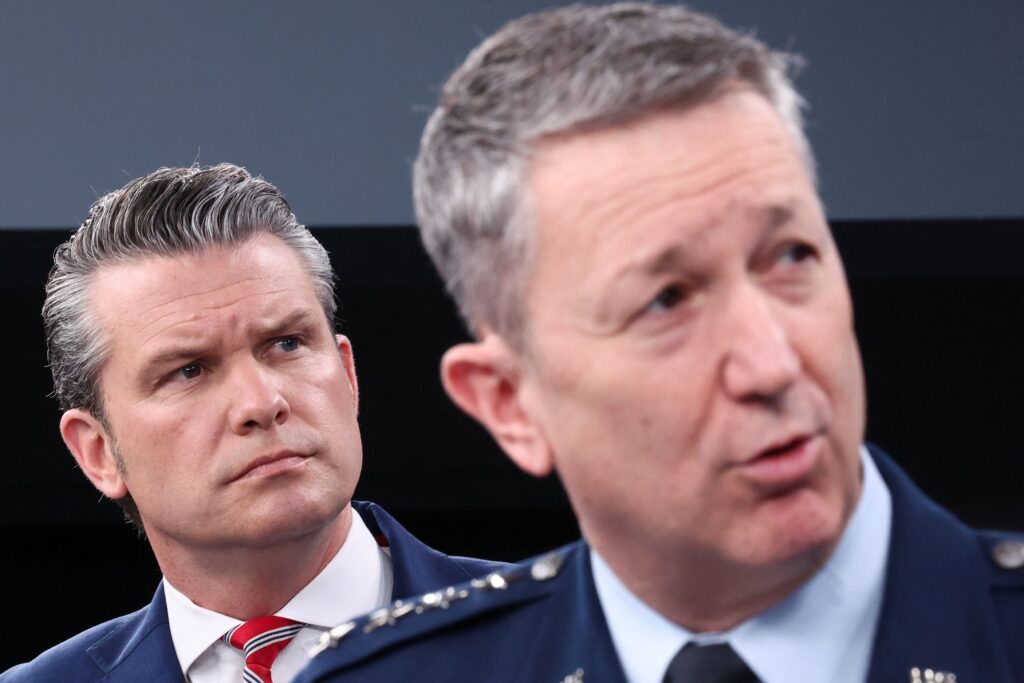
Defense Secretary Pete Hegseth returns to Capitol Hill on Tuesday for back-to-back hearings, during which he is expected to face questions about the Iran war, aid to Ukraine and the U.S. military posture in Europe.
His testimony alongside Gen. Dan Caine, chairman of the Joint Chiefs of Staff, is set to begin at 8 a.m. and will mark the senior Pentagon officials’ last scheduled appearance before Congress to defend the Trump’s administration’s record $1.45 trillion defense budget request.
The sessions before House and Senate panels on defense spending are likely to resemble Hegseth’s combative appearances late last month before the House and Senate Armed Services Committees, where he lashed out at lawmakers skeptical of the Iran war, calling them America’s “biggest adversary.”
Hegseth’s last hearing occurred a day before the conflict reached the deadline by which the Trump administration was required under the law to seek Congress’s approval to continue the war. He argued then that the 60-day threshold had paused during a ceasefire between Washington and Tehran.
The administration later asserted that the hostilities had “terminated,” in a letter sent to Capitol Hill.
The ceasefire showed signs of fragility last week as U.S. warships intercepted Iranian attacks while transiting the Strait of Hormuz, leading to retaliatory strikes on a handful of Iran’s military facilities. President Donald Trump attempted to downplay the attacks at the time, but on Monday he told reporters the ceasefire was on “life support.”
It remains unclear whether enough Republicans will accept the administration’s argument or if some may break ranks and support the next round of Democrat-led resolutions intended to halt the fighting without lawmakers’ explicit approval. All of the measures so far have failed.
While most Republicans avoided directly criticizing Hegseth during his previous testimony on Capitol Hill — and have cheered the administration’s massive defense budget proposal — some prominent GOP lawmakers showed frustration with the Pentagon’s decision in early May to withdraw 5,000 troops from Germany after Chancellor Friedrich Merz said that Iran had “humiliated” the U.S. during the war.
Sen. Mitch McConnell (R-Kentucky), who chairs the Senate defense spending panel, has also publicly called on the Pentagon to explain why it hasn’t spent $400 million in security assistance to Ukraine that Congress passed earlier this year.
A senior Republican Senate aide, speaking on the condition of anonymity per terms required by the office, said that lawmakers were asking for a detailed plan on the Ukraine aid and for more information from the Pentagon to justify the Germany withdrawal.
The staffer said Republicans were also concerned that $350 billion of the administration’s budget request was slated for a risky party-line process in Congress known as reconciliation. While the tool only requires a simple majority, making it easier to pass the Senate, it is also seen in Congress as less predictable than the annual defense budget and could threaten Pentagon priorities from boosting munitions production to energizing America’s sluggish arms industry.
Democrats, who have sought to tie the Iran war to domestic cost-of-living concerns ahead of November’s midterm elections, have said the overall budget request is a nonstarter in Congress.
The post Hegseth to face questions on Iran, Europe in defense budget hearings appeared first on Washington Post.