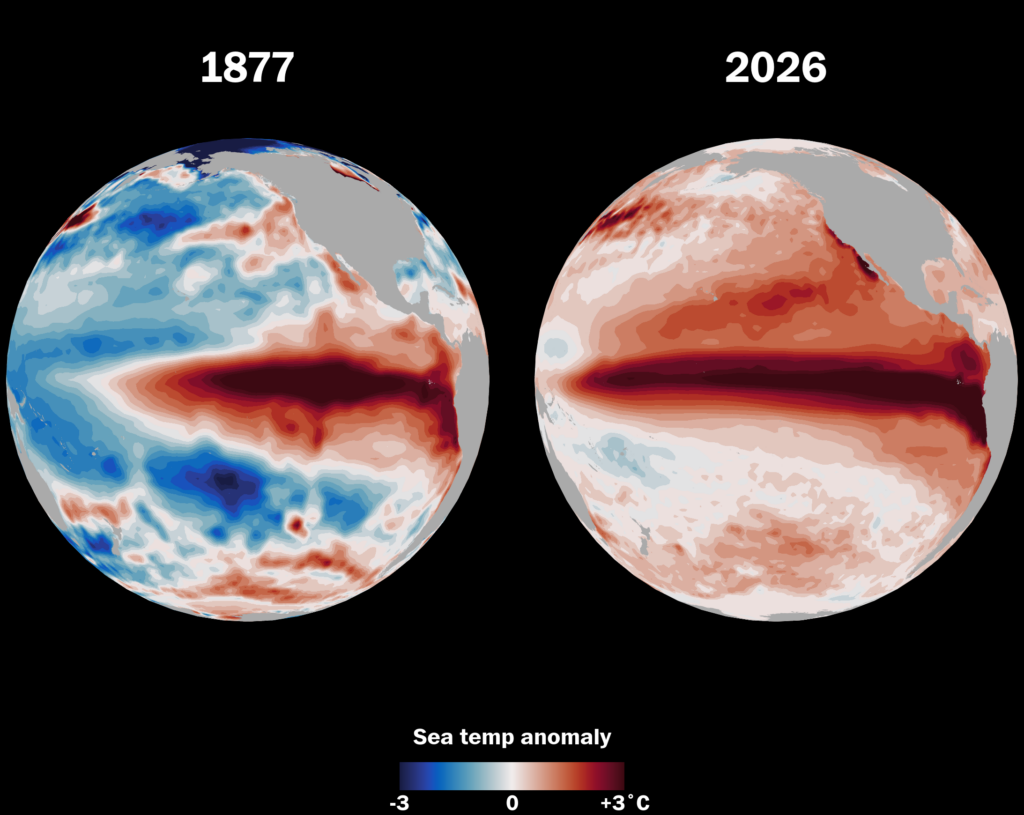
As chances rise for one of the strongest El Niño events on record later this year, the potential for dangerous conditions has prompted comparisons to 1877, when such an event drove catastrophe around the globe.
El Niño is a warming of ocean waters in the east-central tropical Pacific that develops every few years. This year, ocean temperatures there could surge 3 degrees Celsius (5.4 degrees Fahrenheit) above average and break records.
The climatic shift devastated crops nearly 150 years ago, raising the question of whether a similar disruption could threaten global food security yet again. The strongest El Niño on record from 1877 to 1878 fueled conditions that led to a global famine which killed more than 50 million people across India, China, Brazil and elsewhere. That was 3 to 4 percent of the estimated global population at the time, equal to at least 250 million people if it happened today.
“It was arguably the worst environmental disaster to ever befall humanity,” researchers have written about the event.
This disaster took years to unfold. Drought began spreading across the tropics and subtropics in 1875. In the years that followed, a combination of strong climate forces in the Indian and Atlantic oceans formed alongside the record-breaking El Niño, amplifying and prolonging the drought.
Deepti Singh, an associate professor at Washington State University who has studied this super El Niño, said famines are not an inevitable consequence of droughts. The deliberate actions of colonialists in the 1870s disrupted local systems that communities relied on for being resilient to climate variations, Singh said.
Might similar consequences unfold today?
“Simultaneous multiyear droughts similar to those in the 1870s could happen again,” Singh said. “What is different now is that our atmosphere and oceans are substantially warmer than they were in the 1870s, which means the associated extremes could be more extreme.”
But there are other key differences, too. At the time, there was no way to know that such a powerful El Niño was coming nor what it meant. Modern-day knowledge about the phenomenon was boosted by a super El Niño more than a century later from 1982 to 1983.
And because of great advancements in climate monitoring and prediction, the world is now much more prepared to deal with the consequences.
The devastating losses associated with the super El Niño of 1877 to 1878 aren’t likely to repeat today because the social, political and economic factors that exacerbated the effects don’t currently exist.
Still, such an extreme climate event could have significant impacts on food security, particularly in places most vulnerable to long-lasting adverse weather — which could lead to global issues.
“Enhanced drought risk associated with this super El Niño will threaten food, water and economic security in many regions, which could cascade globally across the interconnected socioeconomic systems,” Singh said.
In the past century, tremendous scientific advancements have better positioned the planet to weather the incoming storm. It wasn’t possible to predict a coming super El Niño in 1877, 1888 nor 1972. But now there is much greater awareness of what a super El Niño could bring.
The super El Niño from 1982 into 1983 — which led to huge economic losses — ended up being a pivotal turning point for understanding the phenomenon.
Climate scientist Kevin Trenberth, who was involved with international efforts that revolutionized ocean monitoring in the Pacific Ocean following a surprise super El Niño from 1982 into 1983, described the “major achievement” in establishing real-time tracking of the wide-reaching climate pattern.
He said that by the mid-1990s, about 70 moored buoys — under an international program — had been established across the Pacific, measuring winds, air temperatures, humidity and pressure as well as temperatures and salinity in the upper ocean.
Since then, the number of instruments providing real-time data has ballooned to more than 4,000. This enables the tracking of El Niño development — which occurs in the remote central Pacific — on a daily basis.
Those observations would also eventually help with predicting the phenomenon.
Some of the first El Niño predictions came in 1986 from Columbia University, which were proved accurate following an event from 1986 into 1987. By 1996, seasonal forecast systems were running at ECMWF and NOAA.
They showed that a significant El Niño was likely to develop in 1997 — which ended up becoming even more intense than the one in 1982 — leading to global losses that were estimated to be between $32 billion and $96 billion at the time.
Fast-forward to the present day, and there are many models that make El Niño predictions on a daily, weekly or monthly basis — usually quite accurate but imperfect, especially in spring — enabled by advancements in high-performance computing and new observations from satellites.
But if not for the super El Niño in 1982-1983 and the great scientific advancements that followed, the planet couldn’t be as prepared for the one underway this year.
“International collaboration will be vital to reduce impacts to the most vulnerable and exposed populations in countries most at risk,” Singh said.
The post A super El Niño wiped out millions of people in 1877. Are we better prepared now? appeared first on Washington Post.