President Donald Trump said he will suspend the federal gas tax for an unspecified period as the Iran war continues to push pump prices higher and weigh on his popularity. The measure would require congressional approval.
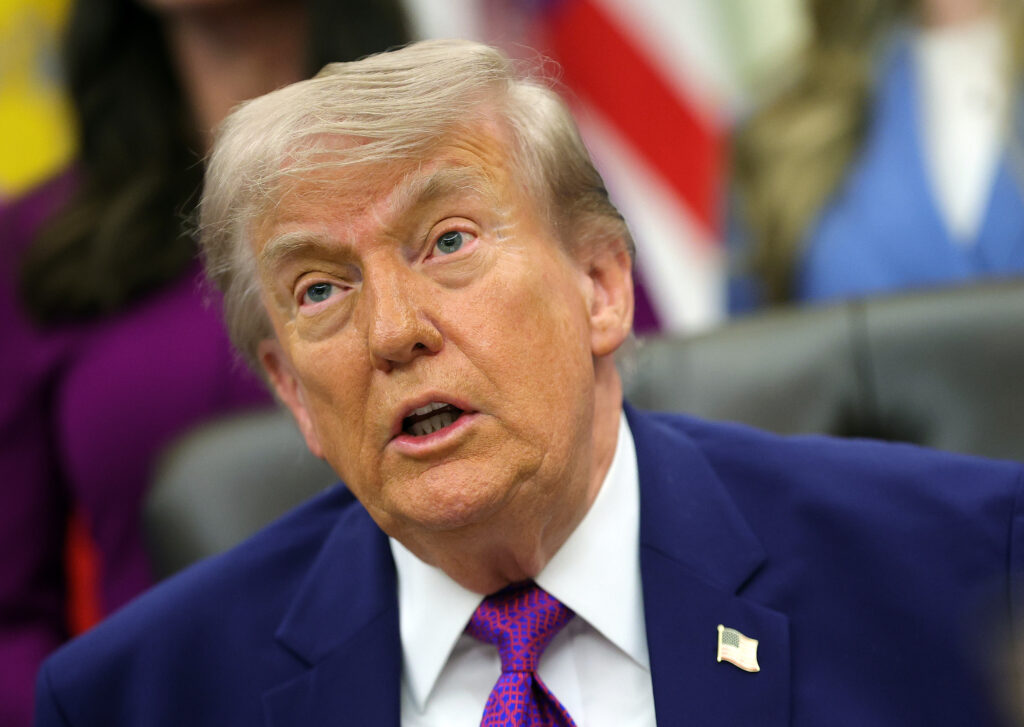
“It’s a small percentage, but it’s, you know, it’s still money,” Trump told reporters in the Oval Office on Monday. “As soon as this is over with Iran, as soon as it’s over, you’re going to see gasoline and oil drop like a rock.”
Federal taxes amount to 18.3 cents per gallon of gasoline and 24.3 cents per gallon of diesel.
The suggestion reflects Trump’s limited options to address surging gas prices as negotiations to end the war remain stuck with no immediate way to reopen key shipping lanes.
Higher prices have contributed to Trump’s declining approval ratings ahead of November’s midterm elections. The national average hit $4.452 last week, the highest since 2022, according to the U.S. Energy Information Administration. Almost two-thirds of Americans disapprove of Trump’s handling of the economy, the highest level in either of his terms, according to a Washington Post-ABC News-Ipsos poll conducted in late April.
Gasoline prices have spiked since the United States and Israel attacked Iran on Feb. 28, leading the country to block oil tankers leaving the Persian Gulf through the Strait of Hormuz. The U.S. and Iran traded attacks on ships in the strait last week despite a ceasefire, and Trump appeared frustrated Monday with the lack of progress in negotiations to end the conflict.
“The ceasefire is on massive life support, where the doctor walks in and says, ‘Sir, your loved one has approximately a 1 percent chance of living,’” Trump said, taking questions at an event about maternal health care.
He also deprecated Iran’s latest negotiating offer. “After reading a piece of garbage they sent us — I didn’t even finish reading it. I said, ‘I’m not going to waste my time reading it.’”
Trump compared the economic costs of fighting Iran to taking a bullet for the good of the country. He said Iranian negotiators agreed to his demand to never have a nuclear weapon and give up all their enriched uranium, but then presented a written proposal that he deemed unacceptable.
He attributed what he said was a discrepancy to tension between Iranian moderates and hard-liners, whom he termed “lunatics.”
“They agree with us, and then they take it back,” he said. “They change their mind. They’re very dishonorable people.”
Still, he said he still believed a diplomatic solution was possible. He said he expected to discuss the situation with Chinese President Xi Jinping during his visit to Beijing later this week, pointing out that China is more dependent on Gulf oil supplies than the United States.
“I have a plan,” Trump said. “The plan is very simple. You know, in war you have to change. You have to be flexible. You have a lot of plans, but you have to do different plans on different days. But I have a great plan. The plan is they cannot have a nuclear weapon. And they didn’t say that in their letter.”
The federal gas tax pays into the Highway Trust Fund, which pays for improvements to roads and public transportation. Congress has been outspending the fund’s growth, and the Congressional Budget Office predicts it will run out of money by 2028. Suspending the gas tax for five months would cost the fund about $17 billion, according to the Bipartisan Policy Center.
Passing the savings on to drivers, rather than oil companies, would be difficult to enforce, according to the Congressional Research Service. The federal tax is collected at the terminal or refinery, not at the pump. The government would have to estimate what prices would have been without the tax suspension, but gas prices depend on many other factors. Savings would also vary dramatically by region, driving habits and vehicle type.
The administration already took steps to relieve prices, including releasing oil reserves, lifting restrictions on ships moving fuel between U.S. ports, easing pollution rules regarding ethanol and temporarily waiving sanctions on Russian oil.
Congress has never suspended the gas tax. Republicans including Sen. Josh Hawley of Missouri and Rep. Anna Paulina Luna of Florida said on Monday that they would introduce bills to do so. Democrats including Sens. Mark Kelly of Arizona and Richard Blumenthal of Connecticut and Rep. Chris Pappas of New Hampshire already had proposals that would suspend the gas tax and offset the losses to the Highway Trust Fund with general funding, adding to the budget deficit.
In 2022, President Joe Biden asked Congress to suspend the gas tax for three months. The Democratic-controlled Congress took no action.
Cat Zakrzewski contributed to this report.
The post Trump seeks to pause federal gas tax as prices soar amid Iran conflict appeared first on Washington Post.