In the shadow of King Charles’ visit to the White House lie the contrasting leadership lessons of three of lands once ruled by Great Britain––the United States, Australia, and Canada. Even now, there are prominent voices among our foreign allies who believe President Donald Trump can be ignored or dismissed outright. Those same voices often argue that nothing can be done about Trump anyway. Such overconfidence is the fertile ground that provides the complacency which nourishes authoritarianism, and such complacency is the complicity upon which Trump and other demagogues rely.
Australia is a case in point. When the world thinks of Australia, it smiles at admired images of the maverick golf legend Greg Norman, the courageous and swashbuckling, in-your-face Crocodile Dundee character played by Paul Hogan, and the brazen media mogul Kerry Packer, who, despite being paralyzed by polio as a child, went on to become the heavyweight boxing champion of his high school and Australia’s wealthiest business leader.
The Australian rock band, “Men at Work” topped the charts in 1981 with their song “Down Under,” with lyrics that declared:
Do you come from a land down under
Where women glow and men plunder?
Can’t you hear, can’t you hear the thunder?
You better run, you better take cover
Thus, celebrated for its feisty anti-authoritarian character, the world took note when during a bilateral meeting between President Trump and the Australian Prime Minister Anthony Albanese in Oct. 2025, Trump complained about social media posts by the Australian Ambassador to the US, Kevin Rudd, critical of Trump, made five years prior in 2020. Trump pointed to Rudd and said, “I don’t like you either, and I probably never will.” He called on Prime Minister Albanese to fire Rudd. Albanese initially insisted that Rudd would serve his full four year term but let him go. While praising Rudd at the time of his exit, something changed with Albanese boasting, “Australia and the United States are the closest of friends and allies, and this will never change.” All the while the public message was that Rudd’s sudden plans to depart were voluntary.
One the most renowned of diplomats in the world, Rudd has native fluency in Chinese and several other languages, and enjoys unrivalled, warm, non-ideological, constructive relationships with heads of state across countries and continents. He successfully served as Australian Prime Minister twice and is frequently rumored to be a top candidate for UN Secretary General on various occasions. Yet, in the face of a displeased and grieving Trump, Rudd was encouraged to step down at least a year early to return to his distinguished post as President of the Asia Society in New York.
On Saturday, One Nation, an Australian anti-immigration party with Trumpian politics, won a special election and garnered its first seat in the lower house of the Parliament, The New York Times reported. Australian analysts fear Trump’s divide and conquer tactics may have taken root in yet another land. “Australia’s conservative parties are fracturing, and the space they leave is being filled by populist energy rather than coherent alternatives,” wrote Rob Prugue, a fellow at University of Technology Sydney. “Both center-right and left, are fracturing. In the US, MAGA has consumed the Republican Party. In the UK, Reform is hollowing-out the Conservatives. In Australia, the Nationals have split from the Liberals, and both are now visibly divided.”
Yes, they have a long way to go, but this populist momentum, according to Australian political scientists, has “the wind is in its sails.” It is noteworthy that this movement has attracted the support of major financial backers such as Gina Rinehart, Australia’s wealthiest woman, and financier Angus Aitken, among other major Australian fund raisers, who just met with Trump at Mar-A-Lago this spring. And the winning candidate from One Nation, David Farley, is a significant force in the agribusiness sector.
As this political tornado hit, one prominent Australian publisher confided in us privately, “I feel that Australians are heartily sick of Trump and the damage he is doing, already understand a number of the tactics you identify, and won’t want to read more about him than they have to—especially when there’s nothing they can do about him.” This defeatist sentiment is wrong and dangerous.
Instead of dismissing Trump, wringing their hands in hopelessness, or resorting to name-calling in horror, there is a playbook for how foreign allies and critics alike can navigate Trump and even outmaneuver him. That playbook is captured in our new book, Trump’s Ten Commandments, published by Worth/Simon & Schuster, though certain foreign allies have already intuited its key messaging and acted effectively while others wring their hands in hopelessness.
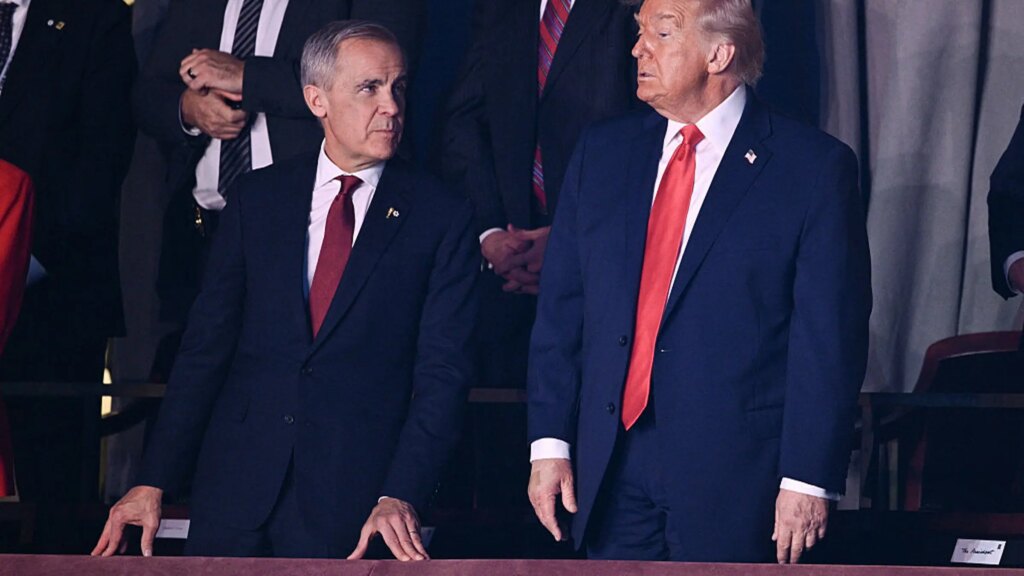
Take one striking example. The implications for how foreign allies can outmaneuver Trump are well-demonstrated by the huge reversal of course by Canadian Prime Minister Mark Carney. We don’t know if it was cause and effect, but we are told that cabinet officials, parliamentarians and financial backers sent copies of our new book to Carney in bound galley form—and he flipped.
Carney initially tried to placate Trump and reprimand Ontario’s popular Premier Doug Ford for criticizing Trump’s trade policies. Upon recognizing that this fell squarely into the divide-and-conquer playbook Trump attempts to execute against allies and adversaries alike — as captured in our book — Carney subsequently reversed course in late January to great effect, calling for a new third pole of geopolitical diplomacy after Trump threatened to take Greenland the hard way and threatened economic sanctions against Greenland and Denmark.
Unifying the UK, the EU, and Canada, Carney’s new strategy rejected the forced choice between aligning with the US or China, arguing instead that middle powers should band together to protect their shared interests and avoid being subjected to the demands of a “predatory hegemon.” This completely halted Trump in his tracks: where his intensifying saber-rattling over Greenland was pervasive in January, it has completely vanished now, as have all the ominously threatened military and trade measures against Greenland and Denmark. As Trump hit this unified wall of resistance, he was not offended and did not escalate tensions—he simply moved on. As a result, some observers called him the “Roomba President,” drawing upon the image of the robotic vacuum cleaner that bounces off walls and moves along.
The lessons here are numerous. As we document in Trump’s Ten Commandments, Trump instinctively views unified coalitions—whether NATO, the EU, or NAFTA—as intolerable threats to his authority. To him, these alliances resemble the tiny Lilliputians trying to bind the giant Gulliver with paralyzing strings. To maintain absolute dominance, his natural impulse is to set allies against one another—pitting Canada against Mexico or France against Germany—so he can act as the all-powerful arbiter and decider.
When foreign leaders try to negotiate with Trump bilaterally, hoping to be the favored “Trump whisperer,” they fall right into his trap. They are met with his second commandment: “Maximizing Leverage by Starting with a Punch in the Face.” The sudden military alert and economic threats against Greenland were exactly this kind of opening blow—a maximalist strike designed to disorient and bludgeon his targets so thoroughly that they emerge willing to accept a bad deal just to survive.
But Carney proved that Trump’s playbook has a fatal vulnerability. As our book makes clear, only collective action can neutralize a bully. By rallying the middle powers against Trump’s bluster over Greenland, Carney demonstrated that collective action is the timeless antidote to divide-and-conquer bullying; standing together in unison making it impossible to drive wedges. Trump probes the limits of what is permissible, pressing forward to test resistance, but retreats once he encounters barriers that cannot be overcome. When faced with a unified, impenetrable front that raises the geopolitical costs of his disruption, Trump simply moves on.
This episode offers powerful and compelling evidence that it is wrong for allied leaders to be so dangerously dismissive and self-defeatist as to believe that there is nothing they can do to effectively counter and constrain Trump. For those who hope to counter him, shouting names and retreating into the bubble of like-minded critics does little to advance their shared mission. The failure to appreciate the ten tactics Trump repeatedly uses to secure his phoenix-like revival leaves society to the fate of naïve victims of a Stephen King novel, where the presumed vanquished villain continues to resurface.
As the octogenarian Benjamin Franklin advised his fellow revolutionary colonists 250 years ago, “We must hang together, or we shall surely hang separately.”
The post Colonies in Collision: What Some Allied Leaders Get Wrong About Trump appeared first on TIME.