We see too much media whose fundamental message is “Don’t give up on your dreams.”
“The Comeback,” which wrapped up its third and final season Sunday on HBO, was the rare show that honestly depicts what that looks like — the humiliations, risks, rewards and trade-offs. Especially the trade-offs.
The first season, which aired in 2005, was about a former sitcom star named Valerie Cherish (Lisa Kudrow) staying relevant by doing reality TV. The second season, which aired in 2014, saw Valerie stay relevant by doing a “gritty” HBO show. By the third season, 20 years on, relevance meant appearing in “the first sitcom written by AI.”
Despite these shifting challenges, some things don’t change. The industry is always fueled by status and scarcity. TV pros flip-flop on whether their work is art or commerce depending on what they’re trying to self-justify. Angelenos salivate at the sight of an Emmy.
When things do change — when reality TV rears its inexpensive head, when streaming ramps up demand for daring network-unfriendly content, when the industry is all but decimated in the era of corporate consolidation and AI — Valerie is ready to throw herself into new opportunities, regardless of whether she understands them.
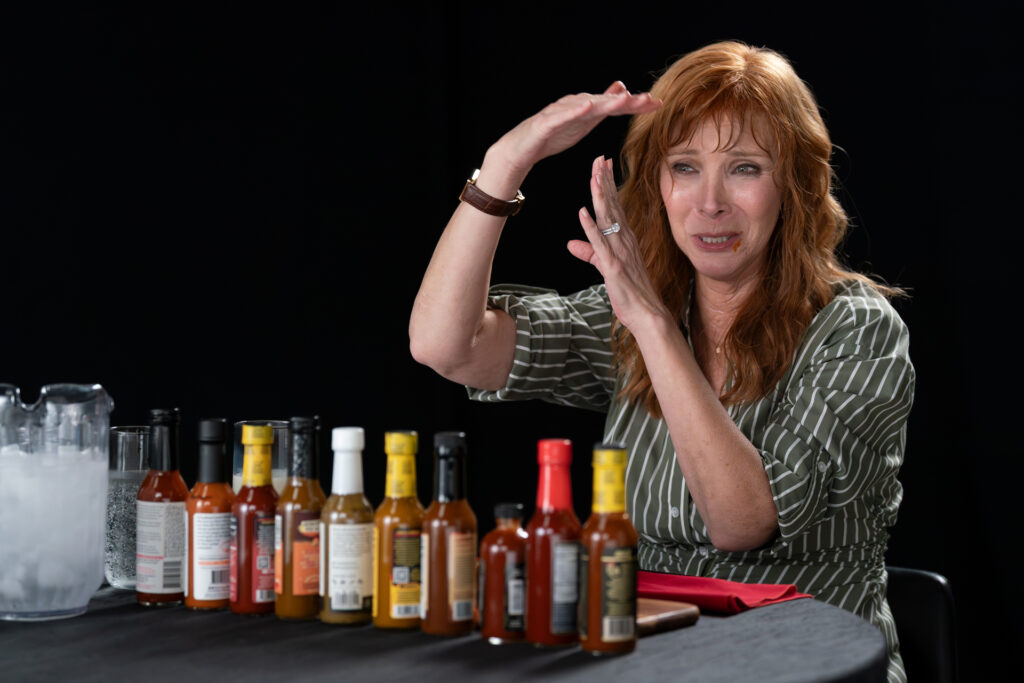
When an executive tells her that she has been booked on “Hot Ones,” the popular real-life YouTube show hosted by Sean Evans in which guests answer questions while eating increasingly spicy chicken wings, Valerie responds, “Don’t know what that is, but sure sounds fun!” Her appearance is one of the funniest moments of the season, as she tries to stick to her talking points about her new sitcom through tears.
“What’s funny about this to you, Sean?” she shouts. “I think you’re a sadist!”
What’s funny about it? So much. Kudrow is an incredible physical comedian. Whoever styled her sweaty bangs in this scene deserves an Emmy. Hearing Valerie accuse Evans — well-prepared, milquetoast Evans — of sadism is sublime. And the scene points to the fundamental pathos of the show: Valerie just wants to work. She used to know how. Now, late in her career, she has to learn on her feet, in front of a documentary crew, three cameras in a sitcom studio and an iPhone permanently held to her face by her assistant.
But Valerie is never a victim. There is no financial incentive for her to work. She’s doing it because she believes in it. Or because it’s the logical next step. Or because it’s all she knows.
That Valerie is rich helps the show in two ways: Without the threat of financial ruin, we’re able to laugh more freely at Valerie’s foibles and consider what drives ambition — of an actor or anyone else — besides money.
If anyone has insight into this, it would be “The Comeback” creators Kudrow and Michael Patrick King. When they created the show in the early aughts, both had achieved the pinnacle of television success — Kudrow as Phoebe in “Friends” and King as a writer, director and executive producer of “Sex and the City.” No one could accuse King or Kudrow of sour grapes. Both achieved a level of commercial and critical success that was once vanishingly rare and now — in an era of dwindling residuals — basically impossible. Their deep knowledge of TV’s inner workings gave the biting satire of “The Comeback” the gravity of a John O’Hara novel but with way more laughs.
Kudrow has been open about her ambivalence with post-“Friends” fame. In 2012, she told Vanity Fair that she expected fame to feel like “a warm hug” but found it to feel more like an “assault.” “Then, not long after, you start to realize, This has almost nothing to do with me, and I better do the work,” she said.
“The work” is what “The Comeback” is all about. But “The Comeback” doesn’t settle for pat pleasantries about labor and passion. In American media, we’re inundated with clichés about the value of hard work. You can’t watch an awards show or a press junket interview without hearing an actor waxing about how important it is to follow your dreams, no matter the cost.
But that cost usually gets skipped. “The Comeback” doesn’t shy away from it. Grit and hard work yield results, no doubt. But they also can lead to frustration, strained relationships, humiliation and poor mental health. And on “The Comeback,” it’s not just limited to Valerie or the unemployed writers applying for jobs at Costco. Andrew Scott, who played the head of the fictional studio “NuNet” on the third season of “The Comeback,” is also ultimately revealed to be scared, desperate and uncertain.
“The Comeback” shows how absurd and depressing it is to want to work in an industry that is pushing you out. It also shows how absurd and depressing it can be to meet that challenge with a simplistic remedy of grit and optimism.
Luckily — mild spoiler alert — Valerie Cherish gets a happy ending. We need her to. We love her, and we’ve spent 20 years cringing with her and rooting for her. But it came with an unflinching acknowledgment that the whole damn system is broken. We needed to see that.
The post Why ‘The Comeback’ was the most important show about work on TV appeared first on Washington Post.