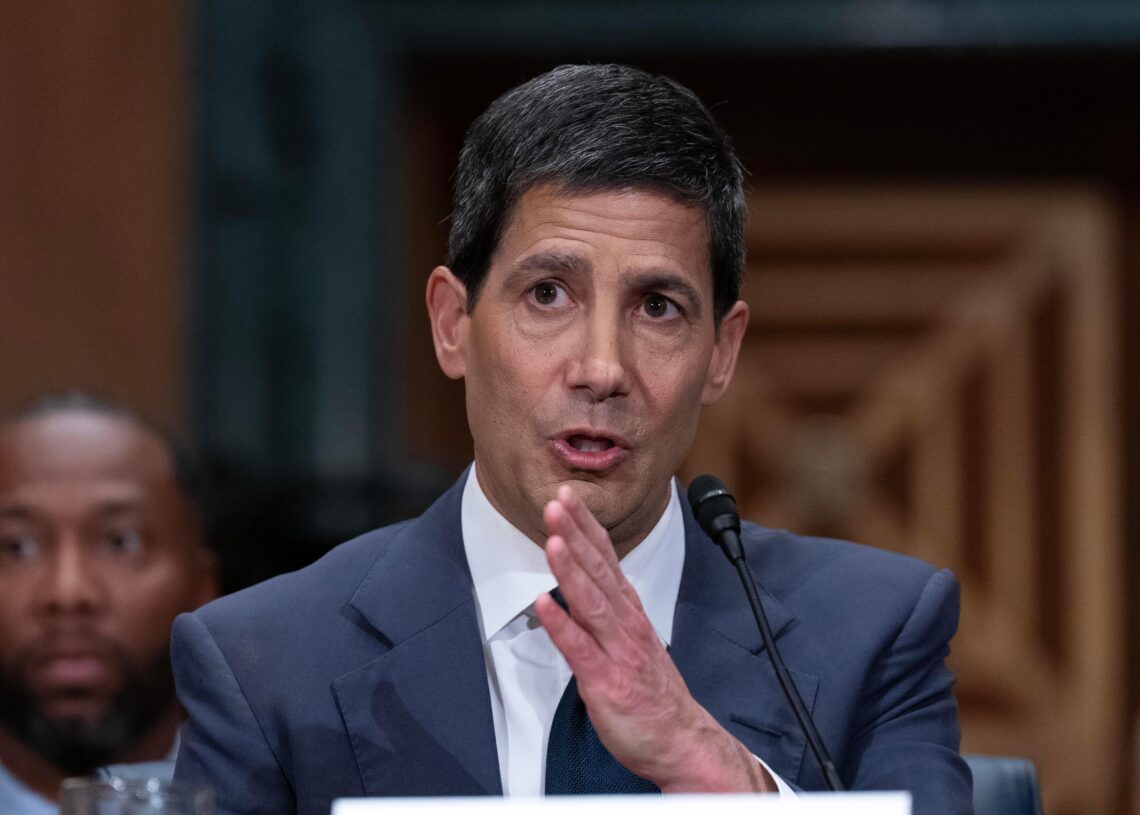
STANFORD, Calif. — Kevin Warsh has spent years positioning himself to lead the Federal Reserve, refining his case that the Fed had lost its way and needs to be reformed, starting with, as he put it last summer, “breaking some heads” at an institution he says is resistant to change.
He is expected to finally get his chance, with a Senate confirmation vote as early as Wednesday.
Warsh is poised to inherit a central bank operating under pressures that would test any new chair, chief among them stubborn inflation that could dominate the early part of his tenure before he gets the chance to dramatically reshape the institution.
Inflation has run above the Fed’s 2 percent target for more than five years and is now moving in the wrong direction, pushed higher by rising fuel costs tied to the war in Iran. The Fed committee that sets interest rates is increasingly skeptical of additional rate cuts.
Warsh’s challenges don’t end there. The biggest surprise is that outgoing Fed chair Jerome H. Powell, rather than stepping aside, is staying on as a governor — a move no outgoing chair has made in decades. Even if Powell keeps his promise to keep a low profile, his presence could give other Fed officials skeptical of Warsh’s agenda a credible focal point to push back.
Looming over all of it is President Donald Trump, who has made no secret of what he expects from his Fed chair: lower interest rates, and quickly. The economic fundamentals, and the majority of the policy committee Warsh will inherit, may make that impossible to deliver, a dynamic that could put Warsh on a collision course with the president.
“Warsh is largely in uncharted territory,” said Michael Bordo, a monetary historian at Rutgers University and a distinguished visiting fellow at the Hoover Institution. “He’s got this president that wants him to lower rates, and an economy that has inflation elevated because of the oil price shock but that has not gotten to its target.”
Those challenges hung over a gathering of Fed officials and economists who were attending a conference last week at the Hoover Institution, a conservative think tank. Warsh has spent roughly 15 years at Hoover, which is associated with Milton Friedman, the free-market economist who spent his career arguing against exactly the kind of government intervention in the economy now emanating from the Trump administration.
At the conference, the mood among economists was less celebratory than apprehensive, not just about Trump but also about longer-term threats to Fed independence. They include a national debt trajectory that could eventually grow so large that the Fed could find itself setting interest rates to keep the government’s borrowing costs manageable rather than to control inflation.
Warsh will inherit all of it. He was passed over once before, when Trump chose Powell in 2017, a decision Trump publicly came to regret.
While Warsh long held a reputation as a “hawk” focused on taming inflation, he has more recently argued for faster rate cuts. He also wants to, over time, dramatically shrink the Fed’s $6.7 trillion balance sheet, which he says amounts to fiscal policy in disguise — financing government spending in a way that should be left to Congress and undermining the Fed’s claim to political independence.
John Cochrane, a senior fellow at Hoover, said the central bank itself may be the biggest obstacle.
“Kevin wants to move the Fed, which is itself a big bureaucratic institution. It’s set in its ways, and it has not been particularly interested in reforms or even admitting that things have gone wrong and need fixing,” he said.
Warsh also faces some political challenges. During his confirmation hearing last month, he declined to distance himself from Trump. He would not say whether Joe Biden won the 2020 election and sidestepped questions about whether tariffs had contributed to inflation.
On inflation — the issue where he was most careful to avoid implicating Trump — Warsh argued that the Fed’s policy errors in 2021 and 2022 caused a price surge as the economy emerged from pandemic shutdowns. But he suggested the damage may be less severe than official measures indicate, arguing that the Fed’s preferred gauges are imprecise and that his favored metrics point to a more encouraging trend.
Indeed, inflation has remained above the Fed’s 2 percent target since early 2021. The Fed itself projects that it may not come back to target for another two years. That stretch risks eroding the public’s confidence that longer-term prices will remain anchored. And the problem is getting worse: Fuel costs have climbed sharply as the war in Iran has disrupted global oil markets, threatening to push inflation higher even as broader economic growth shows signs of flagging.
The dynamic presents the Fed with a dilemma it has no clean answer to. Raising interest rates to combat inflation risks deepening any economic slowdown caused by the war. Cutting them to cushion the economy risks inflating prices further. For a new chair who has promised action and criticized his predecessors, the constraints are significant.
If the inflation picture is difficult, the committee Warsh will chair is also notably divided.
At last month’s interest rate meeting, four officials dissented from the policy statement — the most disagreement since the early 1990s. Three wanted to go further than the majority was willing, pushing to drop any suggestion that the Fed still leans toward cutting rates.
Austan Goolsbee, president of the Federal Reserve Bank of Chicago, told reporters last week that the divisions reflect genuine uncertainty about whether rising prices represent a lasting problem or a one-time shock from the Iran conflict, and about an unusual jobs market in which hiring and firing are both simultaneously low.
In separate remarks Friday at the Hoover conference, he added a cautionary note on artificial intelligence: If people and businesses anticipate future productivity gains and start spending now, the Fed may need to raise rates to prevent the economy from overheating before those gains actually arrive.
Warsh said at his confirmation hearing that he welcomes a “good family fight” at the Fed. Bordo, of Rutgers, noted that Warsh will also have to navigate a committee whose center of gravity on rates may not move as quickly as the White House expects.
“If the majority of the [Federal Open Market Committee] and all the people who look seriously at the economy say we don’t have a big recession risk here and the biggest problem is inflation, he’s not going to go against that,” Bordo said. “Because he will lose credibility, and he wants to be credible.”
The post Trump’s pick to remake the Fed first has to tackle inflation appeared first on Washington Post.