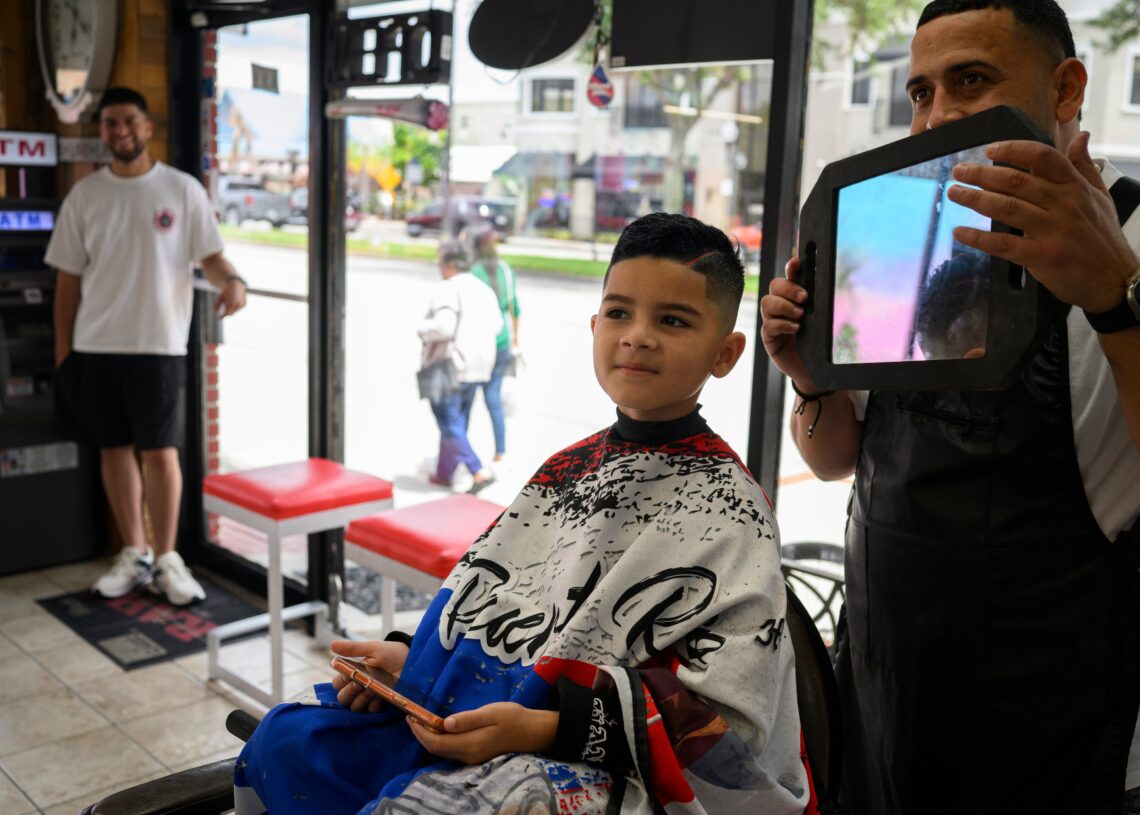
KISSIMMEE, Fla. — The Saturday night crowd at a Mother’s Day celebration in this lakefront city’s lively downtown, decorated with Puerto Rican flags and blasting bomba music, offered a microcosm of the booming congressional district in which it sits and is being torn apart.
Two families sipping sangria were part of a decades-ago wave of Puerto Ricans hailing from colder Northern cities such as New York. Nearby at a snack table was one couple who had moved here from “the island,” as it is simply known, in search of steadier incomes and lower electricity bills. The group of friends singing Karol G on karaoke mics, meanwhile, had left Venezuela and Colombia more recently to rebuild their lives in the United States.
“This is Central Florida in a nutshell. It’s one big community, with people from all over,” said Jerry Millán, who tended a bar during the party. “Our voice shouldn’t get diluted.”
Virtually everyone around him has been represented in Washington for the past decade by Rep. Darren Soto (D), the state’s first Puerto Rican congressman, in a district where Latinos were in the majority.
But under a new congressional map signed into law by Florida Gov. Ron DeSantis (R) last week, the growing community of Puerto Ricans and South Americans on display in Kissimmee will be splintered across four districts.
Two will continue giving Republicans an edge, and one farther north in Orlando will become even more Democratic. In the 9th Congressional District — which is held by Soto — non-Hispanic White people will surpass Latinos as the largest demographic group, and Republican candidates will gain a clear advantage in an area stretching a two-hour drive to the Treasure Coast.
It’s an overhaul that is being seen as a racial and ethnic affront, according to interviews with about 20 voters across the district, and one that strips Puerto Ricans of their hard-earned political power.
“You’re not giving the voters the respect they deserve,” said Ricardo Garcia Rosario, a former Florida GOP field organizer who, like other Hispanic Republicans, has decried the change even as he opposes Soto’s policy stances. “But give me a fair opportunity to vote him out,” he added.
Soto could receive a lifeline from Latinos, who have rapidly moved into the district, turned away from President Donald Trump and grown outraged by the new map. But the district’s new older, conservative White voters — who are more likely to turn out — are tipping the scales against Soto.
As Trump has pressured GOP-led states to redraw their congressional maps to elect more Republicans — and blue states have punched back with referendums doing the opposite — the ensuing arms race has created some odd geopolitical bedfellows around the country.
Pockets of liberal urban voters in Texas and Missouri are being sliced up and diluted by much larger stretches of rural Republicans. New maps in California and Virginia cut up red chunks and overwhelmed them with blue areas. (Virginia’s referendum was struck down Friday by its high court.)
Here in the heart of Florida’s Puerto Rican diaspora, DeSantis’s new map offers a preview of what could be coming for the rest of the Southeast after the Supreme Court weakened the Voting Rights Act last month.
For Millán, who was tending bar and works at a nonprofit focused on organizing the Latino community, it is also an example of how that court decision — unraveling an achievement of the civil rights movement led by African Americans — can have ripple effects across other communities.
The most dramatic shift
In the past two decades, the southern half of the Orlando metro area — a sprawling patch with strip malls, theme parks and retention ponds centered in Osceola County — has seen hundreds of people move in daily.
Millán, a musician and actor who previously lived in the Puerto Rican city of Coamo, was one of them: He settled in Central Florida with his wife and kids just before the coronavirus pandemic, moving for his wife’s new job.
“I’m Puerto Rican, but I embrace it here as if it’s Puerto Rico,” he said. “We’re here to move this country forward.”
As the community transformed, so did its congressional representation. In 2010, Florida voters banned gerrymandering in a statewide referendum, barring lawmakers from drawing districts to favor one political party or to diminish racial minorities’ ability to elect preferred candidates.
The 9th District was created shortly thereafter and gave Florida its first Puerto Rican congressman in Soto, who had been a state lawmaker. Between 2010 and 2020, it was the nation’s fastest-growing district as nearly 273,000 residents moved in. Many were Puerto Ricans displaced by Hurricane Maria and economic crises in the U.S. territory.
Late last month, DeSantis put forth a new map that he said was necessary to account for the state’s explosive growth since 2020.
Republicans currently hold 20 of the state’s 28 congressional districts, but the new map gives them an edge in an additional four districts represented by Democrats.
Soto’s district has undergone one of the starkest demographic shifts of those targeted. The non-Hispanic White population shoots up from 28 percent to 44 percent. The overall Hispanic population, meanwhile, drops from about 54 to 41 percent, with Puerto Ricans falling from 26 to 17 percent.
“I still have a lot of my fellow Boricuas in the community, but it quite deliberately breaks the community apart,” Soto said in an interview.
Civil rights advocates have filed lawsuits challenging the legality of the new map under Florida’s fair districts amendment. DeSantis, however, is betting that the voter-approved rules will be struck down entirely by state judges he has largely appointed.
An uphill battle
Over quesito pastries at a Puerto Rican bakery in Kissimmee, Soto signaled he would stay in the race either way.
“We will either be fighting [DeSantis] in the courthouse or at the ballot box,” he said.
He listed beneficiaries of federal funding he has helped secure as a congressman — a semiconductor project, new rail lines, an airport expansion — that he says will help draw swing voters or infrequent voters in this “tough but winnable” reshaped district.
Some GOP leaders have assumed that a Republican will win the redrawn district because Trump won majority-Hispanic Osceola in 2024, the first GOP presidential candidate to do so in more than three decades. Counties with large numbers of Hispanic voters have shifted sharply right over the past decade, along with the rest of Florida.
But Soto said that Latinos drawn to Trump’s economic message are shifting back to the Democratic Party. They are hampered by rising costs for gas and groceries, upset over the war in Iran, and disturbed by mass deportations sowing fear among their friends, neighbors and relatives, he added.
Dave Wasserman, senior editor at the nonpartisan Cook Political Report, said the math of the new district may be a barrier too tall for Soto to overcome. The new 9th District loops in younger Puerto Rican and other Latino voters with more conservative White retirees on the Treasure Coast.
A victory “is still very far-fetched given that this district is now about as Republican as Kansas,” Wasserman said, even if mounting frustration with Trump and the GOP could give Soto some limited paths to victory.
The best-funded candidate seeking the GOP nomination for the 9th District is a real estate developer who is largely paying for his own campaign. More candidates appear likely to emerge from the coastal area in and around Vero Beach.
Osceola County Republican Party Chair Joel Davis said that he believes Soto, whom he described as well-liked and well-known in the county, could win even with new lines. Davis’s wife, state Rep. Paula Stark (R), won in an Osceola district that heavily favors Democrats.
“If you have a better Republican candidate, they’re going to get elected. If you have a better Democratic candidate, they’re going to get elected,” Davis said. “If we don’t run a decent candidate we’re not going to beat [Soto] anyway.”
Previous predictions about an influx of Puerto Ricans turning Florida blue did not pan out. Yet in a much smaller geographic area, Puerto Ricans outraged by the district’s shattering are motivated to vote, Soto said. He pointed to a boldface headline in a local Spanish-language paper: “Puerto Rican district in danger after electoral redesign.”
‘Deserve to have representation’
Days after DeSantis proposed redistricting, it was already being used as a Democratic talking point, as volunteers met at an Orlando location of the same Puerto Rican bakery to knock on doors for downballot candidates.
“There’s over a million Hispanics in Central Florida who deserve to have representation in Washington, because it leads to actual changes on the ground,” Samuel Vilchez Santiago, a Venezuelan American running for a state House seat that overlaps with the 9th District, told the group.
Soto helped the U.S. territory — which does not have a voting representative in Congress — secure billions in aid following Hurricane Maria and pushed for Osceola County to receive federal investment to help keep up with its rapid growth.
The redistricting effort that threatened this representation, he said, was like the corruption endemic in some Latin American countries.
“We have a critical opportunity to push back,” Vilchez Santiago said.
Inside a gated community of gray and white stucco houses in southeast Orlando, that message seemed to resonate with Mairy Reyes, a consultant and naturalized citizen from Venezuela.
She volunteered for Hillary Clinton’s 2016 presidential campaign but then voted for Trump in 2020 and 2024, in part because of his promise to oust Venezuelan President Nicolás Maduro.
She was happy he made good on that promise, but his immigration policies frayed her support. One of her neighbors, a Venezuelan who had received humanitarian parole, had a panic attack and died after police stopped him for a broken taillight while he was driving for Uber. The new maps splitting apart the area were like salt in the wound.
“Things have been going way too far,” she said.
The day after the Mother’s Day celebration in Kissimmee, Millán met friends at La Vergüenza, a Puerto Rican “chinchorro” in Orlando that’s meant to resemble its sister restaurant in Old San Juan. He and Rolando Rodriguez, 46, sat at the bar nursing Estrella beers and picking at plates of chicken wings and french fries as the new map came up in conversation.
Rodriguez hasn’t voted since moving from Puerto Rico, and he said he is skeptical about politics on the U.S. mainland.
But Millán emphasized that the community — their community — was being torn apart.
“It just seems like the wrong thing to be doing,” Millán said.
Morse reported from Washington.
The post GOP redistricting splintering Florida community angers Republicans and Democrats appeared first on Washington Post.