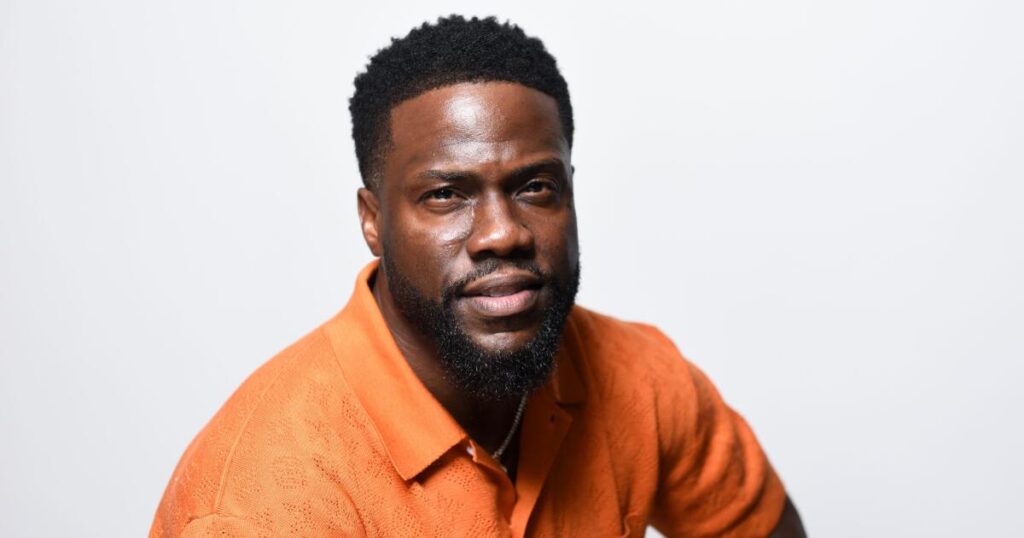
When Kevin Hart announced in January that he’d licensed his name to Authentic Brands Group, the popular comedian was silent on a key detail: the future of his namesake media company.
Hart sold some ownership and oversight of his brand in exchange for an undisclosed sum of money and a stake in Authentic, a New York-based firm that manages the likenesses of Marilyn Monroe, Muhammad Ali, Shaquille O’Neal and David Beckham.
Hart used the partnership with Authentic to reset his relationship with the people around him and his company, according to six current and former employees. Hart’s employees say they worry that this deal marks the beginning of the end of Hartbeat, the comedian’s namesake media company that produces films, owns a network of short-form video channels and handles marketing for brands.
Though the announcement made no mention of Hartbeat, the agreement gave Hart money to buy out his private equity partner in the company over time and regain control of the use of his name, image and likeness. Hart’s endorsement deals, which had been a pillar of Hartbeat business, will now be handled by Authentic.
Once valued at about $650 million, Hartbeat has shriveled over the past few years. The company enacted its latest round of job cuts in December, firing the heads of its scripted TV division, as well as employees working across marketing, social media and brand partnerships, said the people. Earlier this year it let go the leaders of its podcast division and later sued them for breach of contract.
Hart has withdrawn from the company, leaving day-to-day management in the hands of a small group of executives. Staff meetings have been canceled. The development of new film and TV projects has slowed. A slate of new podcasts was pitched but never produced.
Hartbeat’s struggles reflected the challenging environment for many Hollywood production companies as media giants merge and cut spending. The company is also a cautionary tale in this age of the celebrity media mogul. Financial firms have plowed money into media companies led by high-profile figures, believing they could use their notoriety to build valuable businesses. Yet even seemingly successful ones have had a hard time.
Hartbeat, like many of its peers, has suffered from mismanagement and grappled with the tension between the needs of the star and his company. Hart, one of the hardest-working people in Hollywood, tired of subsidizing a company that relied so much on him
Hart declined to comment for this story, which is based on conversations with several current and former employees. On Sunday night, Hart, who hosted the widely viewed roast of NFL great Tom Brady two years ago, was the subject of his own roast on Netflix.
Building a Billion-Dollar Business
One of the most successful stand-up comedians and actors of his generation, Hart, 46, has always been entrepreneurial. In 2017, he started Laugh Out Loud, an online video comedy business that later grew to include branded entertainment. He also operated his own production company, Hartbeat Productions, that made programs for streaming services like Peacock, Quibi and Netflix Inc.
With Hollywood in the midst of a production boom, Hart watched his fellow celebrities get rich from their media enterprises. Reese Witherspoon sold her media company, Hello Sunshine, in a deal that valued it at as much as $900 million. Hart’s friend LeBron James raised money for his company, SpringHill, at a valuation of $725 million. Hart believed he could be next.
In late 2022, Hart merged his business interests under the Hartbeat banner and raised money by selling a 15% stake to the private equity firm Abry Partners. The deal valued the company at about $650 million.
The new business was predicated on three pillars: film and TV, short-form video and advertising. Hartbeat had a deal to produce movies for Netflix, a slate of podcasts for SiriusXM Holdings Inc. and original audio series for Audible. Hartbeat also developed relationships with advertisers such as Lyft Inc., Procter & Gamble Co. and DraftKings Inc.
While Hart would star in Hartbeat projects, the goal of the company was to develop projects and new business that didn’t involve its namesake founder. The company could leverage Hart to sell projects and secure broad programming partnerships. Hart would ask that Hartbeat be involved in producing his movies and any advertising campaign for which he was a spokesperson. His fees as a producer and brand ambassador would help pay the bills. The hope was he’d convince other celebrities to use Hartbeat as well. Thai Randolph, who had been running Laugh Out Loud, was named chief executive officer.
Hartbeat opened offices in New York and Atlanta and took over a 40,000-square-foot West Hollywood office once occupied by Oprah Winfrey. Hart redesigned the space and installed a world-class art collection.
The upper-level lobby featured a work by Ghanaian artist Serge Attukwei Clottey, while the conference room had a sculpture by Zimbabwean artist Moffat Takadiwa made of computer keyboard keys. A portrait of Kobe Bryant by Julian Pace hung outside a podcast studio.
Hart’s own office featured a dressing room, a series of paintings by South African artist Feni Chulumanco, multiple TVs and a desk from a prominent French designer. “He really has almost a full-service apartment in his suite,” Kai Williamson, who worked with Hart on the project, told Architectural Digest. Hart was interviewed for a story and also filmed an episode of the design magazine’s “Open Door” video series.
While Hartbeat expanded, Hollywood entered a recession. Economic uncertainty, rising interest rates and growing skepticism about the profitability of streaming caused major media companies to fire staff and pull back on buying new projects. Hartbeat was a little more insulated than most because talent like Hart could usually still get a project made. Still, producing projects without Hart in a starring role became more difficult.
Randolph left the company in late 2023 and was replaced by Jay Levine, who had spent much of his career at Warner Bros. Discovery Inc. Levine brought in a couple of other senior leaders with experience at major media companies.
A contingent of executives pushed Hart to scale back some ambitions, the people said. The company couldn’t afford to be working in so many different businesses at the same time, especially as areas like free, advertising-supported online video, and podcasts got more competitive. Hart was one of the most prolific and productive creative people in the world, starring in and producing movies, TV shows, comedy, short-form videos and advertisements. The point of the company was to relieve the stress on him, not add to it.
While Hartbeat closed its New York office, Hart was reluctant to scale back his vision or replace some long-time lieutenants. Levine negotiated his exit at the end of 2024 and was followed out the door by the company’s chief financial officer and chief content officer. Days before Thanksgiving, Hartbeat laid off about 20 people, nearly one quarter of its work force.
A year of chaos and conflict
In January 2025, Hart announced he would be the new CEO of Hartbeat and pledged to outline the firm’s strategy in the coming weeks. Instead, Hart went weeks and sometimes months without visiting the office, the people said, and empowered Jeff Clanagan and CFO Eric Stoneburner to run the company day to day. (Hart was on set to shoot at least a couple movies last year, in addition to his other work.)
A former concert promoter and movie producer, Clanagan had helped make Hart a major star. He had partnered with Hart to bring his stand-up specials to the big screen, producing shows such as 2013’s Kevin Hart: Let Me Explain, which grossed $32 million at the box office. Clanagan produced some of these specials under the banner of his own company, Codeblack Films, which helps promote, market and distribute video from Black creators.
Clanagan continued to operate Codeblack while serving in a senior capacity at Hartbeat, said the people. He pushed employees at Hartbeat to post its videos to the Codeblack channels as well, saying they could use the additional reach to raise awareness. The videos generated advertising sales for Codeblack.
Clanagan had employees at Hartbeat oversee Codeblack’s social media pages and asked to get those channels loaded into Hartbeat’s content management system. That gave Codeblack’s YouTube channels advantages over others because of Hart’s prominence and his company’s designation with YouTube. Employees raised concerns with human resources and the company’s lawyer.
Clanagan also became increasingly interested in video generated by artificial intelligence. He started a new app called Blktopia, a streaming service for Black viewers programmed with content from online creators and often made by AI. He urged employees to work on it, the people said. Clanagan initially responded to a request for comment and then retracted the text message.
Meanwhile, many of Hartbeat’s main businesses languished. Sales from the company’s YouTube channels fell and investment in new film and TV projects slowed. Hartbeat, once profitable, started to bleed cash. Hartbeat had hired Eric Eddings and Lesley Gwam to produce audio shows that didn’t involve Hart. While the pair developed a slate of projects, they never got approval to make them.
In mid-December, Hartbeat fired about a dozen employees, including some of those who were supposed to develop the podcasts. Eddings and Gwam then decided to start their own company and began trying to raise money. When Clanagan found out, Hartbeat fired them and sued for alleged theft of trade secrets and breach of contract.
A court approved a temporary restraining order but then rejected a preliminary injunction, saying Hartbeat had not demonstrated Eddings and Gwam had used proprietary information or trade secrets. The court said the request was “vague, ambiguous, and overly broad.” The case is ongoing.
Hartbeat also fired the heads of its TV division, Tiffany Brown and Mike Stein, who were in the middle of producing a TV show based on the film Barbershop for Amazon.com Inc. and a second season of the animated series Lil Kev.
The company made no official announcement explaining the cuts. The following week, senior leadership arranged a Zoom meeting. Hart remained off camera until it was his time to speak. He talked for a few minutes about changes at the company and took no questions. Hart changed his phone number in the weeks following the layoffs. (Some of his advisors had suggested he do this years earlier so that he wasn’t so available.)
A few weeks later, Hart announced the deal with Authentic Brands Group. Hart used some of the proceeds to buy out Abry Partners, freeing him to steer his brand deals to Authentic and outside of Hartbeat. A few of his employees and his publicist joined him at Authentic.
“This is a turning point for Hartbeat,” the company wrote in a subsequent email to employees, explaining that the deal would free Hart up to focus on what he does best, while allowing Hartbeat to stand on its own and grow beyond him.
“I know the past few months have been tough,” Hart wrote, adding that for too long the company had been too dependent on him. The email was said to be from “Kevin AKA Boss Man.” It was sent by Hart’s assistant.
Shaw writes for Bloomberg.
The post Inside a year of chaos and conflict at Kevin Hart’s media company appeared first on Los Angeles Times.