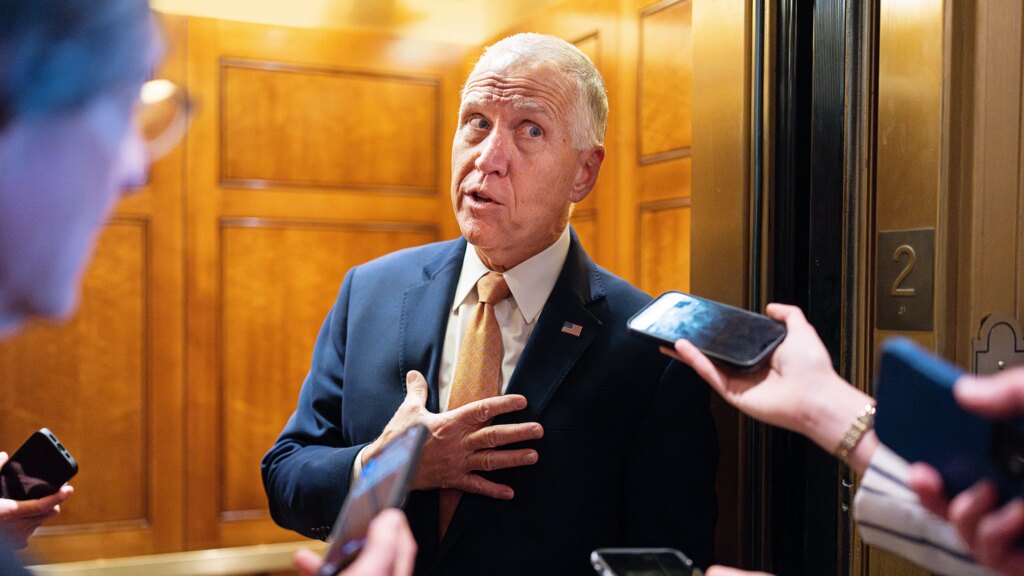
WHEN REPUBLICAN THOM Tillis packs up his Senate office in January to return to North Carolina, he’ll be taking with him a collection of elephant statues that greets visitors. There’s one dressed as a circus clown. A pink elephant. A mama elephant snuggling with her baby. One of his favorites has its legs draped over the edge of a shelf, eyes rolled up, looking tired and relaxed. Tillis calls it “laid-back elephant” and sees himself spiritually in the same pose. “Do I get intense? Of course. But I like being a little bit laid back and a little bit real,” Tillis tells TIME in April, amid evidence that might fairly be described as mixed.
In his remaining eight months in office, Tillis makes clear, he plans to continue showing Washington how a Senator can wield power in the Trump era and get results. Already, he has held up President Trump’s pick to be the next Federal Reserve Chair, forcing the Department of Justice to drop an investigation into outgoing chair Jerome Powell. Tillis says he’ll do the same for Trump’s next Attorney General nominee if that person downplays the storming of the Capitol on Jan. 6, 2021. In March, Trump fired Kristi Noem as Secretary of Homeland Security, days after Tillis had called for her resignation.
“Senator Tillis has shown the difference that one person with the courage of his convictions can make in a key position,” says longtime Republican strategist Whit Ayres.
Some Trump allies have tried to paint Tillis as just another GOP traitor, a gadfly no more consequential than former MAGA star Marjorie Taylor Greene, who has excoriated Trump on everything from the Iran War to his mental fitness since abruptly announcing her resignation from Congress late last year. Tillis, however, has been more surgical in how he publicly defies the leader of his party, all in service of one goal: changing Trump’s mind.
It’s a strategy that could make Tillis’ final year among the most consequential of his two decades in politics, while also, he hopes, helping Republicans avoid a midterm shellacking. “I didn’t come here to make friends,” Tillis says, bending his tight smile slightly to the right. “I came here to be a part of governing the most exceptional nation that’s ever existed.”
Tillis’ effort comes amid stiff political headwinds for his party, as Trump’s approval ratings sink below 40%. In Tillis’ view, if Republicans lose control of Congress, the Administration’s overreaching will be to blame.
But Tillis himself won’t have to face voters again or worry about Trump’s wrath. The President has called Tillis a “loser” and “terrible,” and celebrated when Tillis announced last year he wasn’t running for re-election. But Tillis has avoided hitting back directly at Trump, instead keeping focused on the people advising the President as he angles for more changes in the Administration’s upper ranks.
Some of Tillis’ harshest critiques are for Trump’s deputy chief of staff Stephen Miller, whom Tillis blames for policies that led to the brutal show of force by immigration agents in Minnesota, and whom Tillis was clearly referring to in a recent Senate floor speech when he said he was “sick of stupid.” Republicans would likely fare better in November if Miller left the White House, Tillis told TIME. “If any of the things I have seen are indicative of the sort of advice he’s generally giving the President, then yeah, the President probably would benefit from not having him in his ear,” Tillis says.
White House spokesman Steven Cheung tells TIME that Trump “loves” Miller, and he’s not leaving. “Stephen Miller is one of President Trump’s most trusted and longest serving aides. Stephen has worked relentlessly to expeditiously implement every facet of the President’s America First agenda and he will continue to do so. The President loves Stephen and the White House staff respects him tremendously,” Cheung said.
If there’s a throughline to Tillis’ strategy, it’s shoring up GOP support in toss-up states. “I always laugh at people that are from states where a dead Republican can beat a live Democrat…trying to tell me what I gotta do to win an election in North Carolina.” It’s not too late, he argues, for his caucus to show some independence. “Run alongside the President when it makes sense and take exception on one or two things when it doesn’t,” he says. “It doesn’t mean you are any less loyal; it means you’re smart and trying to get reelected.”
Among the elephants in his office is one he sees as key to his political rise. It appeared on the cover of TIME in May, 2009: a red, white and blue Republican pachyderm labeled “Endangered Species.” Tillis, then a business executive and member of the state House, disagreed with the premise, but also saw an opening. Democrats had just won control of Congress and the White House. His instincts told him they would push their agenda too far. He quit his day job and launched into an effort to help Republicans ride the backlash to control of the North Carolina state House. In 2010, Republicans secured majorities in both the state Senate and House for the first time in 140 years.
Now Tillis fears the mirror image of that is unfolding as Trump’s unpopular policies may tilt the state back toward Democrats. Tillis and Trump butted heads last year as Trump was whipping votes for his sweeping domestic policy package. White House officials had insisted on cuts to Medicaid that were poised to drain billions from North Carolina hospitals and drive up state costs. Tillis told Trump he couldn’t vote for the bill. Trump then put out a call for primary challengers against Tillis.
The Senator found himself boxed in. He knew running for reelection after voting against the GOP’s biggest win wouldn’t work. But, as Tillis sees it, now the party is in a pickle—trying to sell the tax cuts, while struggling to defend the Medicaid cuts they approved with them. Tillis gets most agitated when talking about Trump’s inner circle, who he blames for pivotal decisions that are tanking approval ratings for the President and his party. “These people are clueless,” Tillis says. He was particularly outraged at the Justice Department’s decision to investigate Powell over whether he lied to Congress about renovations at the Fed’s headquarters. The criminal probe came amid Trump’s aggressive effort to pressure Powell to resign as he defied Trump’s calls for the Fed to lower interest rates. Tillis says the DOJ’s efforts were “amateurish” and failed to think through the chain reaction it would set off. It not only spurred Tillis to hold up the nomination of Kevin Warsh, Trump’s pick to replace Powell, it also likely cost Trump a chance to fill another Fed seat. Powell, who had been planning to retire quietly when his term as chair ended in May, has now decided to stay on the Fed’s board after Warsh takes over as chair.
After getting the Powell investigation dropped, Tillis now hopes to further shape the DOJ. He points to the department’s losing streak, some of it tied to pursuing Trump’s enemies. “These people need to go,” Tillis says, “because they didn’t exercise enough courage and enough judgement to tell the President that they probably already knew how the play was going to end.” He is skeptical of DOJ’s case against former FBI director James Comey, who was charged in April with threatening the President over posting a photo of seashells on a beach spelling out a message to “86” Trump. Of those prosecutions, Tillis says, “We’re going to regret this because we’re setting a fairly low bar.” He worries Democrats will someday follow Trump’s example. “It’s political physics,” he says.
When he packs up his elephants in January, Tillis insists, his career in public office will be over. While he’s ruled out a run for governor, he hopes to help state House Republicans hold on to the majorities he helped build. “But I’d have to be blind not to know that we’re going to have head wounds,” says Tillis. It’s now a question, he says, of staunching the bleeding.
The post Inside Thom Tillis’ Playbook to Rein in Trump appeared first on TIME.