Here’s a paradox: Our oldest myths and first novels are, more often than not, stories of sexual violence. Think of Draupadi, stripped of her sari in the Mahabharata; Ovid’s nymphs, fleeing the lecherous gods in terror. And yet firsthand accounts of rape and abuse have long been relegated to second-class status, regarded as a species of testimony, rarely as literature, and almost never as genuine works of art.
Consider the case of Gisèle Pelicot, the Frenchwoman who might be the world’s most recognizable survivor of sexual violence today. When she testified against her husband and the 50 men he had recruited to rape her, the images of her — at 71, with her coppery bob and bright scarves — drew comparisons in this newspaper to the 1989 photographs of the man facing down armored tanks in Tiananmen Square.
“Shame must change sides,” Pelicot said. She insisted on an open courtroom. The men who raped her filled multiple rows; they laughed and high-fived one another during recess. She sat stalwart as her orifices were described in intimate detail and her “average” I.Q. discussed, as videos of the rapes were played for the court. For the last decade, her husband of 50 years, Dominique Pelicot, had been drugging her into a stupor and advertising her body online. She suffered memory loss and unexplained gynecological problems. She thought she was dying. The longer the trial went on, the darker the revelations, the more women gathered at the courthouse in support of Pelicot. Graffiti streaked the streets of Avignon: “Merci, Gisèle.” All the defendants were found guilty, many of aggravated rape. Dominique was sentenced to 20 years in prison.
In February, Pelicot published a memoir, “A Hymn to Life,” written with Judith Perrignon and translated by Natasha Lehrer and Ruth Diver. The book was an instant international best seller, and the recipient of the misreadings to which this genre is so prone. Reviews and interviews have been full of quavering compassion for what Pelicot endured, and vague cheers for her heroism. But they have been oddly reluctant to engage too deeply with what she has made. The book is treated as confession, a howl of pain, its “anguish” and “unflinching honesty” much praised. Pelicot’s achievement, as parsed in a Washington Post review, is, in fact, anti-literary: It lies in her refusal of self-interrogation. “There is only whatever you do to put one foot in front of the other” in a case of such brutality. “There is only what it takes to survive.”
Why read such a book? I almost didn’t. It was only when I overheard a critic, who had given it a long, admiring review in a magazine, confess that she felt unsettled by Pelicot — she didn’t quite trust her as a narrator but had not wanted to say so — that I felt a prickle of curiosity. Why had Pelicot left herself vulnerable in this way? Was it possible that there was more urgent work at hand, beyond the recitation of facts or appealing to the reader — something private, and risky?
This is exactly what you will find, from the very first page and its terrifically tense opening paragraph, as Monsieur and Madame Pelicot sit down for breakfast for the last time, the morning of his arrest. How poised is the scene; how immediately apparent the narrative’s dense, layered architecture, its impatience with ready-made language and scripts for sexual violence. And, yes, suffusing it all is Pelicot’s interesting unreliability — to herself above all.
“Beyond the pain of the revelations and the shame of my body being turned into a sack,” she writes, “there was also the shame of having understood nothing — of feeling like an idiot in the eyes of others, and in my own.” What the simplistic, anti-literary readings lose as they press this book into thin forms — victim’s plaint, feminist manifesto — is the richness of its investigations and its ambition to say something original about victimhood and survival. The book is closer to an anti-manifesto, if anything, an investigation into what escapes our grasp, how thoroughly we can conceal knowledge from ourselves, and how we are encouraged to do so.
When Pelicot read a transcript of one of her meetings with a magistrate investigating her case, she was struck by what was omitted. Asked how she felt about her husband, she responded, “He disgusts me, I feel dirty, soiled, betrayed.” Those words were faithfully recorded, but “my faltering and hesitations have been cut,” she noted, concluding that “justice needs to keep moving along.” “A Hymn to Life” restores the faltering and hesitations to the record, along with all the stories that were irrelevant to the lawyers whom Pelicot relies on now to give shape to her experience.
She gives up on understanding how her husband could split himself in two, how he could be the loving and gentle man she knew, all the while concealing a secret life from her, in which he choreographed assaults so brutal that on at least one occasion, she could have asphyxiated to death. Patiently, she pursues what she can know. She confronts herself and her own mind with simple directness: Did she miss signs — and if so, how? What evades her still? Pelicot does not pose such questions to shift blame onto herself, to assume unfair responsibility, or to absolve her husband in the slightest. What she is trying to do, we sense, is reconstitute her reality by finding a form that can contain all her uncertainty — her identity still in flux, a story still flickering in and out of focus, and all those absences that will abide. Out of necessity, working with what she can, Pelicot has written a memoir of sexual violence, not as a victim or a survivor, but as the site of the crime.
The “survivor’s memoir,” so stubbornly misread in the Anglophone world, enjoys a different reputation in France, which feels crucial to understanding the assurance of “A Hymn to Life.” In the last decade, the French #MeToo movement has been driven not only by celebrities or social media, but also by unabashedly literary memoirs whose power derives explicitly from their sophistication and originality, the force and feeling of their prose. While “trauma plots” have dulled and diminished stories of suffering into bland scripts and formulaic pap, these books have been an antidote.
Two of the most prominent examples, Vanessa Springora’s “Consent” (2021) and Camille Kouchner’s “The Familia Grande” (2022), have incited extraordinary social change in France — forcing an age of consent to be established for the first time and incest laws to be tightened. Both were commercial successes. Kouchner’s memoir, detailing the childhood sexual abuse of her twin brother at the hands of their stepfather, the politician Olivier Duhamel, sold 200,000 copies in its first month. The books’ impact did not stem solely from their revelations, which were often public knowledge. The man who abused Springora, the writer Gabriel Matzneff, wrote openly about his fondness for sex with teenage girls and boys as young as 8. In 1977, he drafted an open letter arguing for the decriminalization of sexual relations between minors and adults. Signatories included Roland Barthes, Simone de Beauvoir, Jean-Paul Sartre. This was the culture in which Springora and Kouchner grew up, the France of the 1970s, in which sexual permissiveness was fostered in the name of artistic license and human freedom. The reigning motto was “It is forbidden to forbid.”
Both books address the abusers (and the networks that protected them) directly, meeting them on literary ground — witness the stylishness of the prose, the canniness of the structure — as if to reclaim a language, to win it back, to assert that art can no longer be an alibi to justify, disguise or minimize the exploitation of women and children.
“A Hymn to Life” also begins with the attempt to reclaim a narrative. Everyone had a notion of how she should act, Pelicot discovers — “I didn’t seem distressed enough, vindictive enough, angry enough.” She feels commandeered by her children and their pain, their criticism and condescension. “You’ve had such a shitty life,” her daughter tells her. She dislikes the strategy of her first lawyer, who tries to cast her story as an epic battle of men against women. A psychologist notes her perfect scores in dictation as a child and pronounces her “a subjugated woman, under your husband’s control.” Pelicot left the consulting room in a fury. “There were so many versions of our story now. Those of the children, the police and the expert witnesses. In other people’s eyes, mine was crumbling.”
Only alone could she breathe easily. She took refuge on an island, and she walked on the beaches for hours. “I found my words, the thread of my history, an old story, deeply anchored in me.” That thread leads into the “black hole” of her childhood. Pelicot tells us she was not destroyed to find herself so monstrously abused and deceived because, for her, the catastrophe had already happened long ago. She had already survived her own annihilation, at the age of 9, when her mother died. She had been ill for some time, eaten away by a brain tumor, which no one would name. Only when Pelicot caught a glimpse of a wound half-hidden by her hair did she realize something was terribly wrong. When her mother died, Pelicot was told she was merely sleeping. She became afraid of sleep, long into adulthood — “afraid of the night from which I might never wake up,” she wrote. “It was as if I were dissolving into my mother’s body, as if I were still seeking answers: Where was she?”
Visiting her aunt as a teenager one day, she felt the sudden pull of the past, the undertow dragging her down — “everything in me was trembling,” she recalls. “And then Dominique walked into the kitchen. I’d been stung between the eyes by a wasp that day, the venom was circulating, my eyelids were so swollen I could barely see.”
There are so many references to eyes, wounded eyes, unseeing eyes in the book. “Open your eyes, Maman! Look what he did to you!” her children tell her in the weeks after the discovery of the rapes, when she is steeped in denial. Later, they prod her to pay attention to the investigation: “Maman, you have to look at your case file.” But how? Pelicot has shown us a childhood education in averting her gaze, in seeing and not understanding, in being gently and forcefully lied to.
In Pelicot’s telling, her past is weapon and wound; its memory gives her terrific strength — a kind of strength, she suggests, that none of her own children possess. She lives under an injunction to enjoy all the days denied to her mother. This was the pact she made with her husband — her twin, she called him, who was fleeing a painful past of his own. The happiness of their children would be proof that they had outrun the shadows of the past, of their unhappy, chaotic families. (Don’t all new parents make such a promise?) There is something brittle about this vow, however. She looks back so often and with such fear that she cannot see what she is running toward.
There is no way Pelicot could have foreseen the scale and savagery of Dominique’s operation. But when the truth emerged, she and her family were flooded with unsettling memories, jarring moments that had filed themselves away, as if waiting to be understood. One surfaced for a daughter-in-law — Dominique saying he wanted to “play doctor” with his young grandson. Pelicot recalled a cocktail that tasted strange. She remembered examining flecks of bleach on her trousers and asking her husband, in jest, “You haven’t been drugging me, have you?” He burst into tears. “I wonder now if perhaps, deep down, in some inaccessible part of me, I didn’t entirely trust him, since I had accused him, albeit in the tone of a bad joke,” she writes. A rupture with a close friend suddenly becomes clear. This friend, Pascale, warned her about Dominique one day: “You put him on a pedestal, but you have no idea what kind of a person you’re living with.” Pelicot did not ask for any more information. She immediately ended the conversation, and for the next 11 years, despite working in the same office, they did not speak. Pelicot now regards her behavior with wonderment: “Was it because the structure had already begun to teeter that I threw Pascale out of my office in such a rage? Did it take just one word from her to make it topple? I didn’t want to hear anything about it.”
Every scandal, every public horror, leaves in its ashes those same acrid questions: Who knew? Who averted their eyes? What Pelicot does, brilliantly and subtly, is to ask the question most avoid — not who, but how? With a kind of coolness and deliberation that feels aided by age, she explores the mechanisms by which one can become so practiced at turning away unwanted knowledge. And she is at her most devastating when she presents what she still cannot face.
Dominique Pelicot kept meticulous records. Among the evidence of his crimes — some 20,000 images and videos — were two snapshots of his daughter, Caroline, sleeping. The discovery of these images was what truly unmoored Pelicot. When describing her husband’s assaults against her, she often uses the word “unthinkable,” in the sense that they are difficult for her to contemplate. With the photographs of Caroline, she uses a different word: “unbearable.” The photographs — and their “incestuous gaze” — could not be borne; her mind recoils from the knowledge, even now. Caroline became convinced that her father had drugged and raped her, too. (Dominique denied touching Caroline as well as taking the photographs.) Pelicot did not subscribe to her daughter’s story. She needed more concrete evidence, out of a desire, she said, to spare her daughter further pain. Caroline took her mother’s denial as an indifference to her own shock and confusion. The two women were estranged for a time but have since reconciled. Pelicot’s refusal to acknowledge her daughter, however, is a striking moment in the book, handled with a revealing awkwardness — and not an isolated example.
Dominique Pelicot routinely babysat his grandchildren. After the news broke of the mass rapes, Pelicot’s eldest son, David, filed a report that his son had also been abused. Pelicot behaved strangely at the time, and she behaves strangely in the book. In life and in these pages, she cannot stop pressing the point about how happy her children and grandchildren were, how loved. She insists that she’d never seen the boy shy away from his grandfather. And when he reported disturbing dreams, she dismissed him very bluntly — and for his own good. “I told Nathan that a dream isn’t a fact, that one has to be careful not to treat it as a true, precise memory,” she explains. “I wanted him to move forward, to stay afloat.” This is the same writer, mind you, who presents her own dreams as singularly telling. It is an ugly moment in the book, but one that she has chosen to include, almost as if to say: Watch me. Here’s the mechanism at work. Watch how I manage the information I cannot assimilate, just yet. Watch how I justify it in the name of love and protection.
But to notice the book’s hidden weave requires a willingness to look at the memoir of sexual violence more attentively, to regard its aesthetic and stylistic choices as meaningful. “A Hymn to Life” gives the reader so many narrative strands to follow: the trial, Pelicot’s childhood and marriage, the fracturing and rebuilding of her relationships with her children, the dawning of a political consciousness, finding love again. Coursing through them all is another story, emanating from Pelicot’s contradictions and careful use of language. The book in our hands is the product of a woman wresting back control of her mind, newly sensitive to its workings. Her efforts to understand herself feel like an offering, even a blueprint. For consider this: Dominique Pelicot enjoyed initiating other men into his hobby; he offered them sedatives and instructions so they might drug, rape and pass around their own wives. After the arrests, the police alerted the men’s partners that they might have been victimized like Pelicot, and offered to test their hair for the presence of the drugs. Every woman refused.
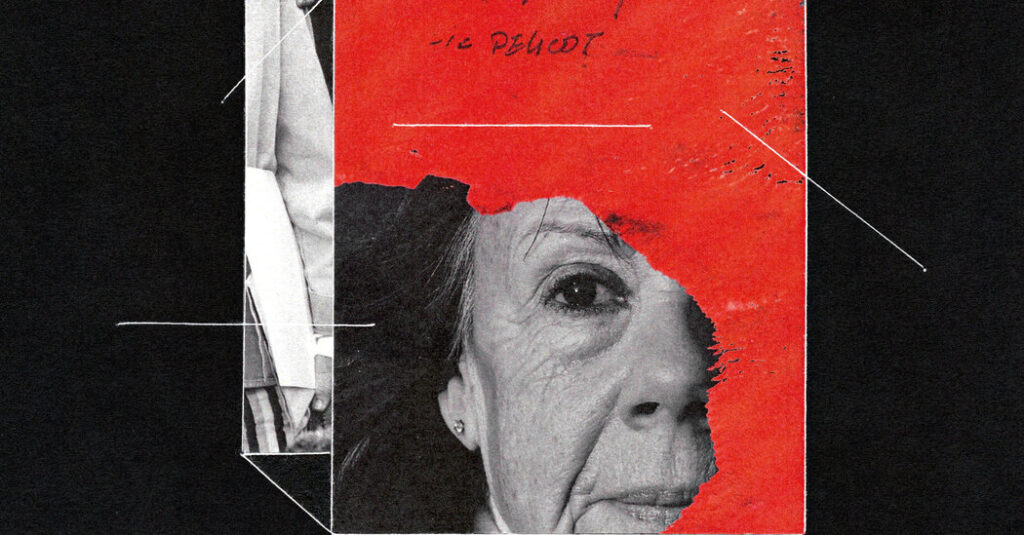
Source photographs for illustration above: Manon Cruz/Reuters; Christophe Simon/Agence France-Presse — Getty Images; Benoit Peyrucq/Agence France-Presse — Getty Images.
The post Gisèle Pelicot’s Memoir Said Something Taboo About Victimhood. We Didn’t Listen. appeared first on New York Times.