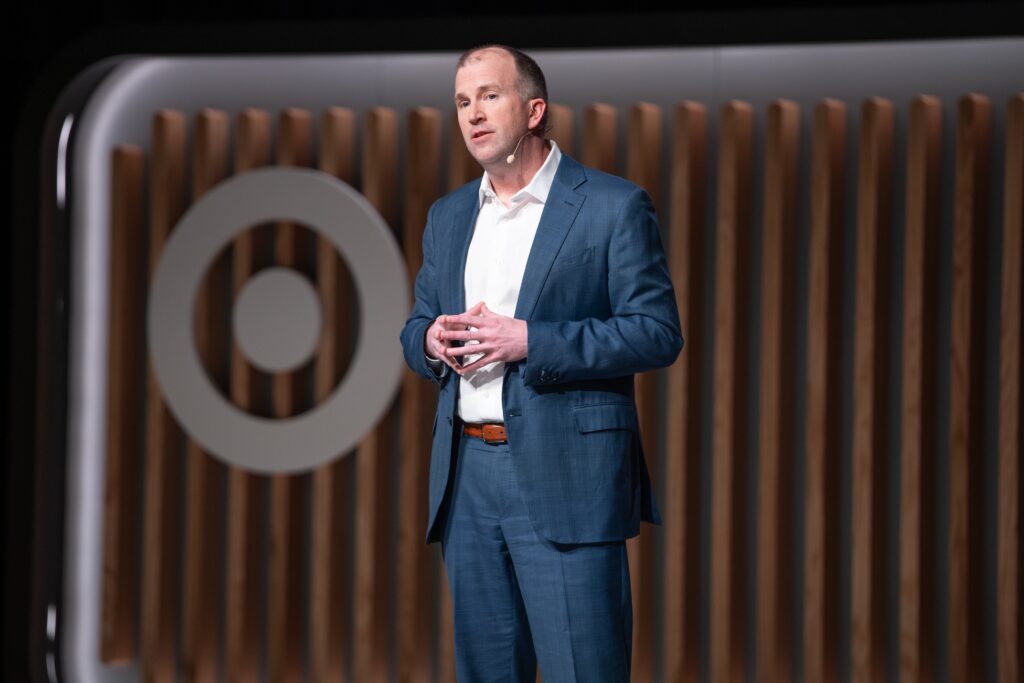
Target CEO Michael Fiddelke was just a month into the job when he stood onstage in March hoping to win people over with his plan to revive the troubled retail giant.
But he wasn’t an outsider with a bold vision for fixing the problems.
Fiddelke, 50, had worked at Target for two decades before ascending to the role of ultimate responsibility. He’d been part of top management when Target lost its brand magic — when sales slumped and the stock price fell 30 percent over five years, even as competitors soared.
His pitch during the annual earnings presentation, held at the company’s headquarters in Minneapolis, was that he understood Target. He’d started out at the big-box retailer as a summer intern in 2003, while wrapping up his MBA. He knew “when Target is at its best, what that’s looked like.” He acknowledged that shoppers had grown disappointed and that it would take time to renew their trust in categories such as home goods where Target “used to be strong and a pacesetter.”
To analysts, it was a tough sell: the idea that an insider like Fiddelke could bring back Target’s glory days, when customers marveled over stylish new products like the “spinning whistle” teakettle and delighted in adopting a faux French accent to exclaim Tar-zhay.
Michael Baker, an analyst with DA Davidson & Co., didn’t sugarcoat his doubt.
“One criticism maybe is that it’s the same management team. You know, I think at some point some investors wanted people from the outside,” he said when it was time to ask questions of Target’s leadership at the Minneapolis event.
“I mean, it’s the same faces, new strategies,” Baker continued. “What happened to all of a sudden realize: Oh, we need to do something different?”
That skepticism is shared by Mark A. Cohen, a past director of retail studies at Columbia University and former top executive for Sears and other major retailers.
“Target went to hell — and he has to be guilty of some of that,” Cohen said. “I have this enormous cynicism for people who are part of the train wreck who are now being called upon to be fix the business.”
Many shoppers say Target has lost its way. They complain about messy stores, long checkout lines and a lack of stylish new products.
Target’s turnaround will be challenging, Cohen said, “because they need to get their mojo back.”
Target and Fiddelke declined to comment ahead of the retailer’s next earnings presentation in late May and pointed to the CEO’s previous public comments.
When hunting for a new CEO, most companies tap an insider. That’s what happened 70 to 80 percent of the time when a company listed in the S&P 500 needed a new leader from 2018 to 2024, according to a Conference Board report.
Troubled companies, though, often turn to outsiders to reverse sagging fortunes. The Conference Board found that firms with declining performance were more likely to hire externally. In 2023, outsider CEOs took the reins at companies that posted an average 8 percent loss in the prior year’s total shareholder return, compared with a 2 percent rise at companies with internal hires.
An outsider offers the promise of a fresh face without the baggage of past failures. Some executives get the job based on a winning record at another company. Some make careers out of it, specializing as “corporate turnaround artists.”
But there is no promise it will work. A study by an executive search consulting firm found “no clear performance advantage between insiders and outsiders.” Another study by two business professors reported that “empirical results on the consequences of the decision to hire a new CEO externally are mixed.” And corporate history is littered with colorful examples of outside CEOs making bad problems worse.
Any new CEO — insider or outsider — promising a dramatic turnaround comes with risks. That’s evident just looking at the trajectories of some prominent Target alums.
Mark Tritton was recruited from Target in 2019 to take over struggling Bed Bath & Beyond, where he cleaned up the crowded aisles and scaled back on the coupons that defined the home goods chain. Customers hated it. Sales plunged. The stock price was down about 60 percent by the time Tritton departed in 2022. BB&B, as it was known, went bankrupt the next year.
Tritton defended his track record when he later sued BB&B over his severance agreement, arguing the retailer’s slide started long before he joined and he faced challenges he couldn’t control, such as prolonged covid pandemic shutdowns.
Ron Johnson was something of a retail rock star when he took over the venerable but struggling department store chain J.C. Penney in 2011.
He’d also come from Target, where he shared credit for its trendy style, and from Apple, where he was known for developing the idea for Apple stores and the Genius Bar. At Penney’s, Johnson got rid of the constant sales and coupons. He wanted “fair and square” pricing and hipper offerings. Customers were not sold. He lasted 17 months. An interview with a Harvard Business School professor assessed Johnson’s brief tenure under the headline, “What Went Wrong at J.C. Penney?”
Anthony Nyberg, who runs the Center for Executive Succession at the University of South Carolina, said Target’s decision to go with an internal hire such as Fiddelke showed the company’s board hoped to retain the retailer’s culture.
Target wants to find its way back to the things that once worked so well without blowing everything up. Change, but not too much change.
“It’s a really interesting balancing act — appeasing Wall Street, the institutional investors, while simultaneously appealing to the customer,” Nyberg said.
A move to rejuvenate, rather than overhaul, a company is what’s credited by analysts with saving Home Depot. It was reeling after CEO Bob Nardelli resigned in 2007 amid criticism for his high pay and the stock’s poor performance. Customer service was a problem. In a letter sent years later to the New Yorker about his tenure, Nardelli argued that the harsh assessments missed the scale of the problem he had to deal with.
Nardelli, who’d joined Home Depot from GE, was replaced by one of his deputies, Frank Blake.
Blake was both insider and outsider — he’d joined Home Depot with Nardelli from GE, but he’d been working there for five years by the time he took over as CEO.
Blake ramped up investment in stores and reinvigorated the so-called Orange Apron Cult — the Home Depot workers who knew what they were selling and loved helping customers.
He is widely credited with strengthening Home Depot’s fortunes. Its stock price soared about 180 percent during his more than seven-year run.
Fiddelke hasn’t proposed a sharp break from his predecessor, Brian Cornell, who served as Target CEO for more than 11 years. And so far Fiddelke has only stirred, not shaken up, the executive suite. He’s promoted two people from within to key positions, with two others leaving the company.
Among the changes he has announced: He wants to spend more on revamping stores and funding better pay and training for staff. Target is launching a new in-store baby boutique. It’s experimenting with using AI to improve the online shopping experience.
Baker, the analyst who doubted Fiddelke in Minneapolis, said in a recent interview that the new CEO has faced plenty of questions since his selection was first announced last August. Target’s stock dropped more than 6 percent that day.
“We weren’t surprised by the market’s disappointment,” he said.
But Fiddelke seemed to be winning over investors and customers, Baker said. Three months into the new CEO’s tenure, Target’s stock is up about 20 percent.
“It’s possible that a fresh set of eyes wouldn’t have the same institutional knowledge,” Baker said. “He brings a wealth of experience of what has made Target great in the past.”
“He knows the company,” Baker said. “The jury is still out on if that’s enough.”
The post Target lost its retail magic. Can an insider get it back? appeared first on Washington Post.