
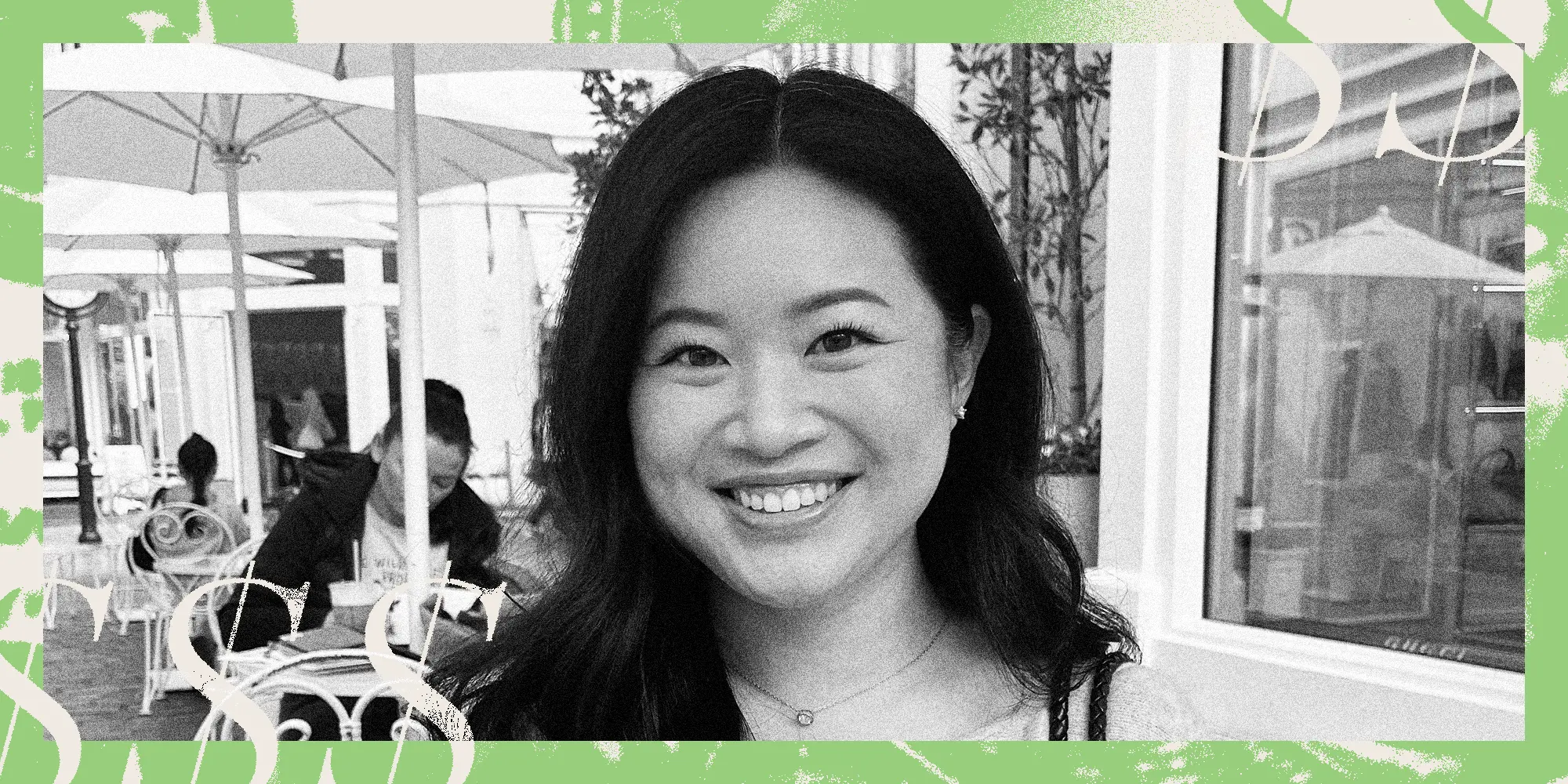
Carmen P is a 29-year-old living in New York City. Business Insider has verified her income and employment history with documentation. The following as-told-to essay has been edited for length and clarity.
I’m a VP of product strategy and development at a multi-national bank and make $155,000 a year.
Before getting my MBA, I worked in market research, but it felt like my earning potential was capped. The real money-makers were the account executives who made commissions, but I wasn’t really comfortable with the dynamic of sales roles.
I think of my student loans from my MBA as my subscription to life. I wouldn’t be able to have the opportunities that I have — now and in the future — if it weren’t for this $700 payment every month. It’s not a small sum of money, but it’s not overbearing.
An MBA isn’t a magical ticket, though. It can put you in the right rooms, but your interview skills, ability to sell yourself, and previous experience still matter.
Earning a higher salary and being financially independent has enabled me to walk away from situations that weren’t serving me a lot faster. Because of that, I feel like I have a lot more options in life.
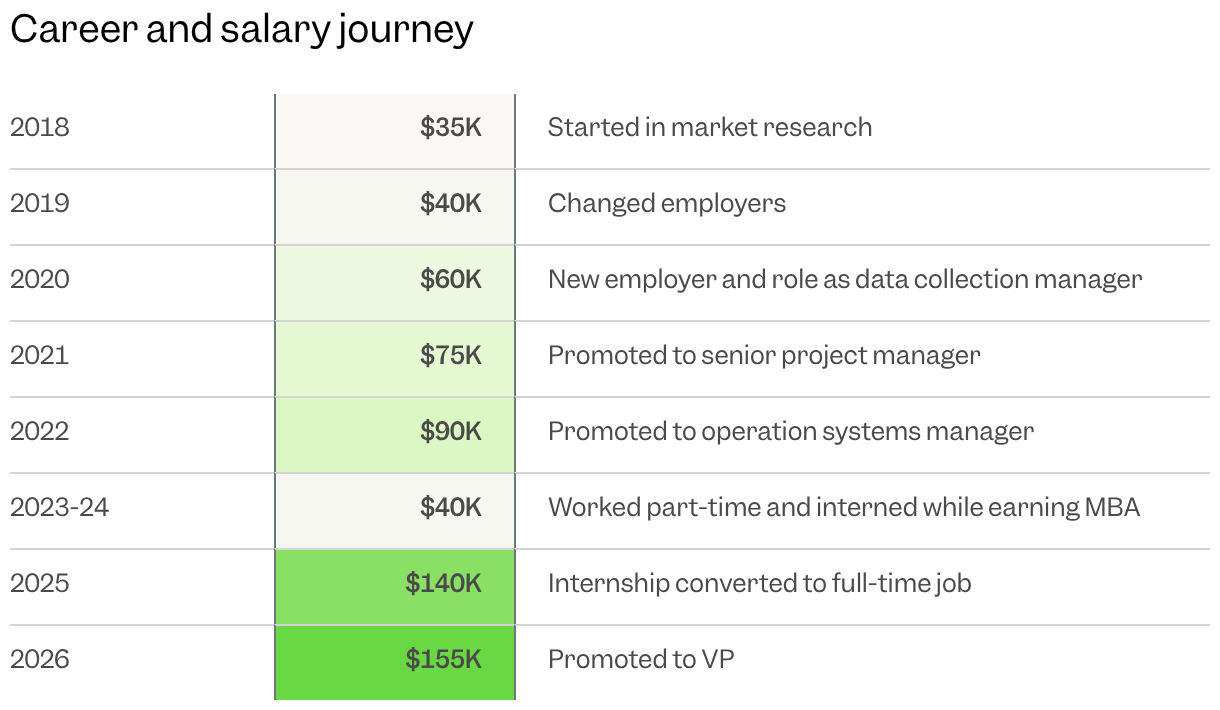
Here’s my salary journey.
Keyword specialist, $35,000
In college, I studied business with a focus on marketing. I initially wanted to be a graphic designer within advertising, but quickly realized that wasn’t going to pay much, so I switched paths.
I landed my first job in 2018 at a small Amazon advertising startup called Channel Bakers. My hourly rate was $17, or around $35,000 a year. I was responsible for tagging search terms on the back end of Amazon products. A few months later, I was transferred to a client success role, diving deeper into our analytics.
I left after about a year because I realized that I didn’t love the advertising side of things and liked the analytical work a lot more.
Research Associate, $40,000
My next role was as a research associate at Lieberman Research Worldwide, a market research consultancy.
It wasn’t a high salary jump — I made around $40,000 a year — but I think of this job as the launchpad for the rest of my career. It was a much larger company and taught me so many business skills that I didn’t learn in college, such as data processing and data manipulation, how to answer questions using Excel, and how to make clean, professional presentations.
Even as a really young associate, I was given opportunities to work on market research studies with big-name clients. The job involved a lot of ground-level work, and my role was more of a project coordinator role — that was the beginning of learning how to be a project manager.
Because it was such a large company, it took a lot of time to get promoted.
I was living at home with my parents at that point and really wanted more autonomy and control over my life. I made the jump to my next company purely for salary reasons.
Data collection manager, $60,000
In 2020, I became a data collection manager at MFour, another market research company, which gave me a nearly $20,000 increase to $60,000 and came with bonuses. Instead of doing presentations and data processing work, I was going out and collecting data for surveys.
I had to manage many different projects — sometimes up to 30 at a time — which helped me stay organized and become a very efficient person.
I made it a point to tell my manager that I wanted to be promoted to a senior project manager in a year to a year-and-a-half, and that’s exactly what happened.
Senior project manager, $75,000
What helped me make that jump was that I knew what issues we were dealing with on a daily basis, and I began to initiate conversations about improvements we could make to be more efficient. My manager loved it.
My scope shifted from many small projects to fewer larger ones. I realized that I loved the operations management side of things — coming up with new processes, helping my manager implement them, and training people.
I wanted to help the company become more profitable, which sparked my desire to go to grad school. I hadn’t studied finance and wasn’t comfortable with accounting and all of the backend work that actually makes a profitable company.
Operations system manager, $90,000
While I was playing around with the idea of going to grad school, I was promoted to operations systems manager in 2022, and my salary became $90,000.
For me, business school was about making a new network outside my existing world. I’d lived in California my entire life and went to college not too far away, so my existing network felt small. It wasn’t going to get me into the types of companies, roles, and salaries that I wanted.
I was only there for around eight more months before I quit for grad school.
MBA, internship, and part-time work, $40,000
I did my MBA at Boston University, with a specific focus on finance and social impact.
I used student loans to cover housing and tuition. I also got a scholarship because I was an early decision applicant. For the first few months of my MBA program, I was also working part-time for my last company, but I eventually quit to focus on finding an internship.
I cold-applied for the internship. Networking felt so unnatural; I’d go to a lot of networking events, but had a hard time asking people directly for referrals. That’s something that I definitely regret.
What I did at those events instead was learn about different ways people joined their companies. That’s where I learned about rotational programs and started applying, including to one at my current company. They were all two-year programs and paid high salaries, and I’d get to rotate within different departments. They were perfectly in alignment with what I wanted to do next in my career.
I landed an internship with my current company for the summer of 2023, after my first year. My take-home pay was around $7,000 a month, a massive jump from my past salary. It was very enticing, as someone who’d invested a lot into an MBA program and also knew that I wanted to move to an expensive city afterward. It was honestly kind of a win on all fronts.
For fun money, I saved some of the money that I made during the summer internship, and worked other part-time jobs, like at the graduate admissions office in my second year.
For the two years I was doing my MBA, my income totaled around $40,000.
Rotational program, $140,000 plus bonuses
I got a return offer from my company in August 2023 and started full-time in July 2024, joining the analytics team.
My starting salary was $140,000. I also got $35,000 in bonuses from my sign-on bonus and signing on early, a relocation bonus of $10,000, and an additional $10,000 yearly bonus.
That paycheck was the biggest I’d ever received in my life — a very defining moment. I remember seeing the amount in my bank account and thinking, I can’t believe I have this. It was intimidating — I felt very small all of a sudden, but it also made me realize that there was so much potential that I could reach.
In the second year of my rotational program, I joined a digital experience team. I only got a $5,000 salary bump, but my yearly bonus increased from $10,000 to $17,500.
My relationship with money has gotten a lot better. Financial literacy wasn’t really something my immigrant parents had taught me, and I’d had trouble saving earlier in my career.
In business school, people talked transparently about financial literacy. That’s when I learned that I need a high-yield savings account, a Roth IRA, and a brokerage account.
VP of product strategy and development, $155,000
In my current role, I monitor the health of multiple of our products in terms of risk and finance, to make sure we’re on track with our goals. My salary is now over $155,000. I don’t know what my bonus will look like next year, because it’s dependent on performance, but I assume the baseline would be higher than what I earned last year.
I’m still paying off my student loans, which I’m able to cover perfectly fine.
I feel well compensated and well balanced now
Looking back, I know that I wasn’t well compensated when I was starting my career, but I don’t feel bitter about it. I learned so many skills in these earlier roles that are priceless now. I met a lot of good people and had good managers. I’m happy I went through it and wouldn’t change a thing.
Looking back, I know that I wasn’t well compensated when I was starting my career, but I don’t feel bitter about it.
I think I’m being well compensated now. It’s a good salary for the work that I do, and it’s a pretty balanced 9-to-5. I don’t ever really feel like I don’t have time for my personal life. I volunteer on Saturdays doing arts and crafts with kids, have time after work to film my TikTok videos, and take sewing and pottery classes.
Before, I would’ve said that my career goals were to have more responsibility and to learn, and that I didn’t care about the money as much.
Now that I have so much work-life balance, I don’t really care about titles. My goal is mainly monetary; for my next role, I wouldn’t mind making a lateral move if it were 15% to 20% higher than what I’m making currently.
Because I live in NYC, my “comfortable” salary number is around $250,000 — about $100,000 more than what I’m making now. That would enable me to rent a decent apartment while also saving to buy an apartment in the city. People say it’s crazy, but I think it’s doable. I’d have to do it on my own.
My life feels very well-rounded now in terms of salary and work-life balance, so I’m very happy with how things have progressed.
If you’re interested in sharing your salary journey, please fill out this Google Form.
Read the original article on Business Insider
The post I’m 29 and increased my income from $35K to $155K after 8 years and an MBA appeared first on Business Insider.