Alejandro, a premature baby born in Havana’s Eusebio Hernández Pérez maternity hospital, weighed only two pounds when we met him in April. We watched him as he lay in an incubator, one of the few in the building whose delicate electronic components hadn’t been damaged by the high-voltage electricity surges that follow nationwide blackouts. Far-reaching U.S. sanctions make importing replacement parts for the other, broken incubators nearly impossible.
Touring the hospital, we saw women in the final days of their pregnancies trudging up flights of stairs, the elevators inoperable without power. The hospital staff members struggle to get to work without fuel for their cars. During blackouts, doctors sometimes have to manually pump ventilators to keep babies alive. They say the hospital has managed to avoid an increase in infant mortality over the past several months, but other facilities around the country have not been so lucky. From 2018 to 2025, as U.S. sanctions grew more punitive, Cuba’s once-impressive infant mortality rate skyrocketed by 148 percent.
As members of the House Foreign Affairs Committee, we spent five days in Cuba in April to better understand the humanitarian impacts of America’s monthslong energy blockade of the island. We came away shocked by the inhumane effects of the policy, whose goal appears to be strangling the economy until the Cuban people are brought to ruin and the country is available, as President Trump put it, for the “taking.”
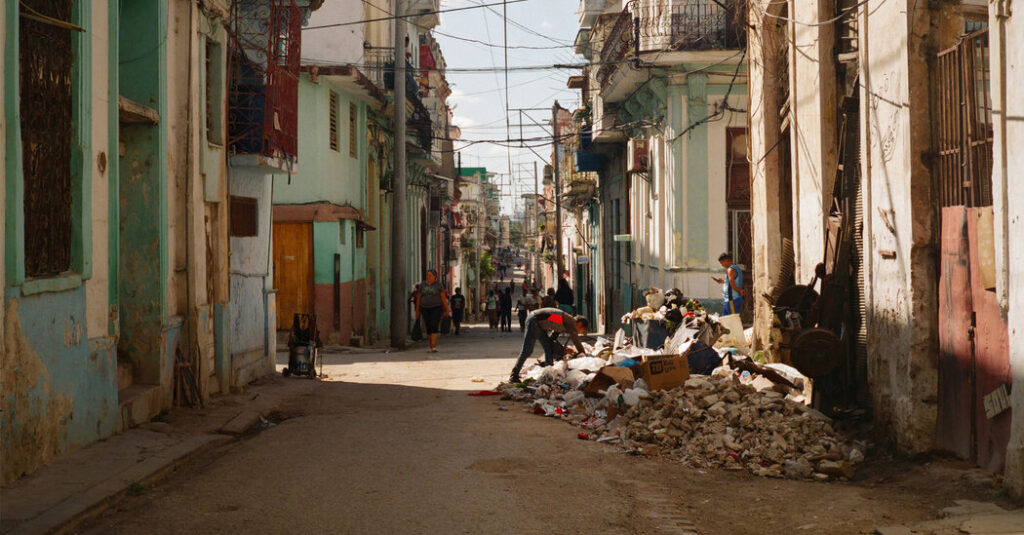
With the exception of one Russian oil tanker carrying 10 to 14 days’ worth of oil, fuel deliveries to Cuba have been blocked for more than four months, as other countries have feared having their tankers seized in open waters by U.S. military vessels. The resulting daily indignities have rippled across Cuban society. We returned from our trip certain that if the American people knew the full extent of what is happening on the ground in Cuba, they would demand an end to the blockade immediately.
The U.S. blockade of fuel to Cuba, on top of the longest embargo in modern U.S. history, defies the norms of international law that provide for state sovereignty, nonintervention in domestic affairs and the right of nations to trade freely. It amounts to an economic assault on the basic infrastructure of Cuba, designed to inflict collective punishment on the civilian population by manufacturing a humanitarian crisis in which health care, running water, agriculture and transportation are no longer available.
During our visit, we spoke with a wide range of Cuban citizens — political dissidents, religious leaders, entrepreneurs and members of civil society organizations and humanitarian aid groups. We also met with the families of Cuba’s political prisoners. Everywhere, there was agreement: America’s blockade must end, and a U.S. invasion must not take place.
We saw for ourselves how Americans could benefit from normalized relations with Cuba in a few key ways. Under different circumstances, Cuba would be a natural U.S. trade partner. Several agricultural secretaries of both red and blue states have visited the island to explore opportunities to export U.S. agricultural products to Cuba, hampered only by the United States’ own financial restrictions under the embargo.
The Cuban health care system, for decades a global model of public health, has produced important advances that could extend to Americans, including promising treatments for Alzheimer’s and lung cancer. And both Cuba and the United States could benefit from a boost in tourism. When President Barack Obama moved to normalize relations with Cuba, hotels, restaurants and shops flourished around the island and fueled the liberalization of the Cuban economy and an emerging independent civil society.
The Cuban government can and must do more internally to improve political and civic rights, including ending arbitrary detention and mistreatment of political prisoners, which we conveyed in our meeting with President Miguel Díaz-Canel. But it has taken some important steps, including announcing the release of 2,010 prisoners in what the country’s state-run newspaper called a “humanitarian and sovereign” gesture. Cuba’s move to authorize an F.B.I. investigation of a recent deadly maritime shootout involving Cuban Americans was another important show of transparency and good will.
Many of the economic changes the Trump administration has claimed it wanted throughout the blockade are already underway. The government recently allowed Cuban American entrepreneurs to invest in private businesses. Small and medium-size businesses now account for large parts of the economy and work force.
But liberalizing reforms cannot counteract a deliberate U.S. campaign to destroy the Cuban economy. Over the past few weeks Mr. Trump and Secretary of State Marco Rubio announced sweeping new sanctions targeting Cuba’s economy under the pretext that the island poses a threat to U.S. national security.
These measures reiterated that the biggest obstacle to improving the daily lives of Cubans continues to be the United States’ outdated, Cold War-era policy of economic coercion and military pressure, whose only upshot has been isolation and suffering for the Cuban people. Further destruction in Cuba, including military action, would lead only to greater economic collapse and more Cubans fleeing the island.
The United States and Cuba can turn the page and enter real negotiations if they are based on mutual respect and aim to benefit the people of both countries. This is what we believe to be in reach — a real chance for children like Alejandro and the next generation of Cubans who deserve to know the generosity of the American people and to live with hope for the future.
Pramila Jayapal, of Washington’s Seventh Congressional District, and Jonathan L. Jackson, of Illinois’s First Congressional District, are Democrats in the House of Representatives.
The Times is committed to publishing a diversity of letters to the editor. We’d like to hear what you think about this or any of our articles. Here are some tips. And here’s our email: [email protected].
Follow the New York Times Opinion section on Facebook, Instagram, TikTok, Bluesky, WhatsApp and Threads.
The post What We Saw in Cuba Shocked Us appeared first on New York Times.