Before this year, it might have seemed like Michael Joo was hiding in plain sight.
The multimedia artist, who might be best considered a conceptual sculptor and installation maker, has been a respected figure on the New York art scene for 30 years, just under fame’s radar.
But now — with a recent solo exhibition in New York; a presence at this week’s fair Frieze New York; a 2025 work on view at Google’s Gradient Canopy campus; a group show appearance coming up at Hauser & Wirth Menorca this summer; and, most significantly, two pieces at the just-opened Venice Biennale — any hint of hiding is over.
James Rondeau, the president and director of the Art Institute of Chicago, said in an email that he was thrilled to see Joo “gain the recognition he has long deserved” — and his museum does not even have any of Joo’s works in its collection. He is just a fan.
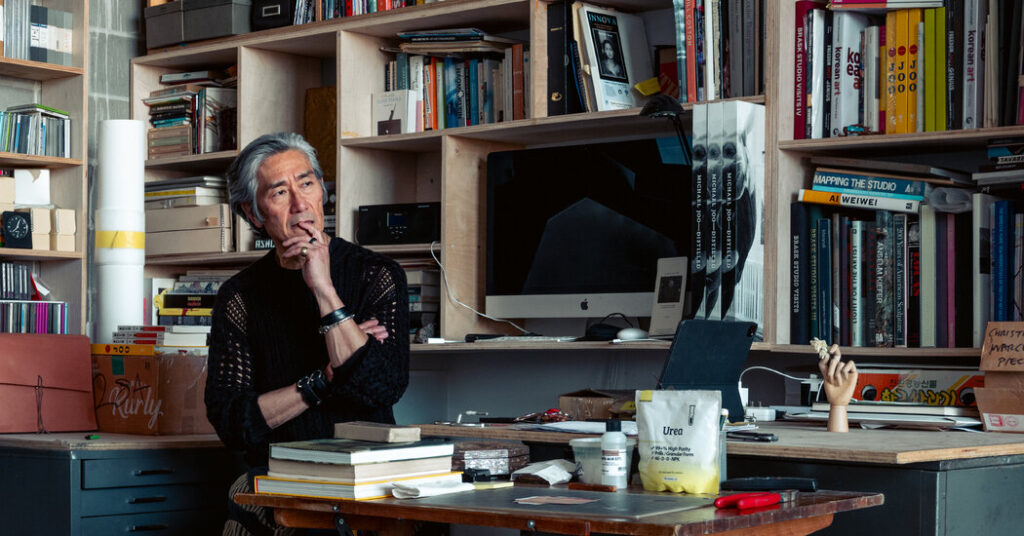
In his Bushwick studio at the end of March (he has multiple New York spaces and one in Seoul), Joo talked about his process and his works, which were often animated by hard data and science; it is not a surprise that both his parents were agricultural scientists.
Joo, 60, said that his works were at once “anchored by some kind of physical identity or material” but also “lifting off the ground and aspiring to go somewhere else.”
The works have layer upon layer of complexity as far as how they are made — sometimes it is hard to keep all the inputs straight — but the resulting pieces always have an intriguing presence that invites the viewer to pause first, and then consider. They take a moment to digest.
Both his pieces in the invited group exhibition at the Venice Biennale — “In Minor Keys,” running until Nov. 22 — have a strong grounding in nature, the environment and science.
One, “That Which Evaporates All Around Us,” is like a huge Calder mobile merged with a multi-arm, scales-of-justice form; the hanging platforms are made of ancient fossil slabs (some 400 million years old). The piece moves slightly from its own weight and produces sound, too. Joo has been collecting fossils since he was a child.
In his proposal for the work, Joo wrote that it “bridges geologic and human histories, resonating with Venice’s layered identity shaped by water, migration, trade and shifting territories.” (Joo was selected by the curator Koyo Kouoh, who died last year.)
The other work, “Noospheres (OG:GR Venice),” builds on a long-term project of Joo’s, “Organic Growth: Crystal Reef,” and this iteration has images of reefs on LED screens and some coral-like sculptures.
Among its ingredients and methods it manages to combine A.I., the blockchain, 3-D printing, marine research and a collaboration with some 10,000 users from Discord — a typical stew of complexity for Joo.
“Noosphere” refers to the philosophical-scientific idea of a “ring or encompassing layer of thought and communication,” he said.
Joo said both works fit with the “minor key” theme, hitting notes that evoked “not the overt melody, but tone and flavor, and the humanism within structure.”
For artists, exploring the theme of humanism often involves depicting the figure. Much of Joo’s art has evoked the body, but usually indirectly, as seen in his show earlier this year at Space ZeroOne in Manhattan, a nonprofit exhibition space run by the Hanwha Foundation of Culture.
“Michael Joo: Sweat Models 1991-2026” focused on his 1990s works and was organized by Christopher Y. Lew, founder of C/O: Curatorial Office, an independent curatorial firm.
Bodily fluids were everywhere. More than one work involved a concoction he calls “synthetic sweat,” and stacks of salt blocks referred to sweat elsewhere.
The show is having reverberations all over. The Frieze New York presentation of South Korea’s Kukje Gallery will have a piece related to one that was on display at Space ZeroOne: “Untitled (the artifice of expenditure – No. American Standard)” (1992) will be in the Kukje fair booth along with his sculpture “Cosms (Catalunya 1)” (2016-24).
Another work from “Sweat Models,” the mixed-media “Concatenations” (1991/2026), will reappear in the Hauser & Wirth Menorca exhibition this summer.
Even though one of the original reference points for the works in “Sweat Models” was the worst part of the AIDS crisis, “people were surprised this work was 30 years old,” said Lew, a former curator at the Whitney Museum of American Art. “It feels so fresh and legible today.”
“Yellow, Yellower, Yellowest” (1991) featured beakers of Joo’s own urine with different degrees of darkness, and referred to his Korean heritage and to a slur used against Asians.
“Depending on your personality, it’s either really funny or really gross,” Lew said.
Joo is not wild about the term Korean American, but it does apply to him. Both his parents are Korean, and he was born near Ithaca, N.Y., then raised from age 9 in southern Minnesota, outside the Twin Cities. In his own words, he was a “feisty Korean kid” who was getting into fights in public school and had to be transferred to a private school.
Seeing very little representation of Asians or Asian Americans while he was growing up may account for some of the metaphorical and indirect quality of his work.
“There were no models,” Joo said. “The missing body, that’s what was interesting.”
His interest in science has been present since at least his student days. Joo studied biology at Wesleyan University in Connecticut for two-and-a-half years, but it did not stick.
“I took a break to work in Vienna and never went back,” he said. Then he moved more decisively toward art, getting a B.F.A. from Washington University and an M.F.A. from Yale, with both degrees specializing in sculpture.
After one temporary move to New York in the late 1980s, Joo settled there in the early 1990s for good and set about making work. He hung out with a cool crowd in the city and in Europe — including artists who would hit it big like Gary Simmons, Matthew Barney and Damien Hirst — and rode around on a Triumph motorcycle. He got a Guggenheim Fellowship in 1998.
In a felicitous bit of timing, his Venice Biennale appearance this spring marks 25 years since his last one, in a very different setting.
In 2001, South Korea selected Joo and the artist Do Ho Suh to represent the country at the Biennale. “That was a huge deal,” Joo said. It came even though he has never lived in the country full-time. The pavilion featured several of his works including “Tree,” a reassembled oak in 300 parts.
Joo said that the experience of emphasizing his heritage as a “nonnational disembodied identity” had had a “weird resonance” in his work ever since.
Melissa Chiu, now the director of the Hirshhorn Museum and Sculpture Garden in Washington, D.C., worked with Joo on a project in 2006, when she was director of the Asia Society Museum in New York.
Joo used a South Asian piece from the museum’s collection in his installation — a third-century Gandharan Buddha — and not one of the many Korean works available, which struck her as notable.
“There’s a resistance in him to an easy categorization of his work,” Chiu said, adding that there are “no easy answers” anywhere in his art. A version of the Asia Society piece won the 2006 grand prize at the Gwangju Biennale in Gwangju, South Korea.
Once Joo was in Venice in late April, busily installing his pieces, he reflected over the phone about his first experience at the Biennale and the trajectory it put him on.
It may have increased the scale of scope of his ideas from the smaller individual to the larger collective. “Earth is now the body,” as he put it.
Asked if he had ever considered doing anything else as a career, Joo said no.
“I do feel compelled to make art,” he said. “There’s something that can be expressed, even though it’s steeped in layers of language and complexity. The world is full of wonder. I’m just peeling back some of the layers.”
The post A Respected Artist Gains Wider Recognition appeared first on New York Times.