For the people who power the art market in its busiest time of the year — dealers, auction house staff, artists and collectors — the shape of the spring season is familiar.
But the market did not always look like it does now, and its evolution over time has shaped the art landscape in surprising and meaningful ways, making some careers and dashing others.
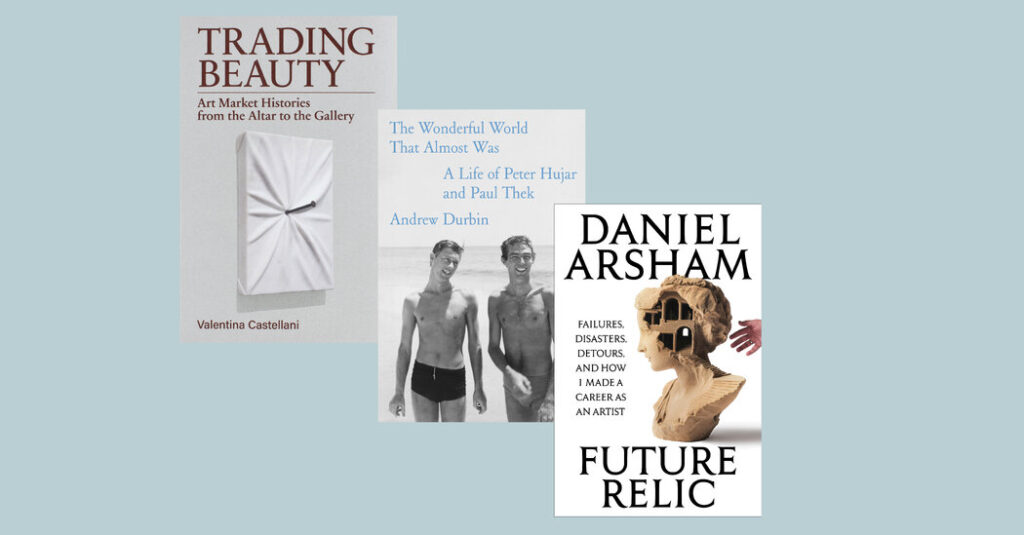
Three recently published books give us some perspective on the selling of art: a long-view history going back to the Middle Ages; a memoir by a successful contemporary maker; and a wistful biography of a relationship between two talented 20th-century artists who struggled to find their place commercially.
“Trading Beauty: Art Market Histories from the Altar to the Gallery” (Gagosian, $40), by Valentina Castellani, is a bird’s-eye view that rewinds all the way back to Charlemagne, tackling the entire record of art-for-money transactions of the (mostly) Western world since then, all in 308 pages. The book is part of Gagosian gallery’s regular publishing program and will be distributed by Rizzoli in the fall.
Castellani is a former Gagosian director and Sotheby’s executive who is now an adjunct professor at N.Y.U., and she shows her extensive research in academic fashion, complete with endnotes.
In the Middle Ages, art was commissioned, mostly by the Roman Catholic Church, meaning that “demand rather than supply determined its dynamics,” Castellani writes, referring to the art market. France in the 17th century was an example of a monopsony, meaning there was effectively only one buyer of art, in this case, the Sun King (Louis XIV) himself.
Only in the Dutch Golden Age of the 16th and 17th centuries did the glimmers of a true market begin to emerge. The economics of the republic meant that upper-middle-class buyers were created, and genres diversified accordingly, as these new art buyers created a demand for landscapes, still lifes and portraits meant for bourgeois homes. Castellani traces some of the earliest dealers and art fairs to this time and earlier, like the Pand market, dating to 1460 in Antwerp.
As Castellani gets closer to our own era, some of the notable names might start to sound familiar: the French dealer Paul Durand-Ruel (1831-1922), who created a market for the Impressionists, and Joseph Duveen (1869-1939), about whom she quotes the writer Don Thompson, who called Duveen “the first to sell social status in the guise of selling art” — a phenomenon amply on display in New York this week.
The narrative takes us further into the 20th century, with dealers like Leo Castelli and Ileana Sonnabend refining the job of representing artists. Of our own diverse and chaotic age, Castellani gives space to the rise of China’s art market, the effect of Instagram on the market and significant outlier events, such as when the artist Damien Hirst bypassed the usual middlemen by bringing a trove of his own work directly to auction in 2008, or when a Leonardo da Vinci came to market and sold for just over $450 million in 2017.
Castellani’s text provides many sidebars along the way about specific notable people, artworks and phenomena, and these spotlights make up a substantial portion of the book’s length.
One of the author’s passions is to highlight women who have mattered as forces in the market yet who have not always gotten enough ink, like the sister-in-law of Vincent van Gogh, Johanna van Gogh-Bonger. (Given that focus, a sidebar on women dealers who have significantly shaped the art world in recent decades, like Marian Goodman, Paula Cooper and Barbara Gladstone would have been welcome — or could be her next book.)
She does not reach any sweeping conclusions about how we got here, and there is no hot take to shock or a skeleton key to unlock the larger story. But she does say that her research “deepened my awe for the unstoppable force of human creativity.”
In that way, it is a relatively rosy view, perhaps unsurprising given her time working as an art world insider.
Another new volume, “Future Relic: Failures, Disasters, Detours and How I Made a Career as an Artist” ($30, Authors Equity), by Daniel Arsham, is about an outsider who became a certified insider.
Arsham was once a guy from Cleveland and then Miami who, after art school, tried to figure out how to break into the art world. Now he is living large, selling his art, showing his work in museums and pursuing other projects, like becoming the first creative director for the Cleveland Cavaliers.
“Future Relic,” which is being distributed by Simon & Schuster, functions as both a memoir and a behind-the-scenes look at the art world. But it is also a how-to: I did it, and you can too. Arsham, 45, takes an approach that is at once upbeat and hard headed, and peppers his prose with curses. Chapter titles include “Why the Art World Sucks and Why It’s Necessary” and “How to Get a Gallery.”
There is no getting around the business of art, according to Arsham, so you might as well master it. “The game is there,” he writes. “Either you play it or it plays you.” Wise up, reader.
His long relationship with the dealer Emmanuel Perrotin forms one of the spines of the story, and the two seem to have a perfect mind meld. (Perrotin is featuring Arsham’s 2026 bronze “Silent Grid” in his Frieze New York fair booth this week.)
Arsham credits the dealer with making him wait years for a New York solo gallery show, by which time, in 2016, his work was ready for scrutiny, and anticipation had ramped up among collectors.
Given his success, Arsham even addresses the criticism he has gotten that he is too commercial, saying he has trained himself not to care.
Over time, Arsham has worked in different disciplines, collaborating with the legendary choreographer Merce Cunningham and cofounding the cheeky design practice Snarkitecture.
He may have had the greatest success as an object maker. His “Future Relic” (2012-present) series of the book’s title featured items of our age that appear corroded and damaged by time, the idea being that they have been excavated by future archaeologists. Some of them are cast in volcanic ash.
If someone were looking back on this book from the future, it would crystallize at least one distinct note about the art world now: Unless you are David Hammons or a similar reclusive genius, being a wallflower is not going to cut it.
“The Wonderful World That Almost Was: A Life of Peter Hujar and Paul Thek” (Farrar, Straus and Giroux, $36), by Andrew Durbin, is about the fraught and tender relationship between two amazingly talented artists. The art market itself is an antagonist in the tale, rather than the protagonist driving the narrative.
Durbin is the editor-in-chief of Frieze magazine — before adding an art fair arm, Frieze started out as a publication — and has also written novels. Not attempting a full biography of either man, he instead focuses on the roughly 20 years they were lovers and friends.
It began in 1956, when they met in Coral Gables, Fla., and lasted until the mid 1970s, after which too much “dirty water” had gone under the bridge, as Thek once put it, in an unsent letter to Hujar. Both died of complications from AIDS.
Thek (1933-88) is a touchstone for contemporary artists today — Arsham cites him in “Future Relic.” Today, he is perhaps best known for the so-called meat pieces, like his “Technological Reliquaries” series, realistic sculptures meant to look like flesh, and his 1967 work “The Tomb,” a.k.a. “Dead Hippie,” which was cast from his own body.
Hujar (1934-87) was a master of unconventionally beautiful, rich black-and-white photography, and he was comfortable shooting the downtown artistic demimonde, gay men cruising the piers on the West Side of Manhattan or a landscape, and portraits were a signature mode.
Arguably both artists are better appreciated today than they were in their lifetimes, and both were frustrated by the lack of commercial recognition their work received — though to be fair, the market was much smaller then, and, in Hujar’s case, photography was barely thought of as collectible in his heyday.
Durbin quotes Thek telling Hujar that he was “trying to get IN not OUT” as far as art world success. They were forever “out of step” with their peers, Durbin writes. Both were famously uncompromising, and Thek by his own admission struggled with his mental health.
Thek showed briefly at Pace Gallery, displaying some of his meat works there in 1966. “Visitors were appalled, titillated,” Durbin writes, noting that “almost none” of the meat pieces sold in Thek’s lifetime. Fast forward 60 years, and Pace is now doing a new Thek show in New York, from Friday through Aug. 14, surveying his work in different media.
Hujar is getting a posthumous spotlight at the Morgan Library & Museum, with the exhibition “Hujar: Contact” focusing on the photographer’s contact sheets, part of the Morgan’s collection of his work. It is on view from May 22 to Oct. 25.
It took the art world a while, but it came around in the end — too late for the artists to enjoy a victory lap, of course. Their tale may serve as a reminder that the market is only one indicator of what art matters, and often a lagging one.
The post Is the Art Market Fair, Flawed or Game-able? Depends Who You Ask. appeared first on New York Times.