This article is part of our Design special section on retrofits.
In Mexico City’s urban core, history runs deep. Beneath the 19th-century buildings erected after Mexico’s independence and the Baroque structures that remain from the Spanish colonial city lie the ruins of the Aztec capital of Tenochtitlan.
Preserving historical structures in the city center is dauntingly complicated said Javier Sánchez, whose architectural firm JSa recently retrofitted a 17th-century house steps from the Zócalo, the main square. What spurred him to take on the project? Chocolate.
“Cacao offers this connection between past and present,” said Agustín Otegui, whose family was involved in commissioning JSa in 2013 to turn the three-story building into the city’s Museum of Cacao & Chocolate. (The institution is part of a network in the Americas and Europe that are devoted to the history of chocolate.) Speaking in a video interview, he added, “You have this bean that was used by the Maya and Aztecs, and now it’s a daily delicacy. It’s a link to the past that keeps going.”
Having designed an extension of the Spanish Cultural Center a few doors from the museum, JSa was familiar with the complexities of working in the historic core. In that project, which was completed in 2012, the ruins of a pre-Hispanic school for the nobility were uncovered on the site. Now, the architects, extrapolating from Spanish maps of Tenochtitlan, had reason to believe that they would encounter another such ancient structure.
Supporting this hypothesis was the 17th-century building’s slant, Aisha Ballesteros, the JSa partner who led the museum’s design, said in a video interview. Many buildings in Mexico City are sinking because of the gradual settling of the underground lake bed; the angle in this particular case suggested that there was something below ground propping it up.
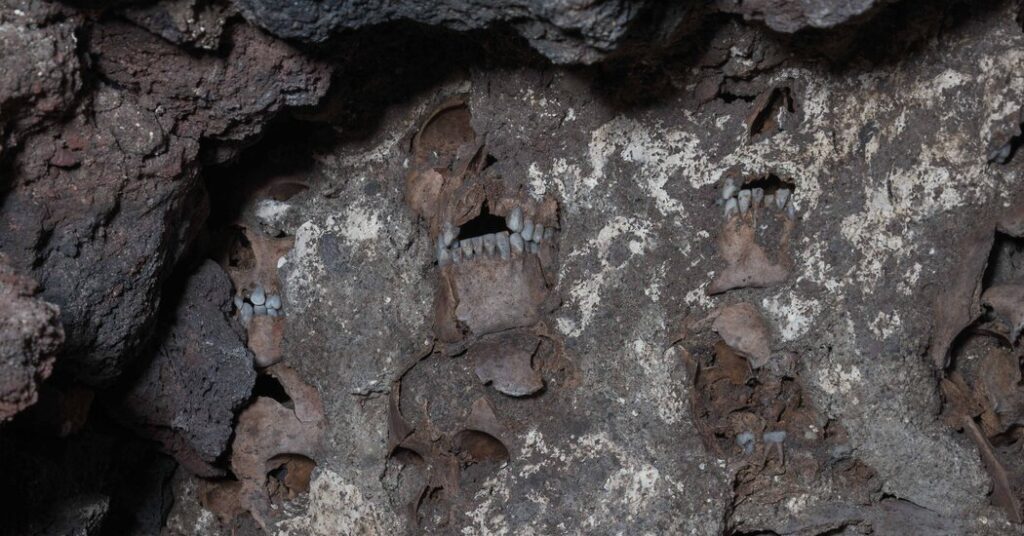
That something turned out to be what the Mexican government describes as one of the country’s most important archaeological finds: a section of a tzompantli, or wooden rack
displaying more than 650 human skulls belonging to people who were believed to have been
sacrificed in the 15th-century reign of the Aztec kings Itzcoatl, Ahuízotl, and Moctezuma
Ilhuicamina. Other tzompantlis have been discovered, but this one — the Huei, or great, Tzompantli — is the biggest and best preserved.
What followed was an 11-year effort to excavate and stabilize the Huei Tzompantli below ground while working on the colonial building above. What’s more, the architects designed a five-story museum addition — one of just a handful of contemporary structures built in the historic quarter in the last two decades — to fill the empty space behind the 17th-century building.
“We were facing three important histories,” Ballesteros said. “Ours, the pre-Hispanic and the colonial one. It was important for us to remember that we are only a small part of this 500-year timeline.”
The design centered on a plan to safely showcase the ancient skull rack and let the colonial building shine, with the contemporary building conceived as a quiet presence where additional museum programs could be housed.
After stabilizing the colonial building — Ballesteros said it was like placing footings underneath the legs of a table that is wobbling — builders sank 100-foot-deep pilings to establish a solid foundation for the new structure. This contemporary building was clad in local, sand-colored travertine, a nod to the volcanic stone composing much of the historic center’s architecture and a quiet presence among the more venerable showplaces.
The two museum structures come close, but never touch. “We separated the new building so that you could see the historic walls, but also because of seismic requirements,” Ballesteros said. In many places, the contemporary addition’s right angles draw attention to the colonial building’s tilt. “It becomes a play between old and new, crooked and straight.”
Between them is a courtyard that allows anyone to pick up a beverage from the cacaotería — a chocolate and coffee shop at the museum’s street level — and catch a glimpse of the chefs making chocolate in the nearby prep kitchen. An open-air corridor illuminated by hand-hammered copper light fixtures leads to a courtyard with shade trees and seating. Eventually, visitors will be able to view the ancient skull rack through a window next to the ticket office.
Those with tickets can visit the exhibitions that start on the second level, tracing the history of cocoa from its Mayan roots to the chocolate we consume today. The circulation path moves from within the building to outdoor terraces, allowing visitors to take in the architecture from different perspectives.
On the museum’s rooftop, JSa designed the new restaurant Charco, which offers views of the National Palace, Templo Mayor, Metropolitan Cathedral and Torre Latinoamericana, a skyscraper.
There, as in the rest of the museum, can be seen the layered architectural fabric making up the city’s past and present.
“The project showcases Mexico’s richness of heritage without making our contemporary heritage any less important,” Sánchez said. “It is possible to recuperate our history, but also make our city be alive at the same time.”
The post A Monument to Chocolate Is Wrapped in Layers of Mexican History appeared first on New York Times.