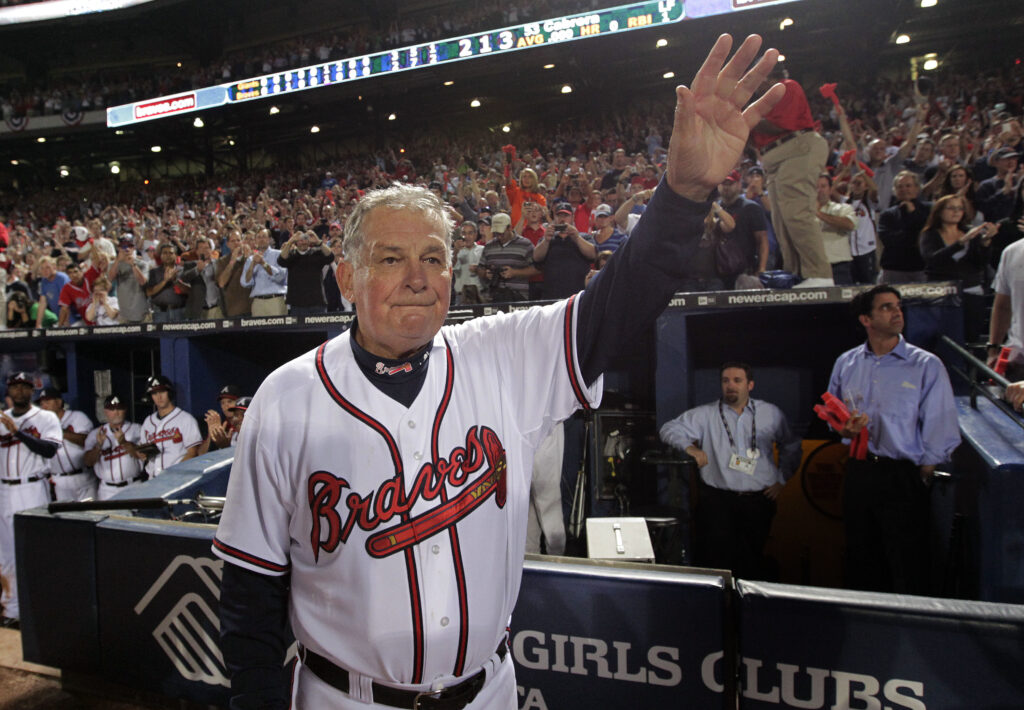
Bobby Cox, who won more than 2,500 games during a Hall of Fame career as one of baseball’s greatest managers, mostly with the Atlanta Braves, and who set a record for the number of times he was ejected from games, died Saturday at his home in Marietta, Georgia. He was 84.
“We mourn the passing of Hall of Famer Bobby Cox, the fourth-winningest manager in MLB history,” Major League Baseball posted on social media Saturday.
The Atlanta Braves wrote on Xthat the team was overcome with emotion over the death of “our treasured skipper. Bobby was the best manager to ever wear a Braves uniform.”
Mr. Cox, a laconic, old-school manager whose ability to lead teams to victory year after year could be a mystery to outsiders, spent 29 years at the helm of big league teams, including 25 years with the Braves, in two stints separated by almost a decade.
He won the Manager of the Year award four times — once with the Blue Jays and three times in Atlanta — and his Braves were the winningest team in baseball in the 1990s. Yet, rightly or not, Mr. Cox developed a reputation as a manager who could lead his team through the long slog of a 162-game season but fell short in the playoffs. He led the Braves to only one World Series title, in 1995.
Other managers of his era, most notably Tony La Russa and Joe Torre, won more championships — three for La Russa and four for Torre. But even they could not match Mr. Cox’s career winning percentage of .556 in 29 seasons. His 2,504 wins are the fourth most in history.
A mediocre player during a brief, two-year career with the New York Yankees, he was such a keen student of baseball that he was tapped to become a minor league manager for the Yankees while still in his 20s.
He became the Braves’ manager in 1978, when he was 36. Fired after four seasons, he moved on to Toronto, where he transformed a losing team into a division champion in four years. Surprising the baseball world, Mr. Cox then left Toronto after the 1985 season to take the front-office job of general manager in Atlanta.
Midway through the 1990 season, team owner Ted Turner tapped him as the field manager. Mr. Cox was back in his element, and for the next two decades he led a roster that included a few superstars — including third baseman Chipper Jones and pitchers Greg Maddux, Tom Glavine and John Smoltz — and a changing cast of role players.
Many journeyman players had their best seasons in Atlanta. When relief pitcher Eric O’Flaherty joined the Braves in 2009, he said Mr. Cox talked with him for 30 minutes about all manner of things, besides baseball. It was the longest discussion, O’Flaherty told Sports Illustrated, he ever had with a manager.
Players often likened Mr. Cox to a father figure. His managerial style was a blend of discipline and freedom. To keep his players focused and to avoid internal arguments, he allowed no music in the clubhouse. He required his players to dress in sport coats when they traveled, yet he had few other rules. He never complained about his players in public.
When relief pitcher Mike Stanton failed to cover first base, leading to a Braves loss, Mr. Cox called him into his office after the game. Stanton expected to be chewed out, but Mr. Cox’s only comment was, “We can’t have that.”
During his second tenure in Atlanta, Mr. Cox compiled a remarkable record, with a winning record 18 times in 21 years. He assembled a stable coaching staff that included pitching coach Leo Mazzone and bench coach Ned Yost, who later won a World Series as manager of the Kansas City Royals.
“The human element of the game is something he understands really well,” Mazzone told the Atlanta Journal-Constitution in 1999.
Mr. Cox’s Braves won 14 consecutive division titles and had six 100-victory seasons. (They were in second place in 1994, when the season ended prematurely because of a strike.)
In five World Series appearances under Mr. Cox, the Braves won only once, beating Cleveland in six games in 1995. Typically, Mr. Cox stood aside as his players savored their moment of glory.
“People ask me if I’m concerned about a lack of recognition,” he said in 1996. “That doesn’t bother me one bit. I’m not the show. The players are the show. I’ll just stay in the background.”
In 2014, Mr. Cox entered the National Baseball Hall of Fame in the same class as two of his star pitchers, Glavine and Maddux, and his managerial counterparts, Torre and La Russa.
La Russa was considered an innovator in the dugout, yet in 161 head-to-head matchups — almost exactly a full season — Mr. Cox bested La Russa with a record of 94-67.
“People have been thinking for years that we have this genie in a bottle that has been doing it for us,” Smoltz said of Mr. Cox’s leadership in 2004. “Maybe now they realize, hey, Bobby Cox has been doing it for us.”
The most ejections in history
Robert Joe Cox was born May 21, 1941, in Tulsa, and was 3 when his family moved to Selma, California, in the San Joaquin Valley. His father installed wells, and his mother worked in a bakery.
An outstanding high school quarterback, Mr. Cox was recruited to play football by both Stanford and the University of California. Instead, he played baseball at a community college for a year before signing a $40,000 bonus with the Los Angeles Dodgers.
He finished his playing career in the Yankees’ farm system in 1970 and was planning to return to college when he was asked to manage in the minor leagues. He later joined the Yankees’ major league club as first base coach under Billy Martin.
Mr. Cox managed in Atlanta from 1978 through 1981, then spent four years as Toronto’s skipper before moving back to Atlanta, where he met his second wife, Pamela Boswell.
They were married in 1978 and settled on a farm about 70 miles north of Atlanta. Mr. Cox drove an old Ford pickup truck back and forth to the ballpark.
In 1995, Mr. Cox was arrested for assault after his wife called the police, charging that he had pulled her hair and slapped her in the face. He spent a night in jail and underwent counseling for anger management. He and his wife later said the severity of the incident had been overstated, and they remained married until his death.
After Mr. Cox’s final season as manager in 2010, the Braves retired his No. 6 jersey and dedicated a statue in his honor outside the team’s stadium.
During his managing career, Mr. Cox was ejected from 162 games, by far the most in baseball history. Many times, Mr. Cox hobbled onto the field, bad knees and all, to take up the argument with the umpires to keep his players from being tossed from the game.
Unlike other managers, such as Earl Weaver and Lou Piniella, who sometimes pulled bases out of the ground and kicked dirt on umpires, Mr. Cox’s arguments were seldom theatrical or personal.
“I’ve never gone on the field looking to get thrown out,” he told the Atlanta Journal-Constitution in 2007. “I like umpires, and there’s not one that I dislike. … But we have our confrontations, and that’s it.”
After the game, Mr. Cox never held a grudge. The umpire who gave Mr. Cox the heave-ho most often — six times — was Bob Davidson. Even he admired Mr. Cox.
“If I was a ballplayer,” Davidson said in 2007, “I’d want to play for Bobby Cox.”
The post Bobby Cox, Hall of Fame manager of Atlanta Braves, dies at 84 appeared first on Washington Post.