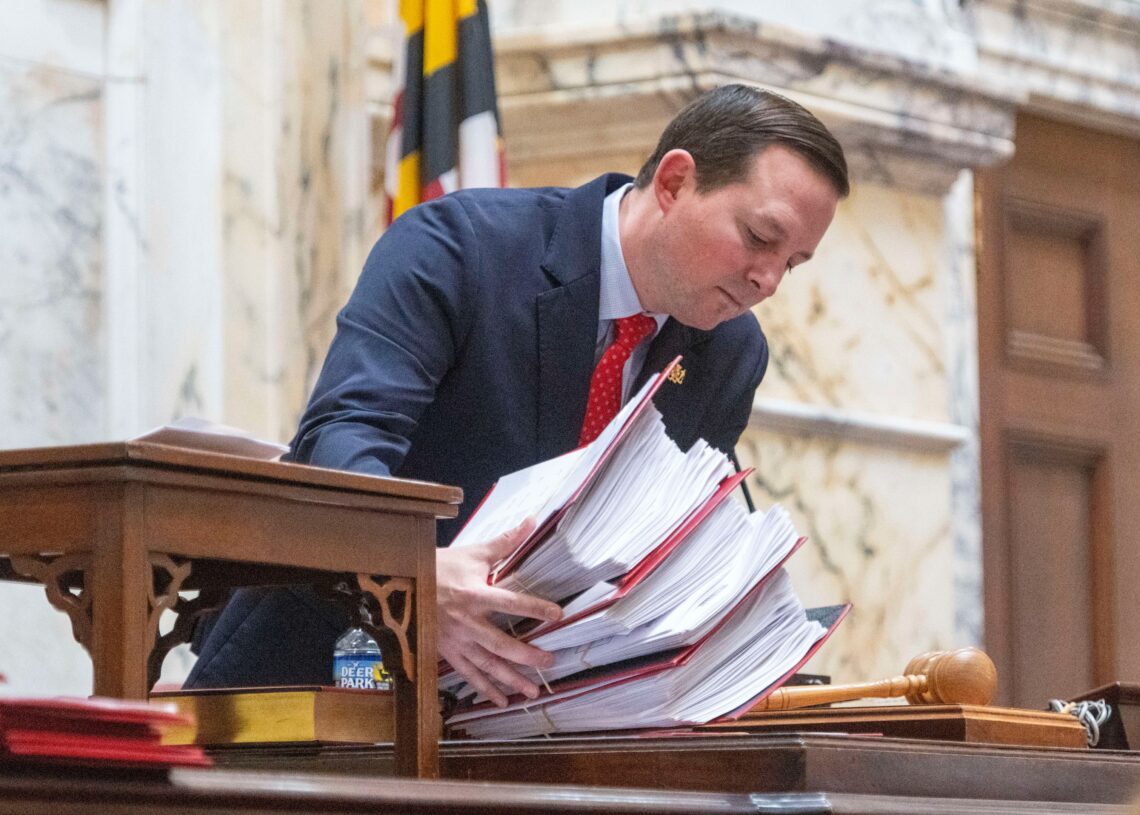
As Republican Indiana state senators lost their seats this week in a revenge-fueled primary after defying President Donald Trump on redistricting, the prominent Maryland Democrat who also sank partisan gerrymandering took note.
Maryland Senate President Bill Ferguson (D-Baltimore City) faces a Democratic version of that retribution, drawing the most difficult primary challenge of his 16-year career.
Like the ousted Indiana Republicans, Ferguson defied demands from his party’s leaders to create new congressional maps to boost chances of controlling the U.S. House. He, too, faces political consequences after rejecting efforts to eliminate the state’s one GOP-leaning House district.
While the Maryland-style payback from fellow Democrats does not resemble the overt revenge campaign waged in Indiana by Trump and his Republican allies, Ferguson is left aggressively defending a seat unlike ever before.
Gov. Wes Moore (D), who led the redistricting charge, pointedly did not include him in a list of more than 160 primary endorsements in state and local races released Thursday, boosting Democrats the governor said would “push back and push forward.”
Legislative leaders typically cruise to reelection and hold massive financial advantages. Ferguson’s only previous primary challenger, in 2014, drew just 10 percent of the vote, and back then, the party infrastructure was squarely behind him. Now some are slow to support him despite private urging. In a sharp departure from Maryland norms, one of his caucus members appeared with his primary opponent at a redistricting event and publicly insulted Ferguson in an interview, calling him “a thug” and “my enemy.”
State Sen. Arthur Ellis (D-Charles) said the caucus elevated Ferguson because he was a progressive but voters in his district should take note that the Senate president has effectively sided with Republicans who wanted fewer Democratic seats. Unlike in Indiana, Maryland’s senators never got a public hearing or vote on jumping into the redistricting arms race. The Supreme Court recently weakened Voting Rights Act protections that produced majority-minority districts.
“So many of our rights are being stripped away, and it feels like the Republicans are winning and the decks are stacked against Democrats,” Ellis said.
Ferguson is philosophically opposed to redistricting and has said it could backfire and result in Republicans gaining extra seats if a court drew a new map. He compared mid-cycle partisan map-drawing to racial gerrymandering by diluting the Black vote by spreading voters across districts.
“It is hypocritical to say that it is abhorrent to tactically shift voters based on race, but not to do so based on party affiliation,” Ferguson wrote in a memo last fall detailing his opposition.
In an interview, Ferguson downplayed his worry about his primary challenge. But he also likened his campaign to his 2010 upset win over a 24-year incumbent. He says he’s running now with that same intensity.
“I’m knocking on thousands of doors and talking to voters one on one and doing meet-and-greets with 10 to 15 people at a time, which is the heart and soul of democracy: standing on somebody’s doorstep and telling them what I care about and listening to them,” Ferguson said.
He found the losses of the Indiana legislators and the flood of outside money to oust them “depressing” and found it “a sign of the political angst in the air.”
But unlike in Indiana, national Democrats have not poured cash into Ferguson’s challenger, a Baltimore tour boat captain named Bobby LaPin with a flair for garnering social media attentionand an arsenal of one-liners about Ferguson’s redistricting call.
“When it comes to redistricting, Maryland is the last line of defense,” LaPin said in an Instagram video post that juxtaposes a photo of Ferguson with Trump and the all-Democratic congressional map Ferguson wouldn’t let come for a vote.
Democrats publicly and privately frustrated with Ferguson’s intransigence on redistricting mostly have not pounded him over it or called for his ouster. They’ve instead responded in the more subtle methods of a machine-politics state.
Ferguson had sought Moore’s endorsement, according to two people familiar with the situation who spoke on the condition of anonymity to discuss the situation. Notably, Moore endorsed Ferguson’s counterpart in Annapolis, House Speaker Joseline A. Peña-Melnyk (D-Prince George’s).
Moore, once a close Ferguson ally, declined an interview request through a spokesperson but released a statement saying the pair “continue to communicate consistently.”
Ferguson’s allies within the party privately called on fellow Democrats to all rally behind him, but they have not yet.
They haven’t backed LaPin either, who said Ferguson’s unwillingness to counterpunch Republican redistricting done at Trump’s behest shows the Senate president should leave office.
“When you have a faction, a political faction, that is working to dismantle American democracy, you can’t just turn over and let it happen,” LaPin said in an interview. “You have to stand up, and you have to fight against it.”
Moore argued that Maryland Democrats have a responsibility to counteract Republicans drawing maps to their advantage. Nationally, Democrats are losing the redistricting war and were dealt a devastating blow Friday when the Virginia Supreme Court struck downa voter-approved map that gave Democrats the edge in flipping four GOP-held seats.
Ferguson argued that Maryland’s existing 7-1 map favoring Democrats seemed gerrymandered to its legal limit already. Trying to oust the state’s only congressional Republican, House Freedom Caucus Chair Andy Harris, would backfire, Ferguson said, given that Maryland’s top state judges have been mostly appointed by Moore’s Republican predecessor, former governor Larry Hogan.
While the Maryland House of Delegates twice passed redistricting efforts, Ferguson torpedoed both by refusing to bring up the legislation for a vote.
Near the end of a recent, private conference call with top Maryland Democrats, U.S. Rep. Sarah Elfreth told everyone Ferguson was in a tough race and needed their support. She was met with silence, according to four people on the call who spoke on the condition of anonymity to discuss private conversations.
Other people on the call, including Ferguson, said other declarations near the end of that long meeting were met with silence.
“That’s just someone making drama,” Ferguson said of the characterization that the silence was resounding.
Elfreth, who was a state Senate colleague of Ferguson before she won her congressional seat, said in interview that she plans to publicly endorse him soon. And while she supported redrawing Maryland’s districts, she also views Ferguson as a skilled bridge-builder who has a strong record in his southeastern Baltimore district.
“We are in a position where we can disagree about something, but I still appreciate just how much he is needed by Baltimore City, by the Senate and by the entire state of Maryland,” she said.
Ferguson did not answer when asked whether he was denied resources he requested from fellow top Democrats. He noted that congressional leaders in the Baltimore area and Baltimore Mayor Brandon Scott endorsed him. “I’m a team player,” he said.
As for his redistricting stance, Ferguson has no regrets.
“I wish I could have done something in 2022 or 2024 to prevent Donald Trump from becoming president,” Ferguson said. “But beyond that, I think that we’re living in political times that are incredibly challenging, and I think effective leadership requires making the best decision you can with the information that’s available.”
The post This powerful Democrat’s job is on the line over redistricting appeared first on Washington Post.