A far-right party in Australia on Saturday won a seat in the country’s lower house of Parliament for the first time, in a race that was closely watched as the first federal test of whether a surge in support for the populist group could translate into political change, according to a projection by the Australian Broadcasting Corporation.
One Nation, an anti-immigration party founded by a firebrand politician, Pauline Hanson, has seen its popularity buoyed in recent months by dissatisfaction with the major parties and turmoil within Australia’s main conservative opposition, a coalition of the Liberal and National parties.
One Nation had never previously been directly voted into the lower house in its three-decade history, during which it has mostly been seen as a fringe entity known for Ms. Hanson’s headline-grabbing antics and unabashedly anti-immigrant rhetoric.
On Saturday, the party’s candidate won a special election to fill the seat of Farrer, a rural, agricultural area along the sinuous Murray River in the state of New South Wales. Farrer is home to about 175,000 residents in a region the size of Mississippi, where the top local concerns are water management and an overburdened local health care system.
Even so, the race was breathlessly covered by the Australian media as a bellwether of whether One Nation was on the cusp of a rise comparable to those of Reform U.K. or Alternative for Germany — one that would shake the two forces that have always dominated politics here, the center-right Liberal-National Coalition and the center-left governing Labor party. On Saturday night, multiple outlets called the win a “political earthquake.”
The seat had been held by the Coalition since its inception in 1949, most recently by Sussan Ley, a former leader of the conservative opposition, whose resignation in February prompted the special election.
“There is serious potential for realignment for Australian politics on the right, the way we’ve seen in Europe,” said Benjamin Moffitt, a senior lecturer in political and international relations at Monash University whose research has focused on the global rise of populism.
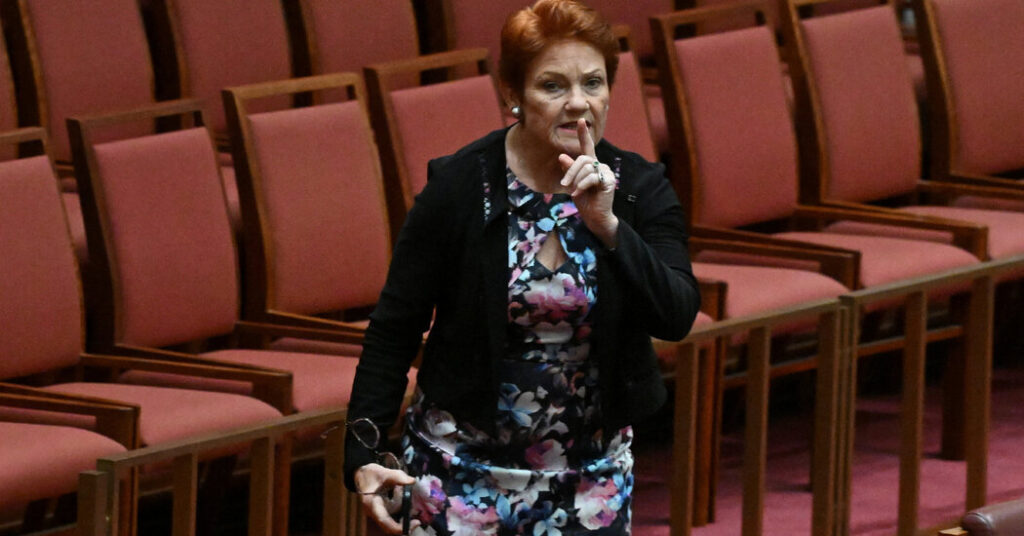
Ms. Hanson, who has said that Australia risks being “swamped” by Asians and Muslims, remains staunchly against immigration. She has also been critical of public support for, or recognition of, Indigenous Australians and has assailed what she calls political correctness.
Many of her positions are closely aligned with President Trump’s messaging. Last year, she spoke at the Conservative Political Action Conference in Mar-a-Lago, where she praised Mr. Trump’s policies and laid out her aims of wanting to mirror them in Australia.
In a victory speech on Saturday evening, she struck a Trumpian note.
“We have a plan for the future of this nation,” Ms. Hanson said at her party’s celebration, adding: “I don’t want Shariah law on our doorstep. I want true people that want to come on board to be Australians, and join us in this journey of making our country the greatest country in the world again.”
The victory of One Nation’s candidate, David Farley, an agricultural businessman, still leaves the party far from substantial power in federal government, and a full picture of its support nationwide won’t come until the next federal election, which isn’t expected until 2028. The party has one other representative in the lower house, who defected from the National Party last year, and four members, including Ms. Hanson, in the Senate, where seats are proportionally allocated based on votes cast for the party.
But the newly gained federal seat, on top of the party’s success in recent state-level elections in South Australia, where it edged out the Coalition, could give it the momentum to continue its rise, Mr. Moffitt said. It has also garnered support in recent months from deep-pocketed backers, including the mining magnate Gina Rinehart, Australia’s richest woman, who gave Ms. Hanson a private plane.
“There’s wind in their sails,” Mr. Moffitt said.
The candidate who finished second, Michelle Milthorpe, is an independent. Labor did not have a candidate in the race, and the Coalition was not a significant contender.
One Nation’s rise — fueled by souring public sentiment on immigration and distress over the cost of living — has already begun shaping messaging from the major parties. Angus Taylor, who replaced Ms. Ley to lead the Liberal Party, pledged in a speech last month to “drastically” reduce immigration numbers and screen the social media accounts of visa applicants, prompting allegations that he was echoing Ms. Hanson.
The election results “will be taken seriously as a message by both major sides of politics, who will recognize there is a significant group of disaffected voters out there,” said Frank Bongiorno, a historian and professor at the University of Canberra.
At the same time, the populist surge in Australia is not yet at the levels seen in Britain, and One Nation has a checkered history when it comes to keeping the party together and organizing on a national level, raising questions about whether it can endure as a movement, Mr. Bongiorno said.
And Ms. Hanson’s and One Nation’s associations with Mr. Trump will increasingly be a damper on support for the party because the U.S. president is deeply unpopular in Australia, he said.
Victoria Kim is the Australia correspondent for The New York Times, based in Sydney, covering Australia, New Zealand and the broader Pacific region.
The post Far-Right Populist Party in Australia Wins Race Seen as a Key Test appeared first on New York Times.