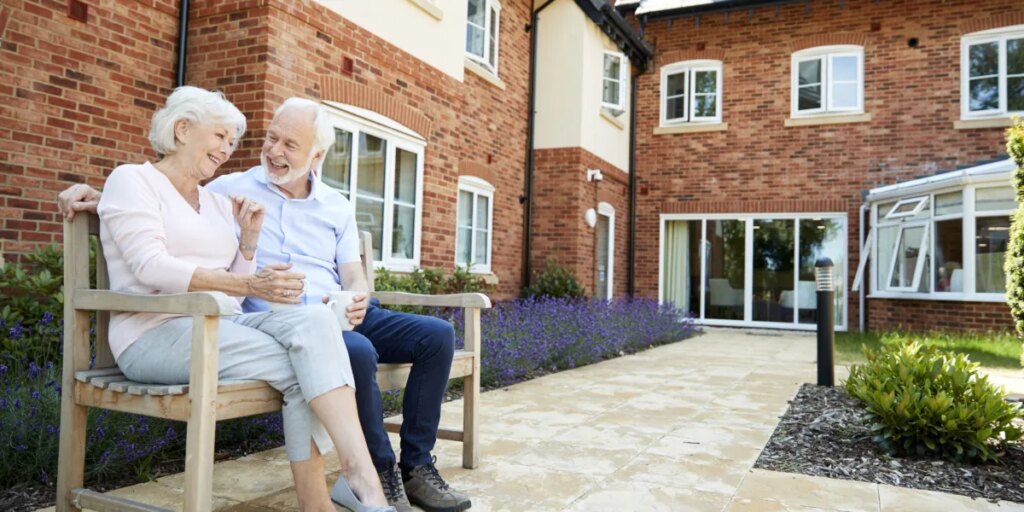
The silver tsunami is shaking up commercial real estate after years of senior housing being the quiet corner of the market.
Major office renovations and headquarters projects, industrial warehouses, data centers, and apartment complexes received more institutional attention for years as senior housing was hammered by the pandemic, prompting investors to look elsewhere.
But now it’s real estate’s hottest sector.
Senior housing transaction volume hit $24 billion on a rolling four-quarter basis through the end of 2025—the highest level in a decade—according to JLL’s 2026 Seniors Housing and Care Investor Survey and Trends Outlook, released in March.
Occupancy has clawed back to 89.9% in primary markets and 90% in secondary markets, meaning the industry has filled more units than it has lost for 19 quarters running, according to the report. Cap rates, or the yield investors get on a property relative to its price, have dropped to 6.2%. (When cap rates fall, it means buyers are paying more for the same income, which is a sign of investor confidence.) And 85% of investors surveyed by JLL expect cap rates to fall even further during the next 12 months. Plus, 86% of respondents said they want to invest more in senior housing in 2026.
The driving factor is demographics. The U.S. population aged 80 and older is projected to grow by 36.6% over the next decade, from 14 million to 19 million, according to JLL’s analysis, compared with just 5% total population growth.
That’s the essence of the silver tsunami phenomenon: the rapid aging of the global population, particularly baby boomers, and the resulting strain on health care, housing, and economic systems. To put that in perspective, more than 10,000 Americans turn 65 every day, according to the U.S. Department of Health & Human Services.
“The combination of the silver tsunami and a halt on development during COVID has created a supply-demand imbalance that has rarely—maybe never—been seen in commercial real estate,” Noah Lindon, a seniors housing associate at Matthews Real Estate Investment Services, told Fortune. “Given the backlog, we are decades away from being ‘overbuilt’ in the space.”
JLL’s figures back him up. New construction starts have fallen 77% in primary markets and 62% in secondary markets from recent peaks, according to JLL, even as demand surges.
That also means existing properties are reaping the rewards. Average rent has climbed to $5,479 per month, a 28.8% jump from pre-COVID levels. Price-per-unit valuations have hit $182,800, a 29% year-over-year increase.
But that also means senior housing has become increasingly unaffordable for many Americans.
The middle-income squeeze
While there are plenty of Class A housing options being built for wealthy individuals who have aged out of living at home, other income groups will be stretched, Jared Rothkopf, a real estate attorney at Polsinelli who works on senior living deals nationwide, told Fortune.
“Middle-income [baby] boomers will definitely find it hard to access these high-end options,” he said. “And without Medicaid options, they may be forced to live at home in less safe conditions or move in with their children.”
That’s also the gap that worries Ben Mizes, president of Clever Real Estate. The fastest-growing slice of the senior population is what the industry calls the “forgotten middle,” or baby boomers who earn too much to qualify for Medicaid but don’t have enough to write a $5,500 rent check every month.
“There is no demand risk with senior housing,” Mizes said. “The risk is with the demand that cannot pay for what is being constructed. While there are plenty of higher-income households that can afford the $5,500 rent, this does not solve the housing crisis for millions of middle-income baby boomers.”
Lindon also sees the middle market as the next big investment opportunity, but doesn’t see it as a crisis yet.
“We’ll see innovation in the industry, including unique conversion plays, as well as an increase in home health care that can act as a bridge to full-care support,” he said. “Don’t rule out increased government support as well.”
The bear case
While much of the current data shows a bullish case for senior housing, the next 24 months aren’t without risk.
That’s because “any number of global issues” could affect cap rates, real estate attorney Rothkopf said.
“Inflation does not seem to be softening, especially due to gas prices surging in the wake of the war in Iran,” he said. “As inflation persists, a softening economy and increase in labor costs—and construction costs for new development—could certainly weaken the outlook for senior living investments.”
Clever Real Estate’s Mizes also flagged three risks: labor and insurance costs outpacing rent growth, a housing market downturn that could squeeze seniors trying to sell their homes to fund a move, and private-equity-driven changes to the operating model just as new capital floods the sector. JLL also noted economic volatility and workforce availability as top concerns, each cited by 29% of respondents.
The cycle of overbuilding, Mizes said, will only be avoided if investors actually underwrite affordability instead of just demographic demand.
“If the same private assisted-living customer in the same higher-income markets is targeted, then 2026-2028 will not have the demographic ‘supercycle,’” he said. “Rather, it will be the same pattern as the last oversupply blunder.”
But for now, the capital is moving anyway. Private capital accounted for 50% of transactions by volume in 2025, with REITs and public buyers taking 32%, up from 24% the year before. The move, Lindon said, is careful.
“The discipline by REITs and private capital is demonstrated by their longstanding operator relationships and reliance on the data that ultimately drives the decision making,” he said.
The silver tsunami is coming, but the question remains who will be able to afford a room.
The post Investors are betting big on senior housing. There’s just one problem—the baby boomers they’re chasing can’t pay the rent appeared first on Fortune.