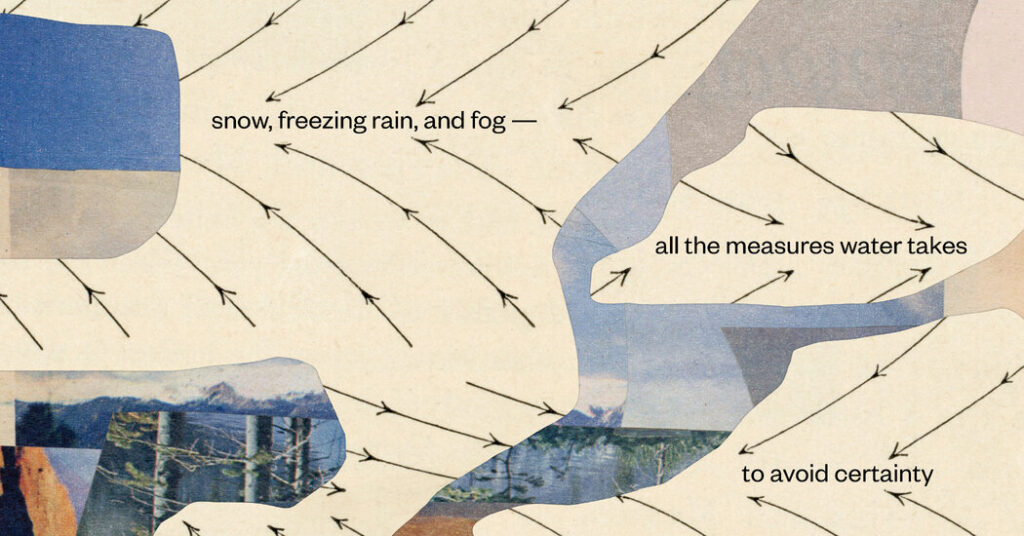
WELLWATER: Poems, by Karen Solie
Despite her light touch and quick wit, the Canadian poet Karen Solie is a tragedian. Her scanning, burrowing, discursive attention to ecosystems and environmental damage can seem not so much guided by the personal as interrupted by it; reading “Wellwater,” her seventh book, I sometimes found myself hunting for vulnerability, and for heat. But beneath her deadpan tone Solie is far from dispassionate, and I came to experience the ecopoetic, probably anticapitalist, poems in this collection as a drama in which the act of minimizing the self has to do with more than mere tact.
These poems appear to ask: Since humans have nearly depleted the planet thanks to our urges and needs, might suppressing the self in poems reduce further harm? It is tempting, anyhow, to read an ethics into Solie’s writerly habits and temperament.
In poems set in prairie landscapes and chilly northern cities, Solie layers memory and observation. The speaker of the title poem recalls driving the “watertruck underage to the well/in a swimsuit, anointed with baby oil.” She listens to Blondie on the radio, music that “tore a strip off the wheatfield,” and remembers to leave the engine running while drawing well water so as not to drain the battery, “a mistake I’d made and lived to regret,/which is the only way I ever learn anything.”
Collective as well as individual mistakes haunt this poem, with its non-native plantings and its ritual childhood chores transformed by “our glyphosate on the wind, our malathion.” (Solie loves the strange music of toxic technical language.) Frackers arrive, “appearing before, as we said, we knew it.”
Into her tapestry of inference and association, Solie threads marvelous aphorisms. “Purity/is not a passive quality,” she writes in one poem. In another: “Money buys the knowledge it isn’t everything.” Yoking farm tools with literature: “The plow is a child of the north,/like Romanticism.”
Solie is aware of the pastoral pleasures of her poems — and knows how the sublime can jam up against colonialist realities:
Rolling hills of bouldery glacial moraine, hunting ground of the nomadic Gros Ventre, Cree, Assiniboine, Blackfoot, Lakota Sioux,
until settlement.
And how a legal document may direct us back toward terrible beauty when it decrees the sale of
… semi-arid acreage to immigrant farmers and the land blew away without the grass to hold it down.
Solie is also a remarkable maker of similes. In “Autumn Day,” bourgeois coffeehouse delights undergo radical transformation:
the incense of coffee and the vulgar muffins, overstuffed as geese with funnels down their throats, truly the muffins of a culture on the brink of steep decline.
This is funny — I wrote HA! in the margins. Solie here also relies on metaphor’s ability to hold together things vastly different in scale and nature, in order to pass judgment and expand the poem’s purview. But her knack for instilling poems with ethics never leads to hectoring, or even to preaching. Solie is thinky and sensory, serious and witty. No tendency cancels any other.
Jaded, curious, “Wellwater” also contains many notes of elegy, beginning with “Basement Suite,” a literal descent (in tercets if not in Dante’s terza rima) to a realm of “fixtures and appliances/repented of by the homeowners” and a catalog of pantry pests: “rice weevil, rose weevil, pea weevil.”
Solie’s whimsical analysis, alive and alert with childhood fantasia, is also a proposition about how we might think differently — “The basement is a treehouse in the roots” — as a way to reconfigure our ideas about humans’ place, and plight, in the world.
This is one of several poems set “low to the ground” and preoccupied with netherworlds, if only to refute them: “It’s not the underworld for Christ’s sake.” These may be places of shelter (there’s a quarantine feeling to some of these poems), or places from which wealth is extracted. “Wellwater” isn’t able to quench hellfire, but Solie ends by looking, literally, upward. “Canopy” describes cottonwood trees that “built their circular staircases/80 feet high, around columns/of absolute nerve.”
That’s a vision of nature that thrives without human intervention, except for language:
We learned the word ‘canopy,’ it was like a miracle, owlets peering through their nursery window to where we sat on the graded dirt, and the smoke from our hot dog fire rose straight up.
After that ritual nitrate-laden animal sacrifice, complete with smoke ascending, the poet’s father — to whose memory “Wellwater” is dedicated — confirms: “it was the same…/when he was a child…/time eddying/deep in the shelter of the cottonwoods.”
The moment is a pitched battle between the solace and the wrench of memory. Heavy equipment crowds back into the poem, passing along the “widened road” closer and closer to the trees. But the trees have survived, Solie writes, and the book’s last words are a concession to the world’s ongoing beauty, granted by metaphors drawn from human manufacture with which Solie describes the trees: “In spring/they champagne the air with cotton.”
I find hope in such verbal and visionary vigor.
WELLWATER: Poems | By Karen Solie | Farrar, Straus & Giroux | 98 pp. | Paperback, $18
The post The Water in These Poems May Be Poisoned, but Beauty Persists appeared first on New York Times.