In 1931, Josephine Baker, wearing an evening gown, slipped into the corner of a Paris stage made up to resemble a boxing ring, knelt and began to sing “Paree,” in honor of the city where she had moved, six years earlier. About a minute in, she raised her arms above her head, forming an exultant V. The audience, which included Marcel Duchamp, “went wild,” the artist Alex Da Corte reports in a catalog essay for “Rising Up: Rocky and the Making of Monuments,” a captivating exhibition on view through Aug. 2 at the Philadelphia Museum of Art.
“Rising Up” is, on its face, little more than a crowd-pleasing ode to the Rocky Balboa statue, an accidental civic monument that Sylvester Stallone commissioned in 1980 from the sculptor A. Thomas Schomberg for the third “Rocky” movie. The artwork outlived its movie-prop origins to become a magnet for tourists from around the world, a good percentage of whom pose for pictures with their arms raised — like Rocky’s, and like Baker’s — in triumph.
An estimated four million people make that pilgrimage each year. That’s twice as many as visit the Liberty Bell, and about five times as many as the Philadelphia Museum of Art, where the statue has been on display outside since 2006.
Yet as the essay by Da Corte, a key contributor to the catalog, makes clear, the show’s ambitions aim far beyond Rocky; it feels at home anywhere boxing and the wider culture (high or low) collide. Organized by the guest curator Paul M. Farber, co-founder of the nonprofit Monument Lab, “Rising Up” is an astute rumination on race, political activism, violence and Philadelphia’s own (depending on your point of view) fighting spirit or inferiority complex.
In its investigations of the American self-image, the exhibition makes a surprisingly useful addition to the cultural events honoring the country’s 250th birthday. And in its nuance, depth and moments of grace, it offers a timely counterpoint to the bombastic monument proposals lately pouring out of Washington.
Among the questions it poses, without ever falling into the trap of taking itself too seriously, are these: Who gets to be memorialized in public space? Who gets to be an underdog? What does it mean that the leading modern symbol of Philadelphia is a fictional character — “the most famous Philadelphian to never live,” as Farber puts it — while many of the city’s real-life heroes, including the boxer Joe Frazier, have languished on the edge of the public spotlight?
You may think, as I naïvely did before seeing “Rising Up,” that the cultural traffic between boxing and the art world is a bit thin, filled mostly with saccharine tributes to the sweet science — LeRoy Neiman knockoffs with heroic forms in garish colors. What Farber discovered in putting the show together, as he said during a recent onstage conversation at the museum, is that “almost every artist I love has made a boxing piece.”
The 160 artworks and artifacts in the exhibition, about one-third from the Philadelphia Museum of Art’s collections, include work by Carrie Mae Weems, Eadweard Muybridge, Andy Warhol, Rashid Johnson, Jean-Michel Basquiat, Kara Walker and Hank Willis Thomas. (And Neiman too, represented here, among other pieces, by a 1975 portrait of Frazier in a star-spangled robe with the words “Smokin’ Joe” across the back.)
The more you dig into the subject, the more you realize that boxing and art share much common ground. The overlap starts with a material connection: canvas, on which painters paint and boxers box. Boxing’s emergence as a popular sport, hitting a peak in the 1920s, also happens to match the rise of modern art. Both glorified, for better and worse, the solitary heroic figure, typically male, doling out blows and taking on all comers. Muhammad Ali’s braggadocio wasn’t so different from Picasso’s.
There’s plenty of bravado in “Rising Up,” but you have to wait for it. The show begins in a quieter key, with modestly scaled treatments of boxers and boxing matches, from Greek and Etruscan examples to a Muybridge collotype to a stocky 1940 bust of Joe Louis, in bronze, by Ruth Yates.
Then, as we move into the second half of the 20th century, the gallery proportions and the artworks themselves leap in scale, as if to make room for the outsize personalities — again, nearly all male, and nearly all self-made, or at least self-mythologizing — we are about to meet: Ali, Warhol, Basquiat, Keith Haring.
Those figures are followed by a large gallery dedicated almost entirely to Frazier. Born in rural South Carolina in 1944, he moved to Philadelphia at age 15. He won a gold medal at 20 and a heavyweight title at 26. Sylvester Stallone, in his Rocky screenplay, borrowed many elements of his hero’s story from Frazier’s life, including a training regimen that mixed punching raw meat with running up and down the Philadelphia museum’s broad limestone steps.
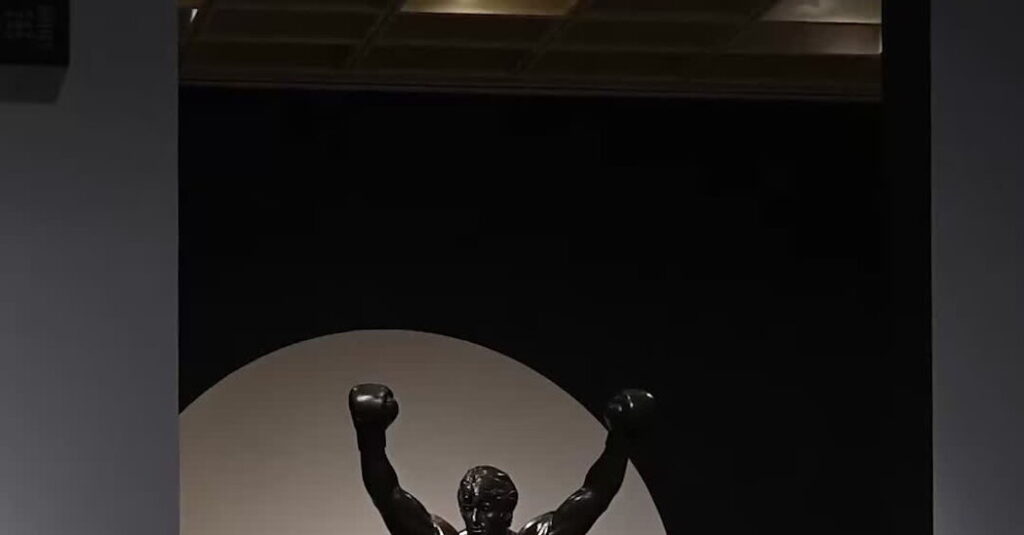
It’s only after “Rising Up” has taken the time to give Frazier his due that we finally come upon the Rocky statue itself, appearing inside the museum for the first time. Three large versions of it, about 120 percent of life size, were made before Schomberg destroyed the mold. The one in the show has been moved from a spot at the bottom of the museum’s grand outdoor staircase that will soon be occupied by a statue of Frazier. The second, now at the top of those steps, is owned by Stallone, who bought it at auction in 2017 for $403,657. The third is on view at Philadelphia International Airport (where Farber, true to the populist nature of the show, hopes to sell the excellent “Rising Up” catalog).
For years, the leaders of the museum, and other guardians of high culture in Philadelphia, scoffed at the idea that Schomberg’s statute deserved a place inside the museum. (“Rocky” got a similar treatment from film critics; in The New York Times, Vincent Canby called it a “sentimental little slum movie.”) And even if that attitude looks shortsighted in retrospect — why would any museum turn up its nose at one of the world’s perfect machines for attracting crowds? — the statue does lose something by moving indoors.
Outside, it occupies a truly public and communal space. It’s accessible without a ticket. No guard will tell you not to touch it. The way the public engages with it creates a vibrant Philly spin on a miniature piazza, often thronged: Wait in line, step up, raise arms, step aside to make way for the next Rocky fan.
Inside, without that ritual playing out in front of you, it’s easier to focus on the statue’s middling artistic quality, which isn’t terribly surprising given the circumstances in which it was made.
(You may also notice, with Rocky standing alone in a dramatic spotlight, that the boxer’s facial expression doesn’t match his victorious pose. His arms are up but his face hangs down. He looks thoughtful, quiet, maybe even a bit blue. We’ll come back to this quality shortly.)
But Farber and his collaborators — Louis Marchesano, Caro Campos and Joslyn Moore — haven’t organized “Rising Up” to make a case for the statue’s virtuosity. Instead they’re fascinated by the compelling and complicated stories — about power, about fame, about Philadelphia’s sense of place — that have always swirled around it. These are stories that Farber, a native of the city, knows well. He explored them at length in “The Statue,” a 2023 podcast he produced with the radio station WHYY that helped break the logjam of opposition at the museum to bringing Schomberg’s artwork in from the cold.
Several pieces in the final galleries of “Rising Up” offer commentary on masculinity, starting with the way many men fight their battles alone. (One section is labeled “Shadowboxing.”) Bombast here gives way to a more contemplative and critical tone, framing the acts of men who suffer silently or act out violently.
This stretch of artworks — by Cassils, Paul Pfeiffer, Kevin Jerome Everson and Derrick Adams, among others — is enough to lead any visitor paying careful attention, and especially any male one, to reflect on the way he moves through the world. Our impulse, flashing back to Rocky’s own expression, is suddenly less to raise our arms in triumph than to look for the nearest mirror. Or therapist.
Among its many other strengths and surprising tributaries, “Rising Up” turns out to be the museum show American men didn’t know we needed.
Rising Up: Rocky and the Making of Monuments
Through Aug. 2 at the Philadelphia Museum of Art, 2600 Benjamin Franklin Parkway; 215-763-8100, philamuseum.org.
The post Rocky Has Entered the Building appeared first on New York Times.