No one gets punched in the face during regular training at the Harvard Boxing Club. But this was fight night, and the jabs, hooks and uppercuts were suddenly very real.
Boxers passed the time before their bouts by meditating, jumping rope or punching at mirrors.
Amid this commotion, Ryan Jiang, a Harvard University freshman, sat alone on the floor. He was on his phone, watching a sparring video he had found of the boxer he was scheduled to fight that evening, trying to learn something, anything, that could help him in their match.
“He throws a mean right hand, that’s what I’ve learned,” he said ruefully. Mr. Jiang is a self-effacing 19-year-old, weighing about 160 pounds, and studying applied mathematics. He awoke the morning of the fight with a racing heart. “I’ve been nervous all day.”
His opponent, Colin Brazas, a senior from the Babson College Boxing Club, was across the room, pounding his right hand into a heavy bag, making thuds like someone beating a rug with a bat.
The Harvard boxing program dates back to the mid-1800s. Theodore Roosevelt and John F. Kennedy were Harvard boxers. After some lean years, the club is on an upswing, with dozens of new members. Thanks to a new coach and a rising interest in boxing, both at Harvard and nationally, students who live much of their lives online are gravitating to one of the ultimate in-real-life activities.
Five Harvard students were scheduled to box at Babson, in one of the club’s biggest tests in years. It was late that evening when Mr. Jiang, wearing black trunks and a light sweat on his neck from warm-ups, made his slow walk into the gym. To reach the raised boxing ring, he climbed four stairs, not unlike those to a gallows.
Mr. Brazas entered next, marching swiftly. He was the same weight as Mr. Jiang, but broader. His entrance song, “S&M” by Rihanna, played through the gym, and the crowd of several hundred chanted his name. He bounced off the ropes like a pro wrestler.
The bell rang, and Mr. Brazas attacked in a flurry. That right hand slammed once into Mr. Jiang’s ribs, and then twice against his head.
Coming out of the Covid-19 pandemic, Harvard’s boxing club lacked a coach, and student captains led the training. “It was quite empty, to be honest,” said the club’s president, Aram Bagdasarian, a Harvard junior.
A new benefactor took notice: Mario Cader-Frech, 62, a former Viacom International executive who happens to drive racecars and appreciates what boxing does for hand-eye coordination.
Mr. Cader-Frech first joined club workouts in 2017 while studying at Harvard Divinity School, he said. When he later learned the club had fallen on hard times, he figured “it needed some funds to retain a coach that could glue it together.”
He donated to the club and found a longtime Massachusetts boxing trainer, Joe Lake, to take the job in 2024.
Mr. Lake is not typical Harvard stock. Born in Boston, he lost his mother when he was 13 and was on his own by 15. “The gym was like a day care center when I was a kid,” he said in an interview. “We just learned how to box. I did that until I lost a finger.”
That finger was blown off when someone pointed a gun at him after a bar fight and Mr. Lake tried to grab it. He could no longer box, but he could coach. He trained some successful fighters, including Dana Rosenblatt, a middleweight and super-middleweight who fought professionally from 1992 to 2002.
Mr. Rosenblatt was amused that his old trainer had landed at Harvard.
“It doesn’t really suit Joe’s overall demeanor,” he said in an interview. “He’s a street dude, a street kid, but he’s been really successful.”
Mr. Lake, 68, said that returning Havard boxing to its former glory presented a compelling new challenge. “And I have always liked a challenge,” he said.
Harvard’s club trains in an exercise room on campus. Mr. Lake works with individual students, catching their punches in padded mitts. He is always correcting, admonishing, praising.
“Keep those hands up,” Mr. Lake barked during one recent practice, to Jacqueline Pena Gomez, who was preparing for her first sparring match. “Letting that hand down is a bad habit.”
The next time it happened, he swung a mitt toward her, freezing it beside her ear. The message: In a match, an opponent might have landed a blow.
She fired more punches into his mitts. Then she ducked, moved away, protected herself, reset and fired another combination. “That’s it! That’s it!” Mr. Lake shouted.
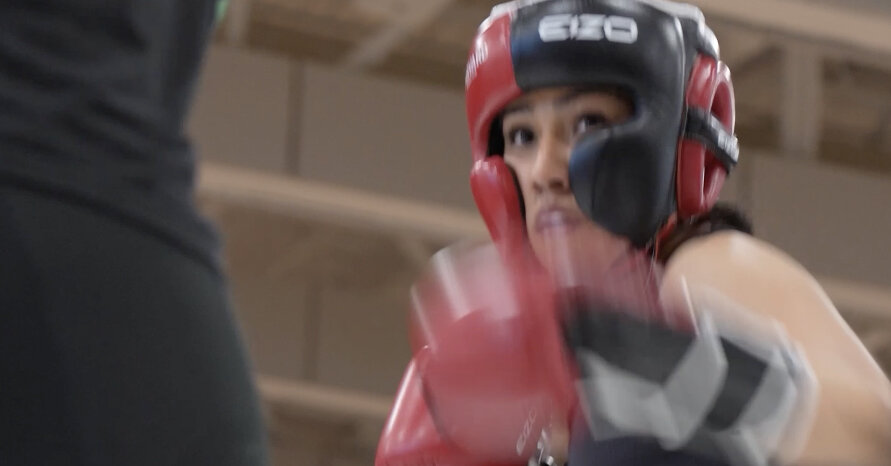
Her opponent at the Babson fight night was her Harvard teammate Muskaan Sandhu, 18, a freshman, who had sparred before. No one likes getting hit, Ms. Sandhu said, but she liked learning that she could take a punch.
It made her feel she could do anything. “After the fight, I never felt so capable in my life,” she said.
Modern life — lived on screens or amid the constant distraction of screens — can feel isolating. She sees boxing as a way to engage with people. “You feel really human,” she said. “You feel a connection with the person you’re fighting. Like we’re in this together.”
Mr. Lake said he intended for Harvard’s club to join the National Collegiate Boxing Association, a nonprofit that provides structure and safety rules. The N.C.B.A. represents about 840 athletes, an 18 percent increase from a year ago, said the group’s president, George Chamberlain, who coaches the University of Iowa’s boxing club.
The well-attended fight night at Babson, which also included boxers from Brandeis University, reflected the growing interest.
Before it began, a volunteer passed out waiver documents. Most of the boxers immediately flipped to the end and signed. Mr. Jiang, of Harvard, appeared to be the only one who read it.
He was a mixed martial arts fan who resolved to try a combat sport in college. “I like the technique side of it,” Mr. Jiang said of boxing, “the science behind the sport.”
His fight plan, he explained, was to control the action with his jab and occasionally throw the right hand, to maintain good defense and try to tire out his opponent.
It seemed a solid strategy — though, as the heavyweight Mike Tyson famously noted, everyone has a plan until they get punched in the face.
Facing an onslaught of punches at the opening of the fight, Mr. Jiang tried to escape and defend himself. The crowd howled at the wild action. Mr. Jiang held Mr. Brazas in a defensive clinch.
The referee broke them up. Mr. Brazas came back with another barrage. Mr. Jiang held his gloves over his face, absorbing multiple blows. They clinched again.
Then Mr. Jiang slipped away. When Mr. Brazas advanced once more, Mr. Jiang threw his jab, ducked, moved, threw the jab again.
He was finally executing his plan: keep throwing the left jab and follow up with his right hand when the opportunity was there.
The bell ended Round 1, of three.
A cheerleader strutted through the ring holding a sign for Round 2. The opening guitar riff of “Welcome to the Jungle” blared through the gym.
In Mr. Jiang’s corner between rounds, Mr. Bagdasarian fanned him furiously with a towel. “Keep sticking that jab!” Mr. Lake said.
Round 2: Mr. Jiang took a couple of hard right hands, but then blocked a third. He fought his way out of a corner and connected with a left hook. He evaded some more punches and relied on his jab.
It was the final round. The fighters traded jabs early. Then Mr. Jiang went on a run, landing one shot after another. The two boxers finished almost in slow motion, fighting fatigue as much as each other. Mr. Jiang collapsed in exhaustion on the top rope after the bell.
The judges rendered their verdict.
The winner: Mr. Jiang of Harvard. He raised his hands, hugged Mr. Brazas and then walked slowly from the ring and into the arms of teammates. Mr. Brazas called him “a great fighter” after their bout.
“He’s such a puzzle,” he said. “I couldn’t figure him out.”
Mr. Lake was pleased by Mr. Jiang’s perseverance. “Ryan learned a little something about himself,” he said. “Something you can’t learn from books.”
Mark Arsenault covers higher education for The Times.
The post The New Harvard Trend? Getting Punched in the Face. appeared first on New York Times.