“The Lost Boys,” the new musical based on the 1987 film of the same name, starts with an old TV set playing an address from President Ronald Reagan. “Freedom, the rule of law, economic prosperity and opportunity,” Reagan says through a staticky screen. “But all these depend upon the strength and integrity of the family.”
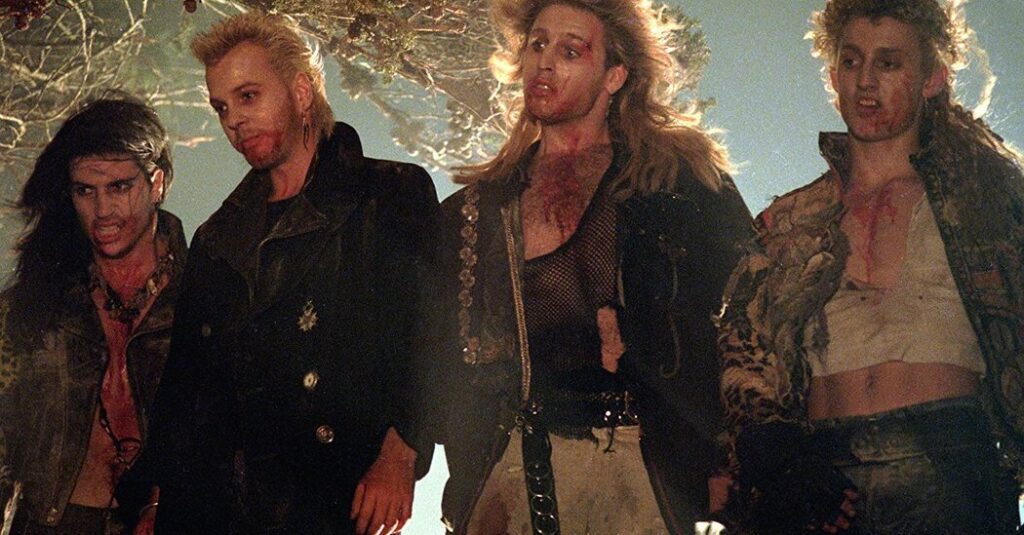
This is just one way that the musical, which leads this year’s pack of Tony nominees, picks up on a theme not immediately apparent in a movie about ’80s punk rock vampires in a California beach town. “The Lost Boys” is one of the cult classics of the decade, a perfect combination of beloved creature-feature flicks of the era like “The Evil Dead” and “An American Werewolf in London” and kid-led adventure quest movies like “The Goonies.” Featuring a cast of ’80s poster boys including the two Coreys (Feldman and Haim) and a young Kiefer Sutherland, the movie boasted an eye-catching aesthetic that was equal parts chaotic punk and West Coast chill. But beyond the big hair, big shoulders and single dangly earrings, “The Lost Boys” is also a tale about the dissolution of the American nuclear family.
The Reagan clip heard on Broadway is from his 1986 radio address to the nation on family values. Reagan, who also once said “as the family goes, so goes the nation,” was in the White House during a dramatic time of change on the American home front. In the 1980s divorce reached a new peak and became much less stigmatized.
And so “The Lost Boys” begins with a recently divorced mother, Lucy Emerson (Dianne Wiest), and her two sons, Michael (Jason Patric) and Sam (Corey Haim), moving from Phoenix to Santa Clara, Calif., the “murder capital of the world.” They’re going to live with Lucy’s eccentric father, who observes that she seems to be the only woman whose situation hasn’t been improved by divorce. It’s a quick moment of foreshadowing: Lucy’s divorce is what causes the move, and her status as a divorced mom is what causes the family to become targets of the Santa Clara vampires.
Their new hometown seems to represent a kind of twisted Neverland, to use the metaphor of the film’s title: Santa Clara is overrun with kids and teens. And the vampires roam among them, choosing their victims at will. They are the Lost Boys, the lawless juveniles of the Peter Pan tale who are forever young, living without parents or adults. Their punk-rock style and coded queerness further emphasizes them as being at the margins of what Reagan defined as the bedrock of society: a traditional American family.
All of this contributes to what makes the vampires appealing to Michael. One of the through lines for his character is his adolescent resentment at being a substitute male guardian in the family dynamic. Lucy relies on him to act responsibly and help out with watching Sam, which Michael brushes off with the usual huffiness of a teen older brother. Max, Lucy’s new employer and would-be beau, greets Michael as the “man of the house,” but Michael is seduced by the vampire gang because it offers him a community without the same responsibilities of the nuclear family. During his transformation into a bloodsucker, Michael is not only alienated from his family, he becomes a threat to their safety.
So the movie’s big final twist — that Max is the head vampire behind the Lost Boys — is as much about Max being the one who will bring back a traditional, patriarchal family model as it is about him being undead. Early in his courtship of Lucy he questions her parenting, suggesting that her sons are undisciplined and in need of a strong father figure. He affectionately calls the vampire brood his “boys” and reveals that he was planning for Lucy to be their new mother.
The Lost Boys aren’t as lost and parentless as they initially appear. Though they’re outsiders, they still aspire to be part of a unit resembling a family — what one of Sam’s amateur vampire hunter pals comically describes as “the bloodsucking Brady Bunch.”
During the film’s final confrontation, David (Sutherland), the mulleted leader of the Lost Boys, fights one-on-one with Michael. Even as they’re locked in a midair battle, David still tries to coax Michael over to his side, reminding Michael that his blood is in his veins from Michael’s vampire initiation. He argues that because of this blood bond they are already kin. They’re the same. After all, family is determined by blood, right? But this works both ways: As Michael gives David the death blow, he reminds David that he also has his own blood, the Emerson family blood. That’s enough to fight this unnatural merging of families.
By the final scene, the house is wrecked and the vampires are vanquished. It’s a symbolic rejection of the domestic model Max stood for. In the end Lucy, Michael and Sam (and Grandpa) are back at the place where they started — a single mom and two kids — and are infinitely better off for it.
Maya Phillips is an arts and culture critic for The Times.
The post ‘The Lost Boys’ Helped Define the ’80s in More Ways Than One appeared first on New York Times.