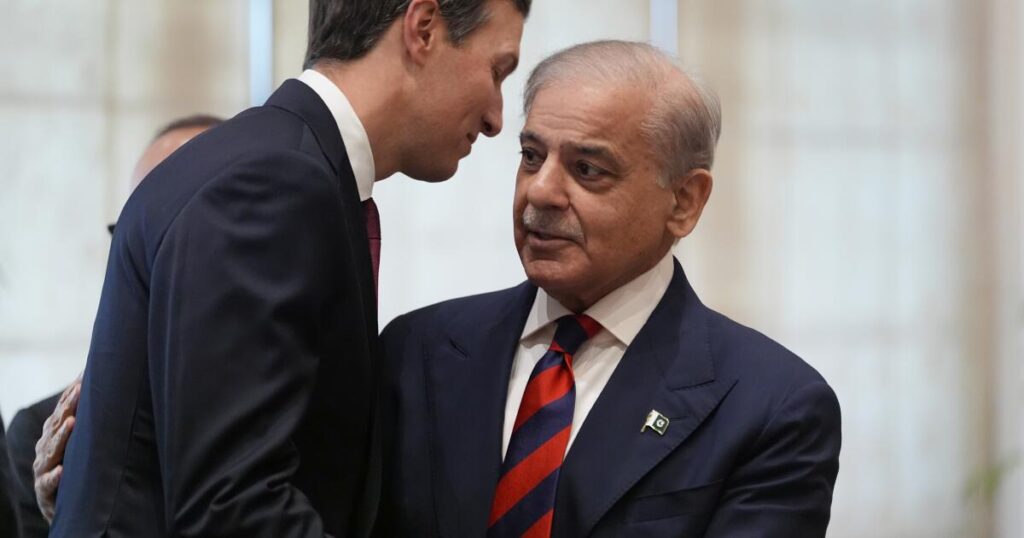
President Trump’s son-in-law Jared Kushner recently conducted some high-stakes diplomacy in Pakistan to bolster a delicate ceasefire with Iran, this despite having no formal job or title in the administration, no legislative confirmation and significant business ties to Israel, Saudi Arabia, Qatar and the United Arab Emirates, four countries directly affected by the war.
In an October interview with CBS News, Kushner sought to reframe his conflicts of interest as “experience and trusted relationships that we have throughout the world,” as if the billions of dollars his investment fund has taken from Middle Eastern governments doesn’t raise questions about whose interests he’s advancing.
Kushner, it turns out, is not the only one with a blind spot.
When I mention to Americans that I lived in Nigeria for four years, where I directed government-funded anti-corruption programs for the U.S. Agency for International Development, it often elicits vaguely coherent jokes about Nigerian princes and scams. It’s true, Nigerian society has been badly disfigured by corruption. But an honest look at how U.S. government resources have been redirected for private gain reveals uncomfortable truths about a country that is in some ways more corrupt than Nigeria. Yet we fail to appreciate the effects of corruption here, particularly its insidious contribution to breaking the trust Americans have in each other. The joke is on us.
I first crossed into Nigeria as a young journalist about 20 years ago in the worst way possible — by land. It was a bit like running an obstacle course, with less running and more bribing. A half-dozen men on the side of the road each proclaimed to be passport control, and each confiscated my documents until I “dashed them small,” donating a few dollars to their wallets.
There’s something inherently anxiety-inducing about having your passport repeatedly held for ransom, even for a pittance. But the stress of my ordeal was greatly alleviated by an unexpected source: women at the nearby market, each with bowls of fresh fruit balanced on their heads, hissing and complaining fearlessly to the venal men that if they kept up their shenanigans, “they,” meaning foreigners like me, “won’t come back.”
The women’s protests were my first demonstration of a hidden truth about corruption in Nigeria — that there’s nothing Nigerian about it. Contrary to the clichés about online schemes and tricks, it’s not somehow inherent to Nigerian culture. Nigerians — even the elites, though usually with less sincerity — talk about corruption with disgust, a sentiment backed up by a Chatham House survey published last year that found 88% of Nigerians believe that bribery and the misappropriation of public funds are unacceptable.
As the anthropologist Daniel Jordan Smith has observed, “Nigeria’s is as much a culture against corruption as a culture of corruption.”
Corruption in Nigeria is pervasive enough that it has pushed ordinary people toward homegrown organizations they can trust. My visits to the small food stall across the street from my house in Abuja would sometimes coincide with the daily rounds of the local esusu, a man named Hassan who collected earnings from participating shops to pool into an informal savings and loan club.
The food stall owner had known Hassan since they were both in primary school. That long history, along with accumulated faith in Hassan’s character, knowledge about his communal ties and confidence in his accessibility, mattered. By contrast, the big-name banks were seen as foreign entities, which many in fact were, catering to the ogas, Nigeria’s wealthy and connected.
Meanwhile, outrage in the U.S. over Kushner’s murky status and his conflicts of interest amid the talks in Pakistan was relatively muted. His participation didn’t dominate evening talk shows or headline newspapers, as corruption scandals in Nigeria regularly do.
To be sure, one example of an egregious Trump-world conflict doesn’t mean the U.S. has become Nigeria. There are still meaningful differences between the countries. Whatever appearance of corruption Trump has helped normalize among the political and economic elite, the average American can still call the police and have them arrive without a demand to cover the officer’s gas.
But it’s still useful to think of Nigeria as a harbinger. Nigerian society is so tragically riven by corruption that citizens don’t much trust anyone outside of their families and neighbors. According to the Chatham House survey, while Nigerians generally distrust anything having to do with the government, a comfortable majority — about 66% — trusted those around them. People like Hassan, the esusu. Nigerians believed it was at least moderately likely that a neighbor who found a lost bag of valuables would return it.
Corruption, we like to think, happens in faraway places. But the United States is heading in the direction of Nigeria, not Norway. The U.S. recently received its lowest score ever, 64 out of 100, on Transparency International’s Corruption Perception Index. In related news, a recent Pew survey showed that Americans’ level of trust in each other has declined, continuing a downward trend going back to the 1970s. As social scientist Robert Putnam has documented in recent years, we’re now in a vicious circle in which disengagement and less civic oversight reinforce each other. We’re becoming, like Nigeria, a country that keeps telling itself a story about democratic participation, with less and less conviction each time.
I once asked my Nigerian neighbor Agnes why she had decided not to vote. “Because they just chop everything,” she said, using the verb as a metaphor for taking. It’s also the sentiment, in a different idiom, of an increasing number of Americans estranged from one another. We think of Nigerian corruption as a joke. We should take it as a warning.
Daniel Morris is a former U.S. diplomat who led USAID’s governance, conflict and anti-corruption work in Nigeria from 2020 to 2024.
The post Americans are in no position to joke about Nigerian corruption appeared first on Los Angeles Times.