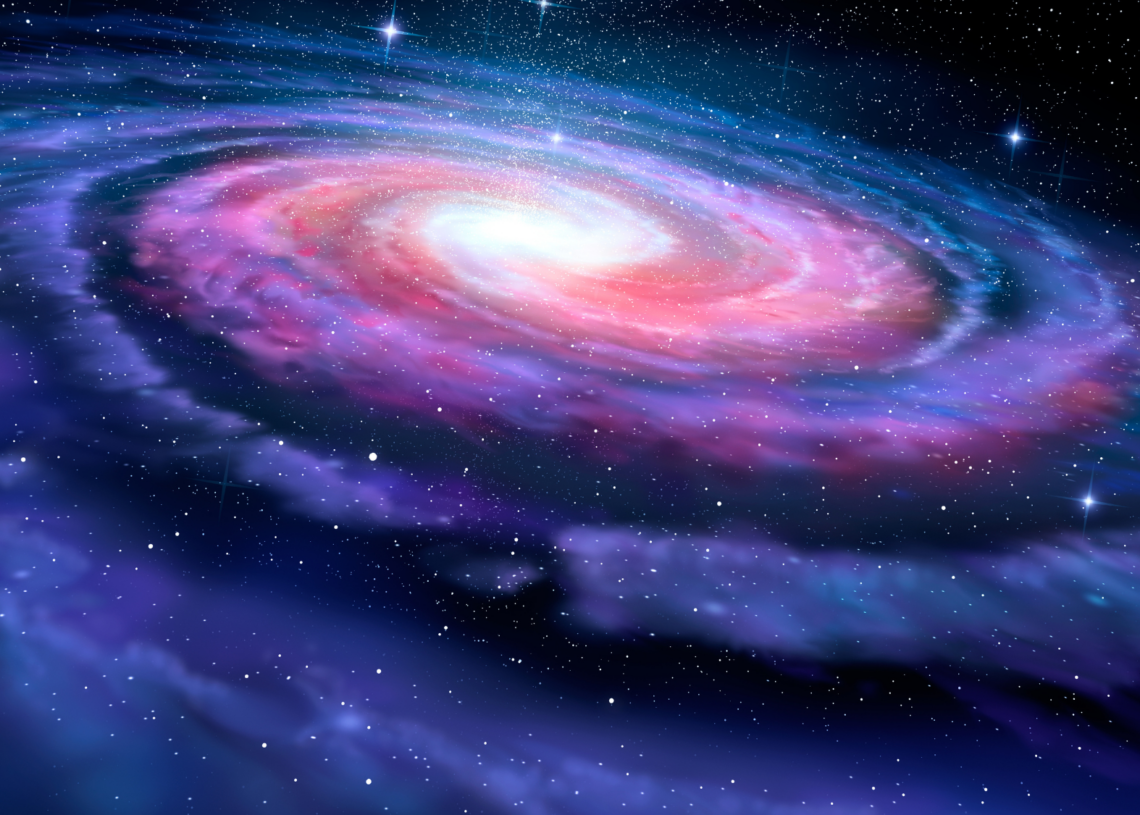
It appears scientists just discovered a classic galaxy within a galaxy situation. We live in the Milky Way galaxy, a stable spiral galaxy with hundreds of billions of stars looping around and around in a circle so vast that most of us can’t even comprehend it, like a gargantuan space hurricane. According to a study recently published in Monthly Notices of the Royal Astronomical Society, and detailed by Phys.org, somewhere buried deep inside our galaxy are the remnants of a long-lost dwarf galaxy that they’ve nicknamed Loki, a fitting name considering this trickster galaxy has been hiding in plain sight for billions of years.
The evidence comes from a small group of 20 unusual stars located in the Milky Way’s galactic plane. These stars are “metal-poor,” meaning they lack heavier elements like iron. That’s a telltale sign of extreme age, since the earliest stars in the universe were mostly hydrogen and helium, only later producing heavier elements through nuclear fusion and in meeting their ultimate end by getting blown to bits.
The stars were old and weird, at least on a chemical level. Researchers found signatures of violent cosmic events like supernovae (a big star explosion), hypernovae (a rare but also big star explosion), and neutron star mergers (self-explanatory). What they didn’t find was evidence of white dwarf explosions. This means that since white dwarfs take billions of years to form, the lack of a work dwarf suggests that the stars came from a system that didn’t live for too long, likely a small dwarf galaxy that lived fast and died young.
How Did the Milky Way Eat Loki?
The idea here is that Loki is a dwarf galaxy that merged with the Milky Way galaxy early on in its formation, back when everything was just a bunch of dust and chemicals, which would explain an odd detail the researchers noticed: the stars orbit in mixed directions, meaning some were moving with the galaxy’s rotation and others were moving against it.
That makes sense. After all, the Milky Way grew by consuming smaller galaxies, absorbing their stars into its structure, but most of those remnants were found in the outer halo of the Milky Way galaxy, and not embedded in the galactic plane itself.
None of this is confirmed just yet, but if it is one day, it would act as a kind of galactic fossil, evidence of the Milky Way’s early days preserved in one of its busiest celestial neighborhoods. Future research will need to gather together bigger datasets to confirm whether this hidden galaxy is actually there or if it’s just space noise we’ve misinterpreted.
The post Astronomers Say Something Massive Is Lurking Inside the Milky Way appeared first on VICE.