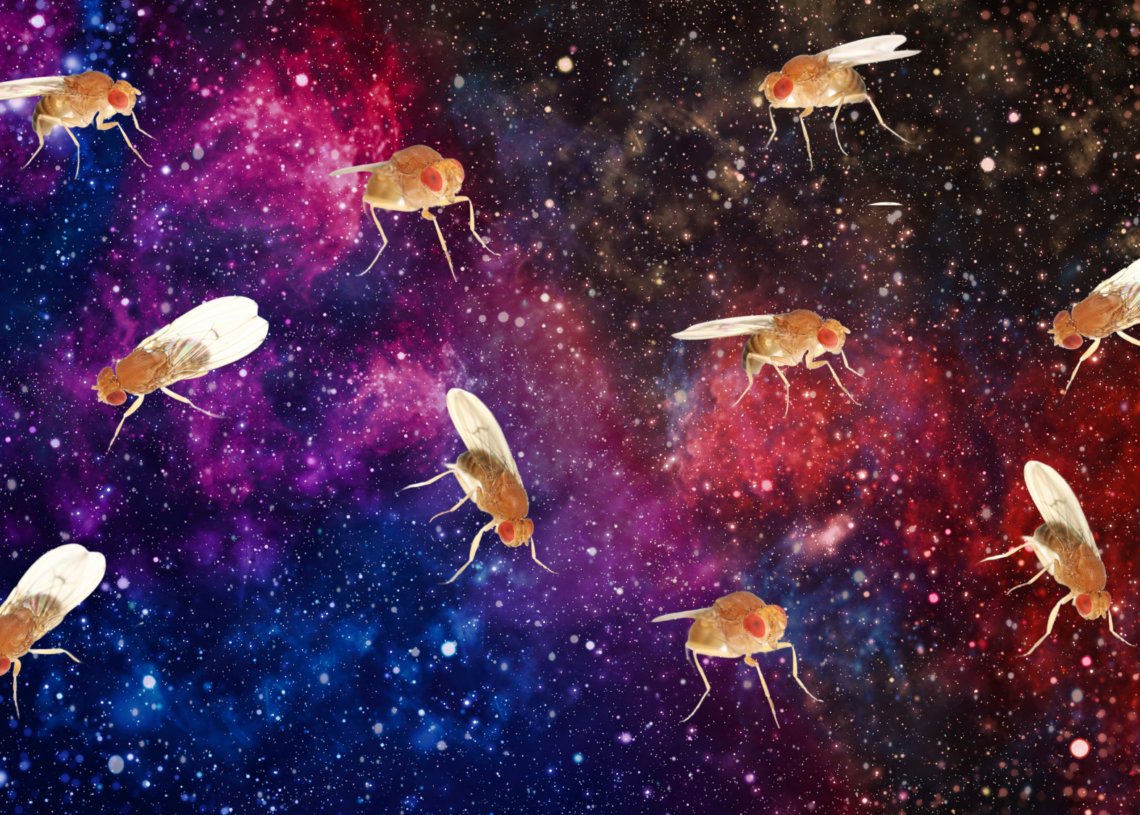
If humanity collectively wants to live among the stars someday, we’ll have to figure out what we can take with us and whether it can survive the trip. That’s why researchers run weird experiments on living things, from plants to animals. According to a study published in the Journal of Experimental Biology, scientists at UC Riverside decided to stress-test one of Earth’s most obnoxious creatures, the fruit fly. They exposed them to hypergravity, which is a cool term for forces several times stronger than what we experience on Earth, just to see what would happen.
Scientists expected the tiny annoying creatures to collapse under the immense pressure. They didn’t. They were just fine.
The flies survived, adapted, and had babies as if they didn’t have an unbelievable amount of gravity crushing down on them. The bugs were subjected to forces ranging from 4G to an absurd 13G. For reference, here on Earth we experience a baseline level of 1G. Astronauts at the peak of lift-off usually experience somewhere between 3 and 4 Gs.
Turns Out Fruit Flies Are Largely Unbothered by Extreme Gravity
The fruit flies were put in a centrifuge designed to simulate hypergravity. At lower levels like 4G, they became hyperactive, moving more as if their bodies were trying to compensate for the added strain. At higher levels, the opposite started happening. They slowed down to conserve energy as movement became more difficult. Regardless of the G, the fruit flies proved stronger-than-expected, and in fact, were mostly unbothered.
The researchers didn’t stop there. In longer-term experiments, some of the fruit flies in the experiment lived their entire lives under hypergravity. In one case, they even produced for 10 consecutive generations in those high-pressure conditions, proving themselves to be quite resistant to something that would be unbearable for humans.
The researchers think that the fruit flies were able to withstand such incredible pressures thanks to having stored more fat after exposure, which they then burned off as their activity levels changed. In other words, their bodies were rapidly recalibrating – ahem – on the fly.
Most space research focuses on how organisms react to microgravity, the near-weightless conditions you see astronauts floating within, as you probably saw during the recent Artemis II lunar mission. The opposite hasn’t been studied as much, though it likely needs to be if we want to master the art and science of rocket launch and reentry, and if we want to prep for future, more sci-fi scenarios where humans might face intense gravitational forces on other planets.
The post Scientists Crushed Fruit Flies With Extreme Gravity. Something Strange Happened Next. appeared first on VICE.