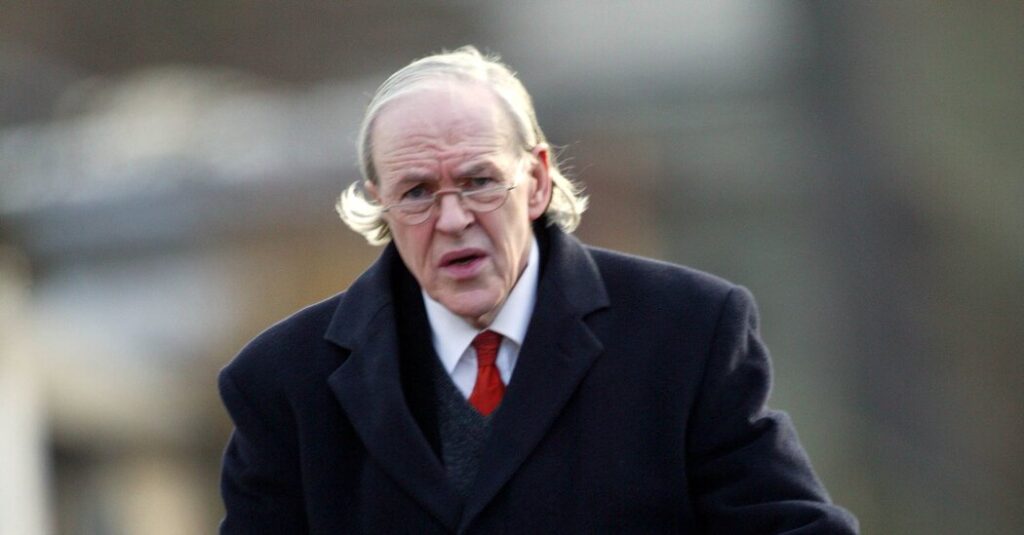
J.H. Prynne, an enigmatic poet who became a cult figure — and, to some, one of Britain’s most inventive literary voices — despite an aversion to giving interviews or readings or doing much of anything to help readers navigate his richly intellectual, at times impenetrable works, died on April 22 in Cambridge, England. He was 89.
His death, in a hospital, was announced in a statement by Gonville and Caius College at Cambridge University, where he taught for five decades and served for nearly 40 years as the college’s librarian.
Mr. Prynne was hailed as a leading light of the so-called Cambridge School, a loose aggregation of poets who emerged in the 1960s and were known for their cerebral approach, marked by late Modernist experimentation.
While not universally embraced, or even understood, he found a loyal following among the avant-garde, as well as some in the literary establishment. The prominent British critic, novelist and biographer Peter Ackroyd wrote in The Times of London in 1987 that Mr. Prynne was “without doubt the most formidable and accomplished poet in England today, a writer who has single-handedly changed the vocabulary of expression.”
At times confoundingly complex, his work was informed by his deep knowledge of a broad range of disciplines: economics, anthropology, geology, game theory, theology, music and etymology, to name just a few. The Telegraph said after his death that he was perhaps the most learned poet since Milton.
Consider one of Mr. Prynne’s best known poems, “The Ideal Star-Fighter,” originally published in his 1971 collection “Brass.” It begins, “Now a slight meniscus floats on the moral pigment of these times, producing displacement of the body image, the politic albino.”
Even his admirers admitted that Mr. Prynne’s work could be “punishing,” as Luke Roberts observed in a critical appraisal in 2020 in The Chicago Review.
“Part of the prestige of Prynne’s poetry,” Mr. Roberts wrote, “is its much-vaunted (and perhaps equally derided) difficulty, and the usual claim about reading Prynne’s work involves the experience of bafflement, frustration, doubt, and dead-ends, all exhilarating in their own way.”
Mr. Prynne was an extremely reticent public figure; he wanted his work to stand on its own, without the distraction of an authorial persona. In that spirit, he almost never gave readings, to avoid the possibility that his performance would overshadow the written word. He also disclosed virtually nothing of his personal life and refused to pose for photographs, even for his book jackets.
Instead, Mr. Prynne made his presence felt through his prolific output. He had dozens of publications, often booklets of fewer than 40 pages, almost exclusively released through small presses.
A major collection of past work, “Poems,” published in 1999, ran over 400 pages. A follow-up, “Poems, 2016-24,” added more than 700 pages of new material to his oeuvre.
Mr. Prynne was also a literary critic, known for analyses of Wordsworth, Shakespeare and Wallace Stevens, as well as an art critic.
With his vast pool of knowledge, his work included “opaque, exquisite experiments in lyric,” The London Review of Books recently noted, as well as “long, argumentative pieces, densely intuitive, often obscure, inviting readers to consider how the poem was supposed to address the world, if it could rise to the occasion.”
If some readers were flummoxed, it was of little concern to him.
“I am frequently accused of having more or less altogether taken leave of discernible sense,” he said in a 2007 lecture. “In fact, I believe this accusation to be more or less true, and not to me alarmingly so, because what for so long has seemed the arduous royal road into the domain of poetry — ‘what does it mean?’ — seems less and less an unavoidably necessary precondition for successful reading.”
Jeremy Halvard Prynne was born on June 24, 1936, in Bromley, Kent, southeast of London, to Halvard and Sarah (Andrade) Prynne. After serving two years of mandatory service in the British Army, he enrolled at Jesus College at Cambridge in 1957.
There, he found inspiration in the work of Stevens, the American Modernist, who was “a seriously intellectual poet of cerebral focus, committed to an active intelligence of mind,” Mr. Prynne recalled in 2016 in a conversation with The Paris Review, his first substantial interview in more than 50 years.
After graduating in 1960 with a bachelor’s degree in English, he accepted a fellowship at Harvard. Lonely and penniless in an unfamiliar country, he developed a love of automats, with their coin-operated food vending machines.
“They were completely impersonal,” he told The Paris Review, adding: “I remember thinking: ‘I have rather few personal connections in this world. How far through this world could I go without exchanging a spoken word?’”
He returned to Cambridge, where he was appointed a fellow at Gonville and Caius in 1962. That same year, he published his debut collection, “Force of Circumstance and Other Poems,” which he disowned almost immediately, deeming it, he later recalled, “uncomfortable, disorderly, imitative, facile, foolish, childish.”
His breakthrough came later that decade, as Mr. Prynne evolved beyond his more mannered early lyricism toward a deeper and more philosophical approach in “Kitchen Poems” (1968) and “The White Stones” (1969), an exploration of landscape, history and geology, and their relationship with thought and language.
The London Review of Books said that “the landscape of English poetry changed” after the publication of “Kitchen Poems.”
In 1969, Mr. Prynne married Suzanne Furmston, although he remained fiercely private about that development, as well. When someone he knew asked the name of his new bride, he replied, according to The Telegraph, “Mrs. Prynne.”
She survives him, as do his two daughters, Jessica and Lorna.
Despite the complexity of much of his work, “Poem 48,” included in his 2021 collection “Snooty Tipoffs,” avoids the philosophical complexity he was known for — and indeed, might be read as an acknowledgment of that complexity’s limits.
When the heart stops, its business concluded
there’s not much to do, however deluded;
immortal longings, like belongings,
abandon their fate at the turnstile’s gate.
Alex Williams is a Times reporter on the Obituaries desk.
The post J.H. Prynne, Erudite and Elusive British Poet, Dies at 89 appeared first on New York Times.