KYIV — Ukraine and Russia agreed Friday to a three-day halt in fighting during Russia’s annual commemoration of the Soviet victory over Nazi Germany in World War II, a pause to begin Saturday and to include a swap of 1,000 prisoners from each side.
President Donald Trump, who announced the agreement, said both Ukrainian President Volodymyr Zelensky and Russian President Vladimir Putin had accepted his request for the truce.
“The Celebration in Russia is for Victory Day but, likewise, in Ukraine, because they were also a big part and factor of World War II,” Trump wrote on Truth Social. He said he hoped the pause represented “the beginning of the end of a very long, deadly, and hard fought War.”
Zelensky and the Kremlin confirmed the truce as part of on-and-off U.S. efforts to negotiate an end to the conflict. Zelensky said Ukraine accepted the pause as an opportunity to exchange prisoners rather than out of deference to Russia’s holiday calendar. Ukraine has used its growing long-range drone capacity to taunt Putin over the safety of Russia’s annual military parades in central Moscow.
“Red Square is less important to us than the lives of Ukrainian prisoners who can be brought home,” Zelensky wrote on X. “I thank the President of the United States and his team for their productive diplomatic involvement. We expect the United States to ensure that the Russian side fulfills these agreements.”
Russian officials also credited Trump with brokering the pause in hostilities.
“We welcome this initiative, which builds on a telephone conversation between the presidents of Russia and the United States,” said Yuri Ushakov, a longtime diplomatic adviser to Putin.
Putin and Trump had “emphasized that our countries were allies during World War II and discussed the possibility of a ceasefire during Victory Day celebrations,” Ushakov said.
The agreement followed a week in which both countries traded threats to launch attacks during the holiday commemorations. Zelensky initially dismissed Russia’s call for a pause, saying Moscow wanted “a permit to hold their parade, so that they can go out onto the square safely for one hour once a year, and then go on killing.”
Putin, who previously scaled back the usual parade of tanks of armored vehicles in recognition of Ukraine’s increasing capacity to strike within Russia, reportedly floated a Victory Day ceasefire during a 90-minute call with Trump last week. Both sides accused the other of breaching two nights of uncertain ceasefires leading up to the weekend holiday, and attacks continued.
Tensions escalated Wednesday when Russian officials warned that if Ukraine attacked Moscow during the holiday, it would launch massive retaliatory strikes on Kyiv. On Thursday, it warned foreign diplomats to evacuate the Ukrainian capital to ensure their safety. The European Union and other embassies said their personnel would remain in place.
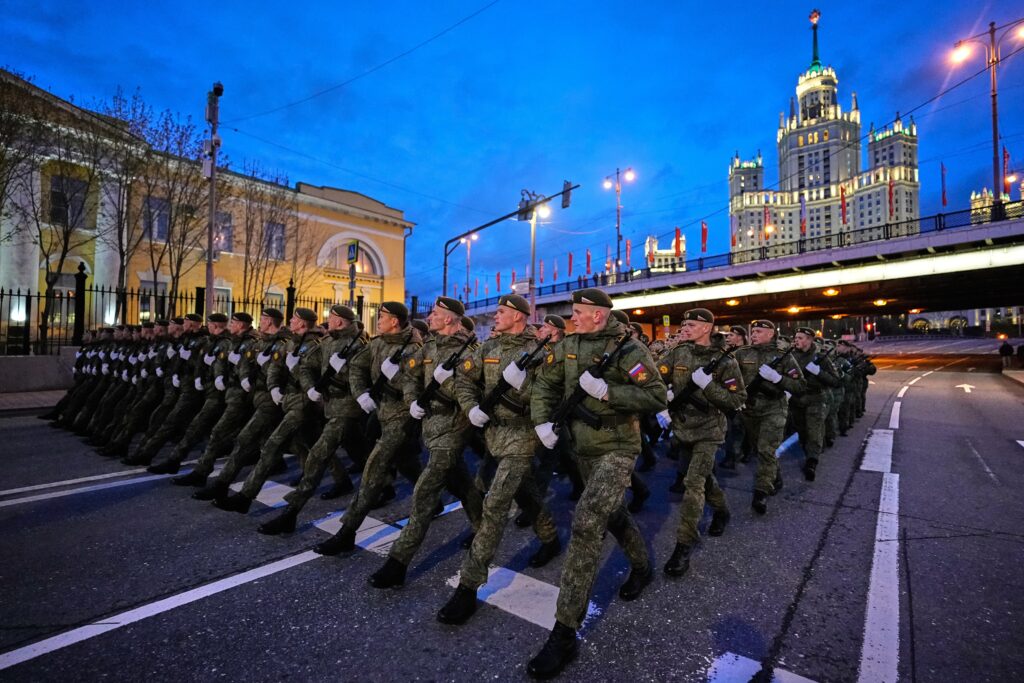
Russia’s annual May 9 parade, which honors the Soviet sacrifice in World War II, has long formed the backbone of the ultraconservative, militaristic identity that Putin has worked to forge over his quarter-century in power. Officially, the Soviet Union lost 26.6 million people in the conflict, the most of any country.
Since Putin launched the full-scale invasion of Ukraine in 2022, Victory Day has taken on new purpose: Putin and other officials have used it to stoke patriotic fervor among Russians and justify the current war.
This year’s parade will be held without a showcase of military hardware, which Russia has long used to project its might, and with fewer marching participants. The aerial display remains scheduled.
The festivities have been shadowed by signs of domestic discontent over the prolonged war, the economy, a crackdown on internet freedoms and fears of long-range Ukrainian drone strikes. Kyiv has launched attacks deep inside Russian territory, most recently striking oil refineries in Tuapse on the Black Sea.
Regional authorities across Russia announced internet shutdowns throughout May 9, and mobile connectivity in Moscow is also expected to go dark during the holiday.
Ilyushina reported from Berlin.
The post Russia, Ukraine agree to truce and prisoner exchange amid WWII observance appeared first on Washington Post.