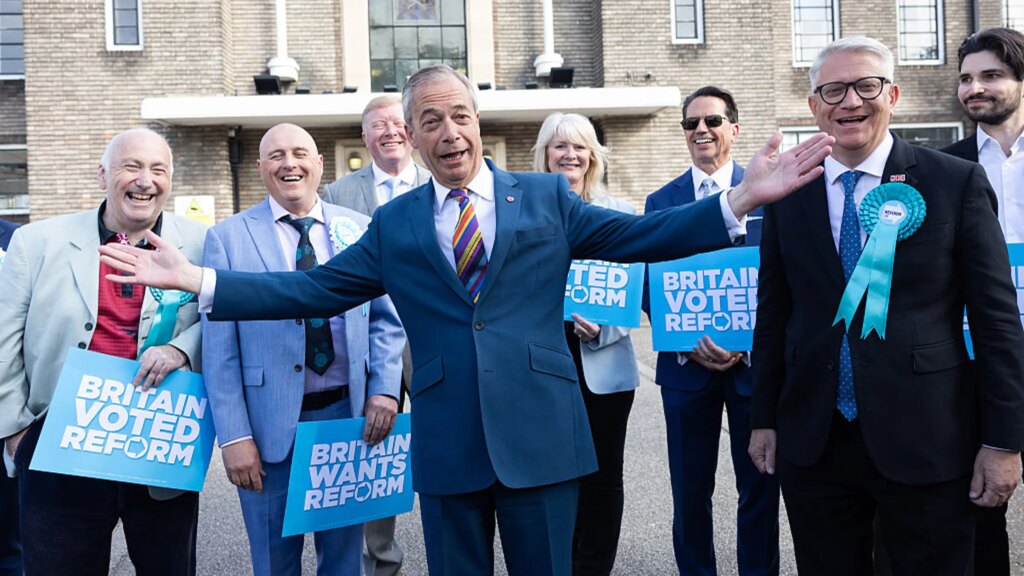
A series of key local election results across the U.K. ended with major gains for Nigel Farage, the longtime ally of President Donald Trump, while raising new questions over the future of British Prime Minister Keir Starmer after heavy losses for his ruling Labour party.
Results from local elections in England showed significant gains for Farage’s right-wing populist Reform UK party, alongside major setbacks for Labour.
Thursday’s municipal elections marked the biggest political test for Starmer since Labour’s landslide victory in the 2024 General Election, with roughly 5,000 seats contested across 136 councils in England, in addition to six mayoral races and elections for the Scottish and Welsh parliaments.
Early results on Friday showed Reform UK gaining more than 1,000 council seats across the country, while Labour had lost more than 900, with votes still being counted through Friday into the weekend.
Starmer acknowledged the outcome was “very tough” for Labour.
“These are tough results for Labour. There’s no sugarcoating it. We’ve lost brilliant Labour representatives who’ve stood up for their communities,” he said.
However, the Prime Minister ruled out stepping down. “I’m not going to walk away,” he added.
Starmer attributed the losses to a “series of economic shocks” and a “very difficult international situation.”
Farage—a longtime supporter and ally of Trump—described the results as a “historic shift in British politics.”
“We’ve been so used to thinking about politics in terms of left and right,” he said Friday. “Yet what Reform are able to do, is to win in areas that have always been Conservative, but equally, we’re proving in a big way, we can win in areas that Labour have dominated, frankly, since the end of WWI.”
Farage’s gains came largely at the expense of both major parties, with the Conservatives also losing over 400 seats.
Tony Travers, a professor of politics at London School of Economics, explained that “these are effectively midterms for the national government.”
“The Labour government has been in office for nearly two years now, and has suffered significantly from falls in its opinion poll ratings, both for the party and for its leader, Prime Minister Keir Starmer,” he told TIME.
Starmer’s Labour party has fallen significantly in national polls, with voting intention for Labour standing at just 18% nationally, second to Reform at 25%, according to YouGov.
Similarly, the approval rating of the British Prime Minister stands at 22% approval and 70% disapproval.
“Traditionally, the U.K., like the United States, had a two-party system, where the Conservatives and Labour dominated politics,” explains Travers. “In recent years, that domination has begun to fall away.”
The Green Party secured a further 250 seats, and counting, including their first directly elected mayor, with Green Party leader Zack Polanski calling the outcome an “historic victory” and also framing the result as the end of Britain’s two-party system.
“Two-party politics is not just dying, it is dead and it is buried,” Polanski said, and added that the emerging political landscape is a rivalry of the “Green Party versus Reform.”
Despite Conservative losses, party leader Kemi Badenoch insisted the “Conservatives are coming back,” describing the results as “signs of renewal,” particularly compared with the party’s poor local election performance in 2025.
Liberal Democrat leader Ed Davey similarly argued the results reflected public frustration with Britain’s two dominant parties, after his party made modest gains of around 60 seats.
“There is a sense in the whole country that Labour and the Conservatives have let the country down,” he said.
Travers explains that this has consequences for the whole of British politics, as its parliamentary system is not designed to host a wide range of parties.
“We effectively moved from a two to a five-party system,” he said. “In Scotland and Wales, where there are nationalist parties, it’s a six-party system, so it’s a much more fragmented system, making it far harder for voters to determine how to use their votes to get particular results.”
Labour’s shortcomings were perhaps best reflected in Wales, a historical stronghold for the party. Eluned Morgan, the Welsh First Minister, lost her place in the Welsh parliament (Senedd), with Labour failing to win any of the six seats in her constituency.
“I’ve lost my seat here in Ceredigion Penfro and I will be standing down as leader of Welsh Labour. I take responsibility for the Labour result in Wales,” said Morgan.
Labour’s ‘disaster’ election results lead to calls for Starmer to step down
Starmer has faced mounting pressure from both lawmakers and the public throughout his almost two years at the head of the British government.
“These results are seen as a test of the party and the Prime Minister’s popularity, and buried inside that is the possibility of a challenge to its leadership,” said Travers.
Calls are beginning to mount from within his own party. “The election results in England, Wales and Scotland are a disaster for the Labour Party,” said Labour Member of Parliament (MP) Nadia Whittome on Friday.
“With this in mind, I believe the Prime Minister should announce a timetable for his departure,” she said on social media.
Travers said that unlike the Presidential system in the U.S. the role of the Prime Minister depends on maintaining the support of his parliamentary party.
“Starmer has 400 members of parliament behind him on the government’s benches, and if they lose confidence in him, that’s it, really,” he explained.
Labour MP Jon Trickett, who also called into question Starmer’s leadership over the Mandelson crisis, said that it was “curtains for Keir,” following Friday’s elections.
“[Starmer] has been a problem for us,” Trickett told the BBC, adding that all Labour leaders have faced criticism in the past.
Leader of Scottish Labour, Anas Sarwar, has also defended comments he made earlier this year calling for Starmer to step down. “My party is hurting,” he said on Friday after Labour saw disappointing results in Scottish parliamentary elections.
“I said what I said back in February, and I stand by that,” he continued. In February, Sarwar had called for Starmer to resign over his decision to appoint Peter Mandelson as ambassador to the U.S., despite his continued communication with convicted sex offender Jeffrey Epstein.
“The distraction needs to end, and the leadership in Downing Street has to change,” said Sarwar in February.
Questions over Mandelson already posed a threat to Starmer’s premiership
The Prime Minister faced calls to step down from his position in the run-up to the election, largely due to criticism over his decision to appoint Peter Mandelson as ambassador to the United States in 2025, despite knowing that Mandelson had maintained contact with Jeffrey Epstein after his conviction as a sex offender.
Starmer has fiercely rejected claims that he misled lawmakers over such a decision, but it did not stop some from within the Labour party questioning his position.
After it was revealed that Mandelson failed a security vetting in January 2025, days before starting his term in Washington, Starmer faced questions over what exactly he knew about Mandelson’s ties with Epstein, as he claimed he was not aware of such a vetting failure.
“He cannot conceivably continue as a credible Prime Minister any longer,” Labour peer Lord Maurice Glasman told the Telegraph. “If you can’t own your mistakes, you can’t move.”
Ian Byrne, another Labour member of parliament, claimed the Mandelson vetting row is indicative of a far larger issue and argued a “toxic culture” has taken hold of “the governing of our country.”
Travers said the Mandelson scandal “contributed to the sense that Starmer wasn’t really in control” and “appeared as if it was sort of incompetent.”
The post Trump Ally Nigel Farage Makes Gains in U.K. Local Elections as Starmer’s Future Uncertain appeared first on TIME.