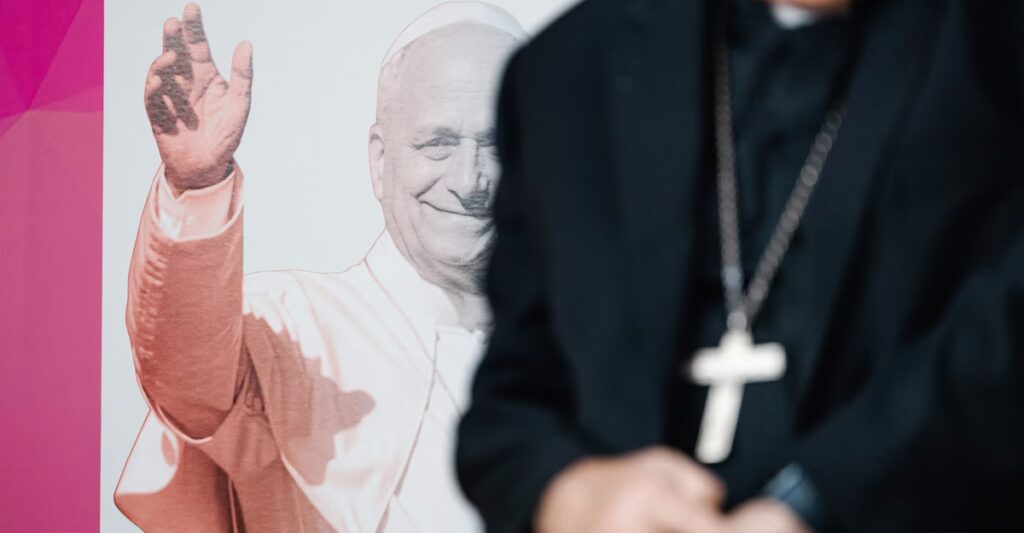
Throughout year one of his pontificate, Pope Leo XIV has been especially vocal about two issues: immigration and war. The first American pope has spoken of the “inalienable rights” of migrants and lamented the growing, global “zeal for war.” He told a delegation of U.S. clergy last fall that “the Church cannot be silent” in a time of mass deportations, and said in March, a month after the United States began attacking Iran, that God “does not listen to the prayers of those who wage war.”
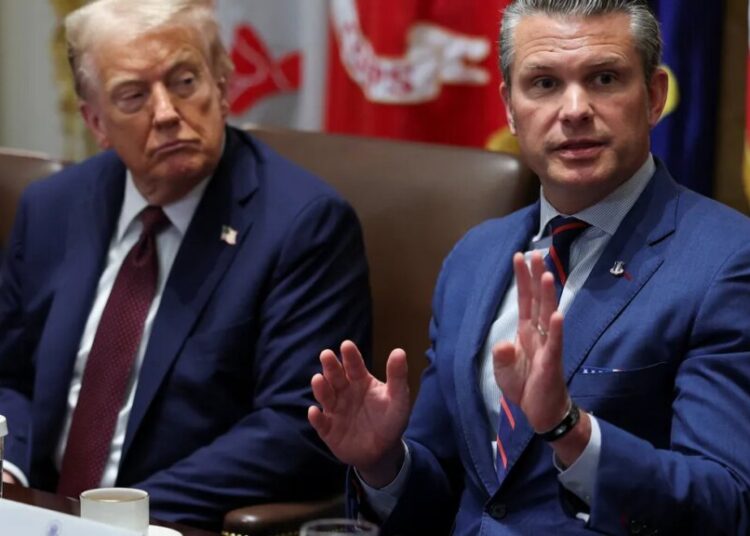
His opposition to the conflict has provoked President Trump’s ire and earned him rebukes from prominent right-leaning Christians. The Fox News anchor Sean Hannity deemed Leo “more interested in spreading left-wing politics than the actual teachings of Jesus Christ.” Vice President Vance advised the pope “to be careful when he talks about matters of theology.” Regarding the pope’s statements about immigration, the podcaster Allie Beth Stuckey accused him of confusing “toxic empathy and Biblical love.”
These critiques, however, miss something crucial about Pope Leo’s reasoning. His statements indicate that he’s not disregarding Church teaching to weigh in on political issues of the day. Instead, he’s making a moral case, rooted deeply in Catholic thought, for how the faithful should treat the vulnerable—a case that results in resisting war and protecting migrants, and also opposing abortion.
In September, for example, the pope remarked, “Someone who says, ‘I’m against abortion but I’m in agreement with the inhuman treatment of immigrants in the United States,’ I don’t know if that’s pro-life.” In a January address to Vatican diplomats, he voiced his support for Christians who defend “the unborn, refugees, and migrants.” In March, before a group of Polish faithful, the pope said that “in a time marked by the madness of war, it is important to defend life from conception to its natural end.”
[Read: The American pope vs. the American president]
The idea that being anti-abortion, being against war, and being protective of immigrants all stem from similar principles is not new. In 1983, during the Cold War arms race, Cardinal Joseph Bernardin delivered a speech in which he popularized a phrase connecting these issues and several others: “a consistent ethic of life.” It has reverberated in the American Catholic consciousness ever since.
For Bernardin, 20th-century technologies had magnified the scale at which life could be harmed. Catholics, he argued, needed a framework that would encompass the protection and promotion of life. It would decry the intentional taking of innocent life, whether noncombatants in war or, in the Catholic view, unborn children through abortion. It would also be concerned with caring for the world’s most defenseless people—among them the poor, the homeless, and “the undocumented immigrant.” Bernardin said, “Our moral, political, and economic responsibilities do not stop at the moment of birth.”
To have a consistent ethic of life did not mean conflating the distinct moral considerations raised by abortion, immigration, and war, or treating them as equally significant. Rather, it meant that a person should strive to notice the “interrelatedness” of these issues and foster a culture that cared about them all. “A systemic vision of life,” Bernardin said, “seeks to expand the moral vision of a society, not partition it into airtight categories.”
The consistent ethic of life, implicitly or explicitly, continued to crop up in Catholic circles over the subsequent years. In his 1995 encyclical, Evangelium Vitae (“The Gospel of Life”), Pope John Paul II emphasized that Catholics ought to be “profoundly consistent” regarding their solidarity for society’s vulnerable, including immigrants. The document denounced assaults on “the right to life” in the context of abortion, and the waging of violent conflicts as well.
Pope Leo’s worldview was also shaped by these ideas. In 2023, when he was Cardinal Robert Prevost, he delivered an address in Chiclayo, Peru, in which he praised Bernardin’s framework as coherent and “anchored in respect for human dignity.” The future pope described discovering ways to “teach and promote precisely this kind of thinking” as one of the “greatest challenges” facing Catholics. As his fellow prelate had done four decades prior, Prevost mentioned modern warfare and the rights of migrants, as well as abortion.
[Read: The real religious ‘renewal’ happening in Gen Z]
American Catholics have long been divided on how to be consistently pro-life. Some liberal Catholics have worried that their conservative brethren condemn abortion while ignoring issues such as poverty and immigration. Some conservative Catholics have said that liberals misuse the ethic of life “to deflect criticism away from pro-abortion politicians and those who support them,” as one writer put it. These debates reflect that Catholics, like Americans more broadly, are polarized by party, and that Catholics who do try to emulate Bernardin’s framework lack a natural political home. “Popes don’t fit into any political category in the U.S.,” Cathleen Kaveny, a law and religion professor at Boston College, told me, “and Catholics don’t really either, in terms of official Catholic teaching.”
Catholic skeptics of the pope’s remarks about deportation policies and the Iran war have pointed out that the Church teaches that abortion is “intrinsically evil”; when a country should wage war and how it should regulate immigration, however, are subject to “prudential judgments.” In a sense, they’re right. Catholics can have good-faith disagreements about how restrictive immigration policy should be, or the moral justifications of a particular armed conflict (though Church teaching says war is permissible only in very limited circumstances). But by intertwining these three issues, Pope Leo has made dismissing concerns about immigration and war as mere “prudential” matters harder for Catholics. This is not because Church teaching has changed recently—it hasn’t—but because present conditions regarding immigration and war have made a “prudential” disagreement less tenable.
[Read: The most urgent issue for the U.S. Catholic Church isn’t abortion anymore]
Immigration debates over the past year, for example, have not been solely or even primarily about optimal migrant flows or procedural requirements. They’ve been about arbitrary detentions and roundups, and about callous rhetoric and imagery. The Trump administration’s policies have threatened immigrants’ ability to practice their faith: Catholic dioceses have reported that Mass attendance is down because many congregants are afraid of being apprehended by ICE at church. Last summer, detainees at a Florida detention center were denied access to Mass for about a month. (An official reportedly told a priest that the facility was too crowded to accept visiting clergy.) Likewise, the current debates about war have not simply been about the efficacy of a given military strategy. They’ve also been about the administration’s apparent disregard for the safety of noncombatants, as demonstrated by Trump’s threat that “a whole civilization will die tonight.”
Abortion—a “pre-eminent priority,” according to U.S. bishops and for many lay Catholics—clearly remains important in the pope’s mind. But Leo has clarified that other threats to the promotion and protection of life should alarm the Catholic conscience, too.
The post How the Pope Connects War, Immigration, and Abortion appeared first on The Atlantic.