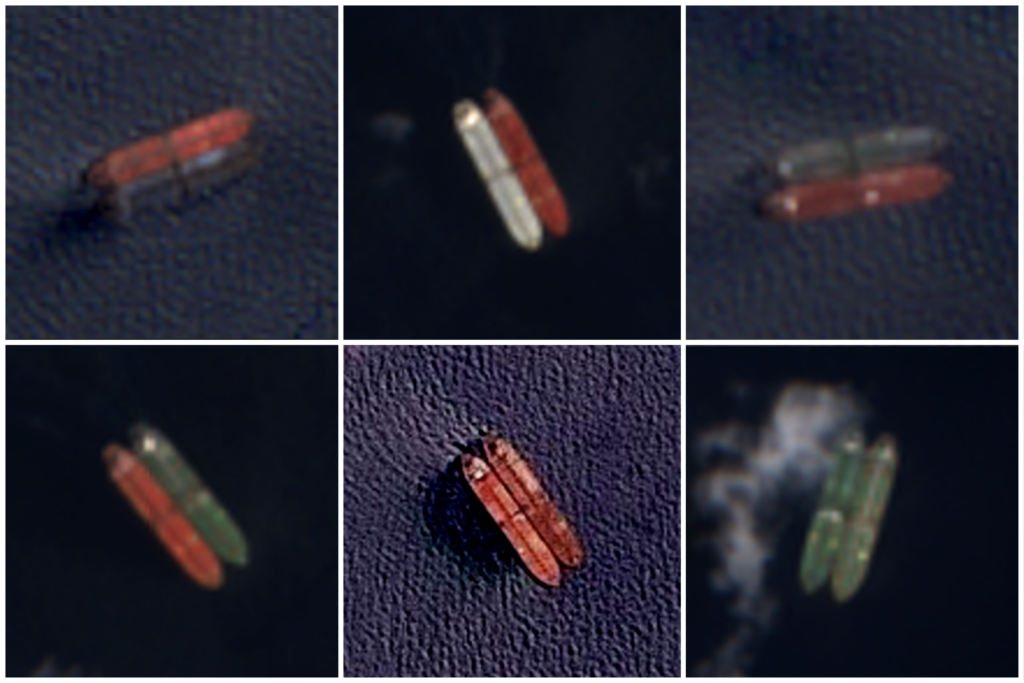
Since the U.S. blockade in the Gulf of Oman began last month, at least 13 tankers have offloaded Iranian oil in covert ship-to-ship transfers thousands of miles away, near a cluster of small islands in Indonesia known as the Riau Archipelago, according to a Washington Post analysis of satellite imagery and ship-tracking data.
The transfers are part of a backdoor arrangement that for years has helped Tehran continue to sell oil despite crushing international sanctions, experts said. While the blockade appears to have stopped new shipments of Iranian oil from escaping the Persian Gulf, the ongoing transfers allow Tehran to leave that financial spigot open, if only temporarily, as shipments that are already at sea make their way to China or other markets.
Satellite imagery since April 16 showed six laden tankers that were sailing under the Iranian flag pull up alongside six empty tankers. Seven additional laden tankers — vessels that appeared to be sailing under false flags or to have undisclosed management, according to shipping information repository Equasis — were captured in imagery next to other empty ships.
The 13 ships offloaded an estimated 22 million barrels of Iranian crude, according to the oil-tracking firm TankerTrackers, an amount potentially worth more than $2 billion at current market prices. Based on the sequence of events, the firm determined oil transfers had taken place, with the laden tankers now empty and the empty tankers now laden.
The Riau Archipelago, on the way to China from the Middle East, has long served as a waypoint where vessels stealthily exchange Iranian oil to obscure its origins, according to the maritime intelligence company Windward.
China buys more than 90 percent of Iranian crude oil, purchasing it at a steep discount but still generating revenue that accounts for nearly half of the Iranian government’s budget, the U.S. government says.
Satellite imagery is one of the few ways to determine that such a transfer has occurred, as the tankers involved rarely broadcast their locations. A single shipment of Iranian oil can sometimes undergo several ship-to-ship transfers at sea before reaching its destination, according to the U.S. Office of Foreign Assets Control. The ships involved often have opaque registration information or fly false flags.
Around 42 million barrels of Iranian oil remain floating on tankers near the Riau Archipelago, down from almost 90 million in early February, according to the global intelligence firm Kpler. “The volumes are there for now. The replenishment is not,” the firm said in a report Wednesday.
“Ultimately, the longer the blockade is in place, the fewer cargos that Iran has in place to ship to China,” said Michelle Wiese Bockmann, a senior analyst at Windward.
The financial details surrounding the sale of oil that is transferred ship to ship, including precisely when Tehran is paid, are typically opaque and sometimes deliberately obfuscated, said Petras Katinas, an energy researcher at the Royal United Services Institute, a defense and security think tank in London. Some buyers appear to pay partially in advance, while others settle once a tanker reaches territorial waters or after it reaches port, he said.
Three days after the blockade began, the U.S. Navy expanded operations against Iranian exports beyond the Middle East. In doing so, officials said, U.S. forces have the authority to stop any ship tied to Iran or suspected of carrying cargo that could help the Iranian government, regardless of its location.
The Defense Department referred questions about the ship-to-ship transfers to the White House. “The United States Military’s forceful blockade has prompted over 50 vessels to turn around or return to port – contributing to the overwhelming success of Operation Economic Fury,” a White House spokeswoman, Anna Kelly, said in a statement. “As a result, the Iranian economy is completely strangled, and President Trump holds all the cards as negotiators work to make a deal.”
The White House did not answer a question about whether the ships involved in the transfers observed by The Post are considered subject to the expanded restrictions.
Grant Rumley, a specialist in Middle East security at the Washington Institute for Near East Policy, said planners must prioritize how best to pressure Iran with finite resources. “Ultimately, this is a question of trade-offs,” Rumley said. “Interdicting all Iranian oil shipments takes time and resources that might otherwise be needed in maintaining the blockade.”
Two weeks ago, U.S. forces boarded the tankers Tifani and Majestic X in the Indian Ocean. The ships have engaged in transfers near the Riau Archipelago in recent months and were probably on their way there when they were interdicted, experts said. Both vessels were laden with Iranian crude oil, according to TankerTrackers.
“We will continue to conduct similar maritime interdiction actions and activities in the Pacific and Indian Oceans against Iranian ships and vessels of the Dark Fleet,” Gen. Dan Caine, chairman of the Joint Chiefs of Staff, said at a news briefing after the vessels were seized.
Since April 16, five additional Iranian-flagged tankers have arrived near the Riau Archipelago laden with Iranian oil, according to satellite imagery and ship-tracking data. Although satellite images do not show it offloading its cargo, one has since departed west and is empty, according to TankerTrackers. It’s not clear whether the other vessels have offloaded their cargo.
To get there from the Gulf of Oman, ships usually sail through the Strait of Malacca, a narrow and busy waterway between Malaysia and Indonesia. Ships are required to broadcast their location while transiting the strait, providing a rare but brief glimpse of tankers that normally keep their transponders off.
As of Monday, no large tanker laden with Iranian oil had transited the Strait of Malacca for 10 days, the longest gap since the war began, according to Windward.
Over the weekend, two Iranian tankers that appear to be headed toward the Riau Archipelago bypassed the Malacca Strait, traveling several days south and east toward Australia before turning north and passing through the Lombok Strait near Bali, according to satellite imagery and ship-tracking data.
The shift suggests that vessels carrying Iranian oil are rerouting away from the Malacca Strait, where visibility is greater, despite the increased journey time.
“Lombok is not improvisation,” Kpler said in its report. “It is the next step in a deliberate adaptation.”
Dan Lamothe contributed to this report.
The post As U.S. blockades Iran, its oil still flows ship to ship an ocean away appeared first on Washington Post.