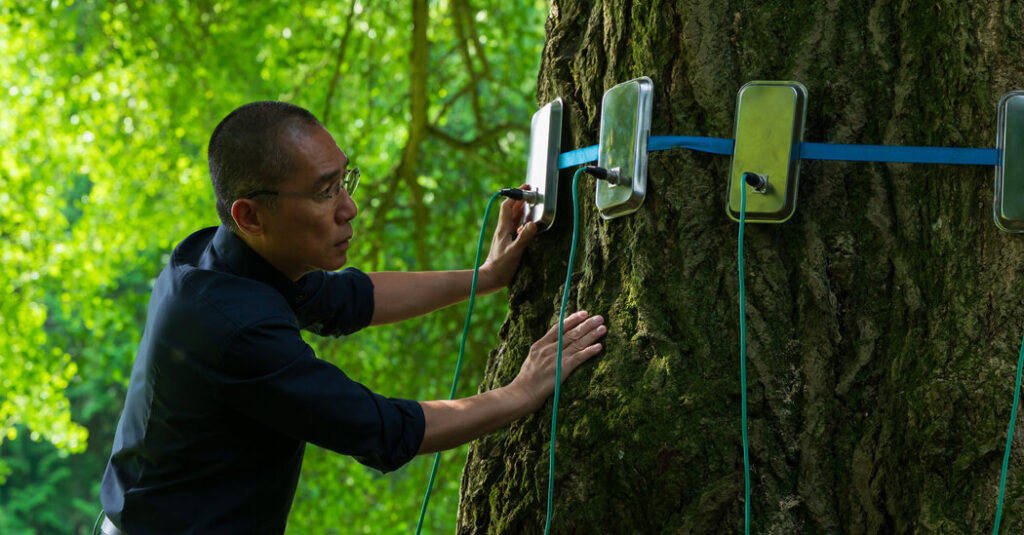
One of the three story lines in the writer-director Ildiko Enyedi’s cerebral drama “Silent Friend” unfolds in 2020, when the coronavirus lockdown stretched time out like taffy, encouraging many of us to observe our immediate surroundings with new eyes. Tony (Tony Leung Chiu-Wai), a neuroscientist from Hong Kong stuck living on the grounds of a German university, becomes fixated on a ginkgo tree during these days of solitude. But what could the ginkgo, part of an order that dates back to prehistoric times, have to teach us about ourselves?
A fair amount, Enyedi wagers.
The film, which takes place entirely in the German college town, jumps in time between Tony and two other individuals from the past. In 1908, Grete (Luna Wedler), the first woman to gain admission into the school, contends with the blatant sexism and cruel puritanism of those around her. In 1972, Hannes (Enzo Brumm), a guileless young man from a rural background, attempts to stay grounded as he encounters for the first time a new culture of sexual freedom and political unrest. Plenty of things happen, but “Silent Friend” isn’t traditionally plot-driven. It’s a film of sprawling ideas that float around like pollen, with some particles creating marvelous blooms. Others drift off aimlessly.
One of Enyedi’s acclaimed previous films, the Oscar-nominated “On Body and Soul” (2017), showcased her fascination with loners and the mysteries of human bonds. “Silent Friend” continues this line of inquiry but proves much more ambitious with its history-spanning trio of stories, in which all three protagonists evolve by slowing down and quite literally smelling the flowers. The cinematographer Gergely Palos fills the screen with dreamy images of quivering canopies and fern fronds, sometimes in psychedelic close-up. These heady interludes weave together the film’s format shifts of 35 mm black-and-white for Grete, grainy, lush colors for Hannes and silken, almost otherworldly digital for Tony.
Anthology films can often feel misshapen, and for all the intriguing echoes between the three stories, there’s also a haphazard quality to the themes. This especially detracts from the Grete story, a sort of feminist period piece with far blunter messaging than the gauzy musings of the other sections. It does, however, add a sobering element to the film’s passage of time: During her entrance exam, Grete is questioned by a smug professor about the early naming practices used to classify plants (“husbands” and “wives” described their reproductive systems). The ginkgo stays the same, but norms change: In a few decades, Hannes will be aggressively flirted with by a liberated woman; and in 2020, a Chinese man will be practicing tai chi in the gardens of a German institution from medieval times.
For a movie with such a green thumb, “Silent Friend” is also deeply preoccupied with technology as a tool for creating new ways of seeing and feeling. Tony strikes up something of an intellectual romance with Alice (Léa Seydoux), a botanist with whom he communicates entirely through video chat. Even limited to screens, their chemistry is palpable, which is a testament to the immense powers of Leung Chiu-Wai and Seydoux — two of our most sensual and effortlessly charismatic living actors.
To make sense of what those two have cooking between them is like trying to explain how plants communicate — for the nonexpert, it’s simply magic. In this more cosmic register, “Silent Friend” is bewitching. Less so as a catchall for human connection across identities and borders. There’s a cute, corny subplot involving Tony and a German groundskeeper who doesn’t speak English that dampens the wonder. Leung Chiu-Wai, forever memorable as the quiet yearner at the center of Wong Kar Wai’s “In the Mood for Love” will inevitably remind us that sometimes intimacy can feel more powerful when it’s withheld.
Silent Friend Not rated. In German and Cantonese, with subtitles. Running time: 2 hours 27 minutes. In theaters.
The post ‘Silent Friend’ Review: What a Ginkgo Can Teach Us appeared first on New York Times.