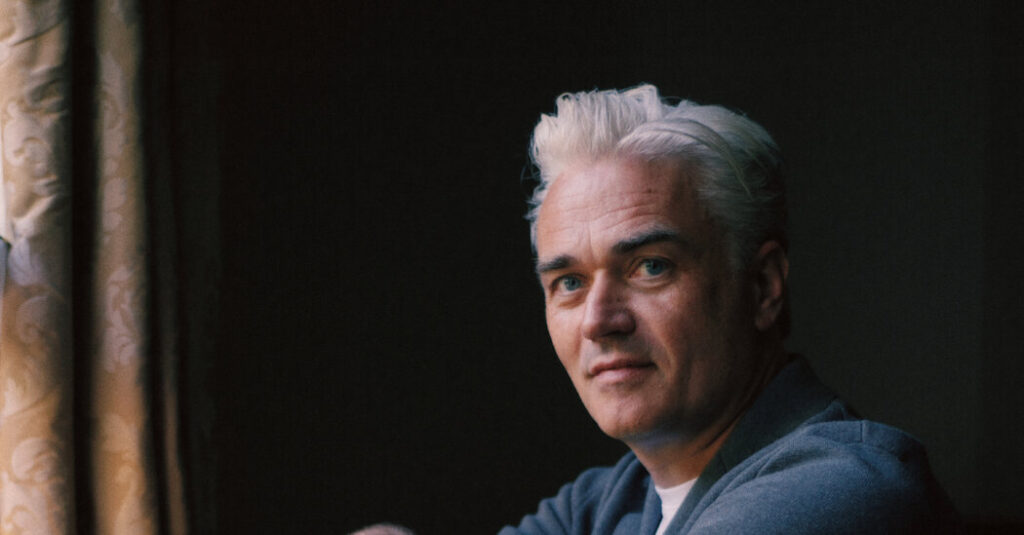
Few conductors have a more quintessentially English résumé than Ed Gardner.
He was a boy chorister at Gloucester Cathedral, then followed a familiar route into British musical society, through Eton College, Cambridge University and the Royal Academy of Music. Many of Gardner’s big breaks were in England: as an assistant to Mark Elder at the Hallé Orchestra in Manchester, and as the music director of the Glyndebourne tour and English National Opera.
It’s hard, therefore, to imagine a more fitting ambassador for his country’s music. “Where he always seems to stand out is British music, particularly as a champion of Britten, Tippett and Elgar,” Neil Fisher, an editor and critic for The Times of London, said of Gardner in an interview.
Gardner, principal conductor of the London Philharmonic Orchestra and music director of the Norwegian Opera and Ballet, has been playing his ambassador role in the United States, taking music by Holst and Vaughan Williams to San Francisco, and William Walton and James MacMillan to Dallas. This month, he conducts Walton at the Chicago Symphony Orchestra, and, in his debut with the Pittsburgh Symphony Orchestra, Oliver Knussen’s orchestral showpiece “Flourish With Fireworks.”
Gardner, 51, is discerning when it comes to programming. And where he might have previously been diplomatic — his unshakable confidence is reminiscent of a skilled politician — today, he’s more happily drawn on his opinions.
“I’m quite specific about what I love in the British repertoire,” he said in a recent interview, “and it’s not all of it.”
Right now, Vaughan Williams’s Fourth and Sixth symphonies don’t speak to him, though the Fifth, Gardner said, is “glorious.” The constantly sliding musical textures of Frederick Delius are “really tricky.” And the man who is the background of “all great British music,” more even than Britten? Michael Tippett.
Gardner won’t go near Britten’s “Billy Budd” (“almost a portrayal of emotion, rather than a felt emotion,” he said). Though commended for performances of “Peter Grimes” — Fisher described his 2009 performances at English National Opera as “one of his standout triumphs” — he has stopped performing the popular stand-alone “Sea Interludes.” “Their emotional resonance is so light compared to the pressure cooker of the opera,” Gardner said. Even if he finds a level of interpretive constraint in Britten’s music, Gardner finds the late period different: The Violin Concerto is “stellar, really extraordinary,” he said, and “Death in Venice” has a “real hinterland to it.”
Flora Willson, a music critic for The Guardian, said in an email that “at some point in the last five years or so, Gardner has gone from being a really good, reliable conductor to being an interpretative force to be reckoned with.” He is at the stage of his career in which he can afford to be more selective, dedicating more energy to the neglected, personally satisfying or ambitious.
Among his ambitious projects was a recent multimedia concert performance of Berg’s “Wozzeck” at the Southbank Center in London, as part of its Multitudes festival. It was assembled in lightning-quick time, and in those rehearsals, Gardner’s strength as a facilitator shone through, with lithe pragmatism supported by winning rhetoric.
Gardner is also preparing for his first “Ring” cycle at Oslo National Opera. (It is one of the reasons for his departure from the London Philharmonic in 2028.) He will spend three successive winters in Norway for it. “I’ll be bearded and pale by the time I’m done,” Gardner said jokingly. “Norwegian winters are a thing you have to contend with.”
For Gardner, an orchestra must be rooted in its city. Best, he said, are “those singular cities where there’s one orchestra, and everyone is proud of what that artistic institution is — from the cabdriver who takes you from the airport to people you meet in shops.”
A successful example, he said, is Simon Rattle’s tenure as music director of the City of Birmingham Symphony Orchestra in the 1980s and ’90s. “The most exciting part of music making is when you can engage with your community,” Gardner said. When Rattle was in Birmingham, “what he could take his audience through — and the trust that they had for the journeys of his programming through seasons — was remarkable.”
By contrast, Gardner lamented the current situation in Birmingham. In 2024, the orchestra lost 100 percent of its local government funding, and cuts from British arts councils have left Birmingham as “the largest city in Europe without any regular professional opera provision,” Gardner said.
Yet, as support shrinks, Gardner has perceived a strengthening of Britain’s musical institutions. “I find there’s a real confidence in what everyone’s delivering,” he said.
Gardner’s belief in the conductor’s civic role was also shaped by his early musical experiences in choirs. “There was a time in my life where I had to reject it, or put it to one side to pursue orchestral or operatic conducting,” Gardner said of the choral tradition. “But breathing, moving together, psalm singing’s natural cadence and rubato — so many beautiful things about the flexibility of music I learned at that time.”
A desire for roots was something that would later take him from cosmopolitan, orchestrally competitive London, to Bergen, Norway, a small coastal town with a single high-class orchestra. “There was definitely something about breathing after a difficult job in London,” Gardner said diplomatically, referring to his tenure as music director at English National Opera, a period of budget cuts, strikes and management fallouts.
Gardner made a recording of “Grimes” in Bergen, and it won the Gramophone Classical Music Award for recording of the year in 2021. “It opens a window for me when I do British music abroad, somehow,” he said. “To hear what great international orchestras also bring to this repertoire and new flavors really makes it that more fascinating.” Taking Holst’s “The Planets,” one of the most programmed concert works, to the United States was eye-opening. “The rehearsal starts as a blank canvas,” he said, “and you can really shape it with a completely open mind.”
Would he consider a post in the United States, where there are multiple vacancies among the country’s top orchestras? “American orchestras have that civic quality,” he said, “and they demand that of their music directors as well.”
The post A Conducting ‘Force to Be Reckoned With’ Comes Into His Own appeared first on New York Times.