I feel that lately we’ve been having an “end of the American empire” moment.
In part, I think it’s the stalemated war in Iran. In part, it’s the strain that Donald Trump is putting on American alliances. And in part, I think, it’s a sense that our biggest rival, China, is sitting back, biding its time, and waiting for the collapse.
My guest this week has been on this beat for a while now, and he has a grand theory of history that predicts that America is headed for a fall. He’s kind of an unlikely Cassandra.
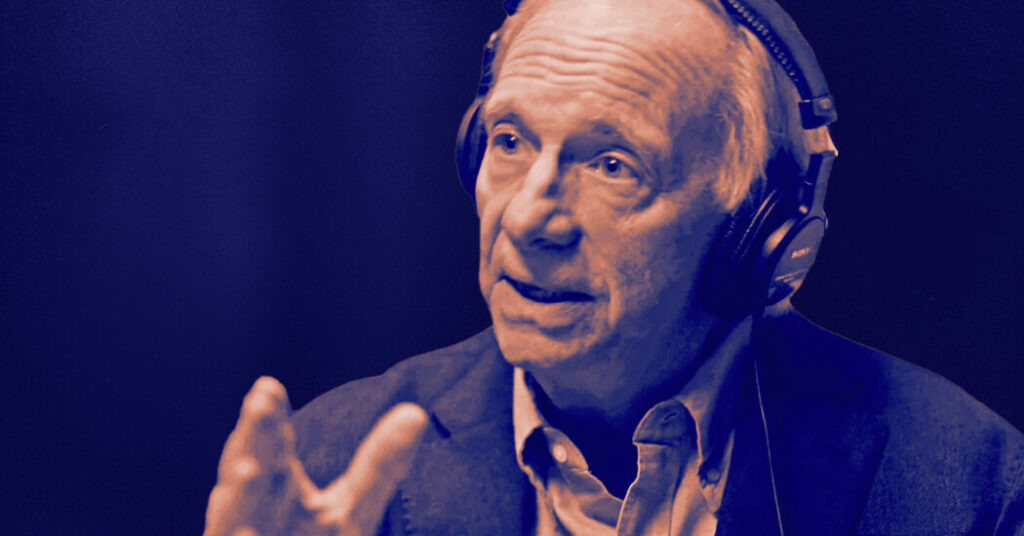
Ray Dalio built one of the world’s largest hedge funds, Bridgewater Associates, from the ground up. But these days, he mostly wants to talk about our imperial decadence, and whether there’s anything we can do to pull the American empire back from the brink.
Below is an edited transcript of an episode of “Interesting Times.” We recommend listening to it in its original form for the full effect. You can do so using the player above or on the NYTimes app, Apple, Spotify, Amazon Music, YouTube, iHeartRadio or wherever you get your podcasts.
Ross Douthat: Ray Dalio, welcome to “Interesting Times.”
Ray Dalio: Thank you. It’s interesting to be in interesting times.
Douthat: So people say. So you’re someone who spent your career making bets, and a substantial number of them have paid off over the last few decades. Lately, you have been arguing that the United States of America is maybe not such a good bet at the moment.
So if someone is looking at America right now, trying to decide, let’s say, whether to bet on the American empire as a dominant force in the 21st century, what are the big forces or factors that they should be looking at?
Dalio: I’d correct that. I’m not saying that America is a bad bet or a good bet. I’m just describing what’s going on. And what I learned through my roughly 50 years of investing is that many things that are important that happened to me didn’t happen in my lifetime before, but happened many times in history.
So I learned to study the last 500 years of history to find what caused the rises and declines of reserve currencies, their empires, and so on. And you see a pattern over and over again. There is such a thing as a big cycle, and the big cycle starts when there are new orders.
There are three types of orders. There’s a monetary order, a domestic political order, and an international world order. These are three big forces that evolve.
So on the first force, as we look at that monetary order, there’s a debt cycle. When debts rise relative to incomes, and debt service payments rise relative to incomes. For countries, for individuals ——
Douthat: For empires.
Dalio: For anybody!
Douthat: Yep.
Dalio: That squeezes out spending. That’s a problem.
For example, the United States now spends about $7 trillion. It takes in about $5 trillion, so it spends about 40 percent more than it takes in. It’s been running those deficits for a while, so it has a debt that’s about six times its income, the amount that it takes in.
And you can see throughout history that that produces problems. It’s a very simple thing: The debts for a country work the same as the debts for an individual or a company — except the government can print money.
Douthat: Right. Which is an important difference.
Dalio: An important difference! OK.
Douthat: Just speaking personally, I can’t print money to pay my mortgage.
Dalio: Right. But what that does is it also devalues money. So that’s the mechanics. That’s why there’s a long-term debt cycle, as well as short-term debt cycles and money cycles and economic cycles that take us from one recession to an overheating to another recession.
Related to that is the domestic political and social cycle that relates to the money part. And when you have very large wealth and values differences, big gaps in those ——
Douthat: Meaning, between rich and poor?
Dalio: Between rich and poor, and those with different values. And you get to the point where there are irreconcilable differences. Then you have political conflicts that are such that the system is at risk.
OK. I think we have the first cycle going on. I think we have the second cycle going on — the political left and right and their irreconcilable differences. We can get into those.
Douthat: How does the international aspect factor in?
Dalio: And then international is the same thing. Following a war, there is a dominant power, and the dominant power creates the new world order. The order means the system.
So that began in 1945.
Douthat: For us. The United States was the dominant power establishing that system.
Dalio: That’s right. And it established a system, which was largely modeled after the United States system in that it was meant to be representative. The United Nations, for example, was a multilateral world order. And so all different countries would operate and there was supposed to be a rule-based system.
But the problem with that is, without enforcement, it’s not going to be an effective system. It was an idealistic system and it was a beautiful system while it lasted, but we no longer have a multilateral rule-based system.
We have what existed prior to 1945 through most of history, and now you’re going to have geopolitical disagreements, such as even what is existing with Iran.
How are those disagreements resolved? You don’t take it to the World Court and get a verdict and get it enforced. It’s power that rules.
Douthat: Right. But even at the height of what we think of as the rules-based international order, first, for most of that history, the U.S. was in conflict with the Soviet Union.
Dalio: That’s right.
Douthat: So there was an ongoing Cold War. It was a relatively narrow window of just that system existing independent of great power conflict. And even then, American power was, in the end, sort of the decisive force. Right?
Dalio: Of course. Because the Soviets did not have real power. They had military power, but at the end of World War II, the United States had about 80 percent of the world’s money. It had half the world’s G.D.P. It also had the dominant military power. As a result, we could give away money, and those who received the money appreciated the money.
And then they had the Soviet system, which was a very limited part and financially, almost broke. Certainly insignificant.
Douthat: So the military balance of power was real, but the financial balance of power just put America in charge, basically.
Dalio: That’s right. Fortunately, when there was mutually assured destruction, we didn’t use that military power. Although, I remember the Cuban missile crisis — as a kid, I watched and we didn’t know whether there would be a nuclear exchange. But it never came to that, and then the Soviet Union collapsed.
Douthat: What role do contingent events play in this cyclical view of history?
Dalio: All the events that come along, I guess the question is: Do they lead to a dispute? And how is the dispute resolved in a world where there’s not the court system to resolve it, either domestically or internationally?
For example, what’s happening in the Middle East — particularly with Iran — there’s a conflict, and then there is a war, because there’s no other resolution. And what the world is looking at right now is: Will this war be able to be won by the United States, or will it be lost?
When we look at that, it’ll be measured in almost black-and-white terms of who will control the Strait of Hormuz, and who will control the nuclear materials. Will the United States win a war?
And we should also recognize that there are alignments here. Russia and China and Iran tend to be more supportive of each other, just as there are supports on the other side.
Douthat: And again, just to emphasize what is distinctive about this moment relative to the past few decades, it’s the strength of the alignment on the other side?
Dalio: It’s the relative strength, and the breakdown of that order. In addition, there are big debtor-creditor relationships that enter into it. For example, when the United States runs large deficits, it has to borrow money. And that is very risky during periods of conflict. So are interdependencies.
In other words, in this world of greater risk, then you have to have self-sufficiency. Because history has taught us that you can be cut off. Either side can be cut off.
Douthat: Yeah. I’m very interested in how the pieces fit together. Suppose the end game in Iran is that we are perceived to have lost the war or at the very least failed in our objectives. Maybe the Strait of Hormuz is open, but the Iranian regime is still in power, and there’s just sort of a perception that America tried this thing and it didn’t work. You think that then bleeds back into people’s perceptions of whether we are trustworthy to pay our debts?
Dalio: I just spent about a month in Asia, going and meeting different leaders and others. It has a very big implication, very much like the implication that happened when the British lost the Suez Canal, because Egypt took control of the Suez Canal. And that was perceived to be the end of the British Empire. In other words, very significant.
Douthat: Right. This was in the 1950s.
Dalio: That’s right. And that’s also when there was not a willingness to hold the debt and so on.
What’s happening now in different countries is the question of: Will the United States defend us? Or is the United States not in a position to defend us? Because the population does not want to fight a war that lasts long, so the war has to be quick and not expensive and ——
Douthat: Popular. Right?
Dalio: Popular.
Douthat: Which our wars don’t tend to be these days.
Just to stay with the Suez analogy for a minute, though, because I think it’s interesting. I’ve heard a lot of people offer that analogy. This was a case where Britain and the French and the Israelis basically tried to retake the Suez Canal after it was nationalized by Egypt.
So obviously, there’s parallels to Iran: You have a choke point in global trade. You have a conflict over it between Western powers and a regional power.
But in that case, the key element of Suez, it seems to me, was that Dwight Eisenhower and the United States basically told the British, no, you’re not going to do that.
And so part of the crisis and confidence for the British Empire and the British pound and everything else was connected to this realization that this was, as you said before, the post-World War II order, and America is in charge.
Do you need that to happen now with China? Do you need to have a similar moment for people to really lose confidence in America? How much do you need a new hegemon to emerge for people to abandon the old one?
Dalio: By the way, I don’t think China will end up being the classic hegemon, which we can get into in a few minutes.
Douthat: I’m interested in that.
Dalio: But what I would say is there was the combination of the British debts and the fact that it clearly lost power. The decline began before the Suez because there was a recognition that the United States was in a financially better position, as well as a world power.
Douthat: So if there is value in that analogy, what is the equivalent now? If people decide the U.S. is no longer as trustworthy as we thought, it’s less likely to pay off its debts and so on — and maybe this goes to your point about China and whether they’re a new hegemon — do people go to China? Do people abandon the dollar as a reserve currency? Where does the money go if people lose confidence in America?
Dalio: I’ll give you my thoughts on that, but I also want to say this is typical of every cycle. So when the British took over from the Dutch, it happened in the same way. The British were financially strong, capably strong. They lost, and it caused the shift from the Dutch empire, which at the time had the reserve currency and the debt. And it’s happened repeatedly the same way.
So you don’t need the particular of, let’s say, President Eisenhower ——
Douthat: No, but you need a successor power. That’s what I’m asking about.
Dalio: Then I think what happens is — in answer to your question of where the money goes, or where the wealth is — you could still be or have a dominant power, and you could still have financial problems.
Like the breakdown of the monetary system in 1971. The United States was still a dominant power. In 1971, you had too much debt, you couldn’t back up your promise to deliver gold, and you had a breakdown of the monetary system. And we had the ’70s stagflation. You could still have that.
Douthat: So that is a situation where you have a crisis, you don’t have a successor power yet. The Soviet Union didn’t take over in the ’70s.
Dalio: That’s right.
Douthat: We just went through a really bad 10 years roughly.
Dalio: You still have lousy finances. And what that means is that holding the bonds is not a good store of wealth. To answer your question, there are two purposes of money: medium of exchange, and a storehold of wealth.
I think that you’re seeing right now China’s currency increasingly become a medium of exchange for a number of reasons. But I very much doubt that Chinese debt or whatever will be a serious storehold of wealth because of their history of not protecting wealth.
Douthat: Right.
Dalio: And I don’t think any of the fiat currencies will be effective storeholds of wealth.
Douthat: A fiat currency, for our listeners, is just a currency issued by a nation state that isn’t backed in gold or anything else, right?
Dalio: And where they can print the money.
Douthat: Where they can print the money.
Dalio: So when we look at history, we see that in all such periods, all the fiat currencies go down, and gold goes up. Gold, right now, is the second-largest reserve currency of central banks. In other words, the dollar is first, then there’s gold, then there is euros, then there is yen.
So I think the question is: What is money as a storehold of wealth?
Gold has been the leading candidate of that out of default, because it’s been the winner over thousands of years.
Douthat: So alternatives to the dollar become more attractive without there being this shift to we’re just buying Chinese debt instead?
Dalio: From transactions’ point of view, the way it works traditionally is that countries, as they start to transact in a currency, will build reserves in that currency. It’s like their cash account, so that they expect that when they pay for those things they just bought, they have enough cash on hand to do that. So I would expect that would increase the reserves.
The issue of saving in that debt is a problem. So we are in a new world of saying: What is a safe storehold of wealth?
Douthat: For the average American looking at your cycle and saying: OK, yeah, this has happened before. It’s happening again. We’re going through a period when we’ve spent beyond our means and there’s going to be a correction — what do you expect that correction to look like?
There’s the 1970s, which is a period of inflation and slow growth — a stagflation. There’s the Great Depression model, which is a financial crash and crisis that leads to poverty and deflation. Which one should we be most worried about in this environment?
Dalio: I think everybody should be most worried about what they don’t know about the future. OK?
Douthat: OK. I am worried about that. That’s why I’m asking you to tell me.
Dalio: So what I’m saying is: We do not know a lot about what the world will look like in three to five years. What we don’t know is much greater than anything we know. I think we know that we are in increasingly disorderly times, and these are the greater risks.
So what do I think that answer should be? I think that answer should be to know how to have a well-diversified portfolio that is largely balanced for these kinds of uncertainties.
To give this simplicity, if you’re saying, “What is my typical portfolio?” There’s stocks, there’s bonds, there’s investments in other countries — diversification is good. I’m not going to be able to go through all the things about how to structure that. But I think any portfolio should have between 5 percent and 15 percent in gold because when you get into the really bad times for the rest of it, that is when gold does best. So whatever it is, it’s one of the reasons it’s been such a great investment in a sense over the last few years, because there’s a movement in that direction.
So I would say: Balance, to know how to have good diversification in one’s portfolio as a hedge against the other stuff.
Douthat: As an investor myself, I do want the investment advice. But as a pundit, a columnist — whatever I am — who’s trying to describe or anticipate reality, even accepting that we can’t know for sure, if there are these lessons from history, if there are these cycles that repeat, and we’re headed for a kind of bottoming out or reset, that maybe we bounce back from it, but I’m just trying to get a sense of what you think life looks like at the bottom of the cycle and whether it is a stagnation and a persistent unhappiness, or is it more like crisis and clashes in the streets kind of thing? Because the ’70s versus the ’30s seem like different examples. That’s all.
Dalio: I’ll give you my concerns. I think we have these big issues — the money issue, the political social issue domestically, and the international geopolitical issues. As I look at the clock, we’re going to come into the midterm elections and I think that the Republicans will probably lose the House. I think from that point on, you’re going to see an intensification of political and social conflict that’ll take place in that period, particularly between that election and the presidential election in 2028.
I worry that those can be irreconcilable differences. I don’t know how they will go down. I don’t know how the respect for rules and law and order and whatever will keep law and order.
I am concerned about, but I’m not predicting, broader-based violence. You could have broader-based violence. There are more guns in the United States than people
Douthat: People ——
Dalio: I’m not predicting — let me complete my thought, if I may.
Douthat: Yep.
Dalio: I’ve seen the possibilities. I think that everybody around them can look at these things and judge for themselves. My general reaction is that we are entering a period of greater disorder, to answer your question. I think greater risk than existed, and it is following that arc. Now we talk with words, but I plot things on charts in terms of what the patterns are, and these things are following those kinds of patterns.
You asked me the question, I’m giving you my answer, and I think for those reasons, [have] a good diversification of a portfolio, and be alert to those types of things.
Douthat: Tell me how you think the debt picture and the political and social picture interact, because it seems like if you ask people what they’re divided about right now, they don’t say interest payments on the national debt. They have a much longer list of things they’re divided about.
I’m just curious: Interest payments go up, they crowd out other forms of investment. What is the economic force that interacts with social disarray here?
Dalio: They’re divided about who has what money and who gets it, which is very much related to the deficit.
I wrote my most recent book to explain how it works with 35 examples. It was called “How Countries Go Broke.” And I’ve been speaking to top levels of both the Democratic and the Republican Parties, and everybody agrees on those mechanics.
When I go down and I say to them, you’ve got to get to 3 percent of G.D.P. deficit through some mix of raising taxes, cutting spending and controlling interest rates — because that’s how you have to do it mechanically.
Then they say, Ray, you don’t understand, in order to be elected, I have to make at least one of two promises: “I will not raise your taxes” and “I will not cut your benefits.”
What the country’s divided on is, let’s say, the multibillionaire class and those who are struggling financially, the left and the right and populism, and so on — and that has a money component. So the deficits and the money part is a very big part of the social conflict part.
Douthat: So you’re talking to politicians about this, and they give you this spiel about how we can’t raise taxes and we can’t cut spending, I think the follow-up that they would say is that people experience those things as threats to opportunity or equality. That people who rely on Medicare and Social Security think this is the guarantee of equality, and people who rely on low taxes to build a business think this is the guarantee of opportunity.
If you are trying to sell those people on cutting deficits to 3 percent of G.D.P., what do you tell them you’re saving them from?
Dalio: You’re saving them from a financial crisis.
Douthat: And what happens in a financial crisis in the U.S.? What does that look like?
Dalio: The financial crisis will mean that the capacity to spend will be very limited. In other words, you can’t afford military expenses and social expenses, and so on. You’ll be very constrained. And because the demand won’t meet up with the supply, you’ll have interest rates going up, which will curtail borrowing, will hurt markets, and so on. And that will lead to the central banks trying to balance that by printing money, which will also devalue the money and create a stagflation kind of environment.
Douthat: OK. So it sounds like in the worst case, it’s the 2008 financial crisis yielding 1970s-style stagflation? I’m sorry to try and demand ——
Dalio: No, no, I’m happy to try to give.
Douthat: Just to put it in perspective for you, I am 46 years old. I have lived my entire life in the shadow of predictions about the U.S. deficit being unsustainable. The first presidential election I really remember is Ross Perot’s campaign in 1992, which was run in part on those themes.
But like a lot of Americans, that means that I tend to tune out the deficit argument. The first time I feel like the deficit’s overspending became a really big issue for people’s pocketbooks since the 1990s was the wave of inflation in the first couple of years of the Biden administration.
So I just think it’s useful for me and for listeners to understand concretely why are the 2030s or the late 2020s different from the last 20 years, when we’ve also had these deficits?
Dalio: Thank you for your curiosity! And I feel compelled to give you that answer.
It is like the plaque building up. It’s like you saying, “I haven’t had a heart attack yet.”
Douthat: “I feel OK.”
Dalio: And I can say: OK, I understand you haven’t had a heart attack yet. Can I show you the M.R.I. of this plaque building up in your system? And can you understand what I’m saying about that plaque, that you will have a heart attack if that plaque then starts to get there? Can you understand that? Can you understand where the numbers are, and where you are? Look, it’s your life. It’s your choices. Ask yourself, “Is that right or is that wrong?” That’s what you need to do for your own well-being.
Douthat: In your story, it sounds like if you combine that diagnosis with your sense — and my sense — of how the American political system currently works, that you’re going to get at least a mild version of the heart attack before you get change.
You said at the outset, you weren’t really betting against America, in spite of my podcaster’s framing. Are you optimistic that we could have, I guess you could call it, a minor heart attack and recover?
Dalio: I think we’re going to come into a period of greater disorder as there’s a confluence between the monetary part; the domestic, social and political part, where there’s irreconcilable differences; and the international world order part.
I would say then, I should bring in two other factors. One of them is acts of nature through history ——
Douthat: Pandemics.
Dalio: Droughts, floods and pandemics. And if you take what most people think about what’s happening to climate, it’s not a movement toward improvement, it’s a movement toward worsening. And then technology and A.I.
We have to talk about technology and A.I. as it enters into this picture because it plays a role. And it does so in three ways. It can be a tremendous productivity enhancing result that can help to mitigate maybe a number of the debt problems — perhaps. We can get into this. I don’t think it’s going to come across at that speed.
Douthat: Well, I hear this from A.I. people. They will say that in the best case, if A.I. just adds X percent to G.D.P. growth, X percent to productivity growth, that it reduces your original problem.
Dalio: That’s right. That’s right.
Douthat: It makes the debt easier to bear.
Dalio: That’s what I’m saying. Because it can produce the incomes, let’s say, and the incomes can help debt service payments and the like. So that’s one of the three effects of the A.I.
The second effect of that A.I. is it is now creating enormous wealth gaps. Those who are the beneficiaries of it are approaching “Who will be the first trillionaire?” The wealth gap thing has increased at great amounts, and it will replace a lot of jobs. So that’s No. 2 as a factor. Those gaps are an issue however we deal with them. They will have to be dealt with, and that’s going to become probably a political question, but that’s an issue.
And then No. 3 is that the technologies themselves can be used for harm — a lot of power. It could be used by other countries. It can be used by those who want to inflict harm. It could be used by those who want to steal money. It can be used for harm.
Douthat: Right. But in your pattern, in your cycles, you can see, in that last sense, that it increases geopolitical tensions potentially. That it heightens Cold War dynamics. That it increases domestic tensions.
Dalio: That’s right.
Douthat: But it could ease fiscal tensions.
Dalio: Right, it could produce the productivity.
Douthat: But if it has some of the bad effects, it will probably have some of the good effects too.
Dalio: And how that balances.
Douthat: Yeah.
Dalio: And we won’t know what it is like in the future because it’s [beyond] our human capacity to anticipate what it’ll be like in three to five years.
For all these forces, these five forces, over the next five years it’ll be like going through a time warp. There will be huge changes over the next five years, with all of these forces coming together. And on the other side of that, it’ll be almost unrecognizable. It’ll be very different, and it’ll be a period of great change and great turbulence.
So what does one do? Knowing that one is not going to know what that’s going to be like, my own approach to this — and my recommendation — is knowing how to balance positions.
Douthat: For politicians, though, listening to that account, maybe it makes them say: Well, I know Ray Dalio wants us to cut deficits to 3 percent but he also thinks we’re going through a five-year time warp unlike anything in human history, so maybe we’ll just wait and see what the world looks like in five years, before we painfully restructure Medicare and Social Security.
Dalio: I don’t think they’re going to think about what Ray Dalio thinks. [Laughs.]
Douthat: Well, no. But ——
Dalio: I think they’re going to think about what the ballot box thinks.
Douthat: Yes, absolutely. I’ve talked to people in Washington, D.C. — there’s always legitimate concern about the deficit. And there are actual attempts to do something about it.
I guess what I’m interested in is, in your account of the rise and fall of empires — Spanish Empire, British Empire, the Dutch mini empire, and so on — you don’t have these case studies of a great power going through this cycle, hitting what you think of as the bottom, and then bouncing back and having another run. Or do you?
Because, look, as Americans, that’s our goal. If someone buys into your narrative, they would say: OK, but history isn’t determinist. We can make choices and we can have ourselves another cycle. Right?
Dalio: Yes. I think that’s possible, but here’s what has to happen — and history would suggest it: Plato talked about this cycle ——
Douthat: Yes.
Dalio: In “The Republic.” And he talked about the democracy and the problems with the democracy because the people don’t vote for what is good for them and the strength. About 60 percent of the American people have below a sixth-grade reading level, and there’s a problem with productivity, and so on. And they vote and they determine a lot.
The question is: How in a democracy can that happen? His view is that’s when you have, ideally, the benevolent despot — somebody who is going to take control, be strong and give for the country. In a sense, bring people together.
However that happens, what you need is a strong leader of the middle who recognizes essentially that the partisanship and the conflict is going to be a problem, but has the strength to get people and everything working in a way that it needs to work so that there can be a debt restructuring of some form, there can be an improvement in our education system, there can be the structural changes in efficiency.
It’s difficult to run a big company. Imagine what it’s like to run this country and to run it well. So you have to have a remarkable person with great strength and you have to have strong leadership that is then followed, rather than subverted, by either of those sides.
Douthat: So you’re looking for the Franklin Roosevelt, maybe the Ronald Reagan figure of this particular crisis?
Dalio: Well, I think it’s tougher now than it has ever been.
Douthat: Because we’re further down ——
Dalio: Everybody’s got an opinion. Do you know how difficult it is to lead? [Chuckles.]
I mean, can you imagine?
So can you lead people down the middle, bring people together, and get them to do difficult things?
Douthat: Right. But this is something that I think about with these debates: We’re also extremely rich. The United States is much richer than it was even in the 1980s. It’s certainly much richer than it was during the Great Depression. And as much as people feel the bite of inflation or feel the struggle of a spike in the unemployment rate, that itself is a kind of stabilizer.
It seems like you can also see scenarios where, take the example of Japan. Japan is a country that has carried a tremendous debt burden for a long time, and I wouldn’t say it’s done so with great success. It has become less economically dynamic. It’s more stagnant. It’s not where it was in the 1980s or 1990s when people were talking about Japan taking over the world. But it also has this kind of wealthy, older society stability. Do you think that’s a plausible scenario for the U.S.?
Dalio: I think you raise two questions and I want to treat them separately, even though they’re related. The first is about the higher living standards and the U.S. being richer. That has been true throughout history. So all of these times before World War II, that has been true. And the big issue is how people deal with each other.
Douthat: Meaning that at the peak of debt, the empire is richer than ever before?
Dalio: Yes. If you take per capita income, many measures — life expectancy, any measures of well-being — and you do a chart from the 1400s, or the Dark Ages, it was relatively flat. And so at every moment in time, we as a world, as a society, have been richer than before, making your point.
That didn’t prevent World War II, didn’t prevent the debt problems, didn’t prevent any of those things, because the most important thing is how people deal with each other. Can they together deal with those problems? Because realistically, so what if we had a 10 percent decline in our living standards as part of a healthy adjustment?
I’m almost finished, but I want to get this out.
So that’s the first thing. It doesn’t alleviate the debt problem, doesn’t alleviate the fighting for who controls ——
Douthat: But maybe it does a little. Like the ’30s —
Dalio: No, no, no. Just wait a second. I didn’t interrupt you. Please don’t ——
Douthat: OK. Go on. Sorry.
Dalio: I’ll finish, and then you’ll reply.
So on the Japanese case — or do you want me to answer this one and then we’ll go to the Japanese case?
Douthat: Wait on the Japanese. Just one question on that: Don’t you think, though, that if you look at the ’30s, the ’70s, and the aftermath of the financial crisis in 2008, each a period of some kind of economic crisis, it was better. The ’30s were worse than the ’70s, and the ’70s were worse than the 2010s, so maybe things can stabilize a little bit because we’ve gotten richer. Right?
Dalio: Yes. If you were to look at per capita income, life expectancy — any measures of standard of living or whatever it is — and you would’ve seen a graph ——
Douthat: I’m just saying, even the fighting was not as bad in the ’70s as it was in the ’30s. That’s all I’m saying.
Dalio: Well, I wouldn’t make too much of that.
Douthat: OK.
Dalio: In other words, I would say this is much more like the ’30s for a variety of reasons having to do with the measures. If you were to say the severity of the debt, the severity of the internal conflict — I mean, I lived through these. And I would say ——
Douthat: So you think we’re worse off than the ’70s?
Dalio: Our debt is worse off.
Douthat: That’s true.
Dalio: And the United States dominance in the world order and the conflict is worse off.
Douthat: OK.
Dalio: So I would say that’s objectively the case. I’m not trying to make a bad case, I’m just trying to be analytical because my job is to bet correctly.
Douthat: All right. So how about our Japanese future? Could we have a Japanese future?
Dalio: The Japanese situation is two main things — very interesting. The Japanese debt is an internal debt. In that particular case, the way it was dealt with is that the central bank printed a lot of money and bought the debt. That’s how they did it.
And as a result of that, the Japanese yen declined . and so they had a tremendous depreciation in the value of the wealth because of the depreciation in the value of the money and the debt.
So yes, we can see something happening like that. But we also, one-third of our debt is held by foreigners. That’s a different thing. And we as a country owe money to other countries.
Douthat: And here I’ll ——
Dalio: And if you think that’s a good outcome —— [Chuckles]
Douthat: No, I don’t. Well, I think it ——
Dalio: It’s like the decline of the British Empire.
Douthat: No, I don’t ——
Dalio: You can have the decline of the British Empire. The same sort of thing.
Douthat: No, I don’t think it’s a good outcome. I’m interested in it because, in the case of Japan, it’s sort of a sustainable stagnation rather than crisis and collapse. But I think where I would agree with you is that, for various reasons that are beyond the scope of this conversation, Japanese society seems more likely to accept a depreciation in living standards than American society. In that sense, it probably isn’t a model.
Let me ask you a last question in the form of a comment about my own optimism that you can respond to. I mentioned earlier that I’ve lived my entire life in a world of people worrying about deficits and deficit spending, and I think it is completely reasonable to say, as you’ve said, that just because the crisis hasn’t arrived doesn’t mean that you aren’t going to have a heart attack tomorrow. And so I totally expect everything you’re describing to have significant negative impacts on the United States.
At the same time, I do think it’s a weird moment where the U.S. looks weak if you look at certain indicators, but we can also look very, very strong in many ways. If you look at the last 10 or 15 years, our G.D.P. growth has substantially outpaced Western Europe, Canada, peer economies. We still have the world’s most profitable cutting-edge technology companies. We still have the world’s most capable military. And then socially, we have a lot of problems, but are there other big countries in the world that are better at assimilating immigrants, that have higher birthrates, that are geographically isolated from major wars and refugee streams, and so on? I’m not sure there is a better bet.
If I’m looking forward 50 years, isn’t America still, in the context of the whole world order, a place to have a certain kind of confidence in? What do you make of that?
Dalio: I think we can’t frame it as, like in the beginning of what I objected to, “Is the United States going to win or lose?” or anything like that.
I think we know what healthy is. There are only three things any country has to do in order to be healthy, and this is throughout history. First, educate your children well in terms of their capabilities, the quality of their ability to be productive, and their civility. No. 2, have them come out to a country in which there’s order and that people work together to be productive so that there’s broad-based productivity and prosperity. And don’t get into a war. Don’t get into a civil war or don’t get into an international war. That’s all you have to do.
Then you can look at the fundamentals of that. Are we educating our children well so that they can be productive and capable and they’re civil with each other, that we have a civil population? Do we have an environment where there is productivity and we can get along?
I think we have terrible circumstances. I live in Connecticut and my wife helps the poorest kids trying to get through high school. The gaps in education, the gaps in these things and civility, are real problems. So I think that it really comes to that.
And it’s basics. Do you earn more than you spend? What’s your income like? What is your balance sheet like? These are basics. You know those basics. So if we can have those basics — yes, I thank God that I grew up in the United States because, oh my God, it was unbelievable. It was the place that anybody from anywhere in the world could come and truly be a citizen, so it had that real meritocracy. And I grew up in a lower-middle-class family. My dad was a jazz musician. I could go to a good school, and I could make my way, OK? And I think of that creativity and all the wonderful things — a broad-based education. A middle class — that we had a middle class, and we had those things.
So I’ve seen the difference. I know what the fundamentals are, and I look at measures and I’m worried about that.
Douthat: All right. Ray Dalio, thanks for joining me.
Dalio: Thank you for having me.
Thoughts? Email us at [email protected].
This episode of “Interesting Times” was produced by Sophia Alvarez Boyd, Victoria Chamberlin, Emily Holzknecht and Rochelle Widdowson. It was edited by Jordana Hochman. Mixing and engineering by Nick Pitman and Efim Shapiro. Cinematography by Bets Wilkins. Video editing by Dani Dillon. The supervising editor is Jan Kobal. The postproduction manager is Mike Puretz. Original music by Isaac Jones, Sonia Herrero, Pat McCusker and Aman Sahota. Fact-checking by Kate Sinclair and Mary Marge Locker. Audience strategy by Shannon Busta, Emma Kehlbeck and Andrea Betanzos. The executive producer is Jordana Hochman. The director of Opinion Video is Jonah M. Kessel. The deputy director of Opinion Shows is Alison Bruzek. The director of Opinion Shows is Annie-Rose Strasser. The head of Opinion is Kathleen Kingsbury.
The Times is committed to publishing a diversity of letters to the editor. We’d like to hear what you think about this or any of our articles. Here are some tips. And here’s our email: [email protected].
Follow the New York Times Opinion section on Facebook, Instagram, TikTok, Bluesky, WhatsApp and Threads.
The post A Legendary Investor on How to Prevent America’s Coming ‘Heart Attack’ appeared first on New York Times.