New York Times leadership defended war photographer Saher Alghorra this week after the Gaza-based contributor’s Pulitzer Prize win for breaking news photography was hit with what the paper deemed “baseless” accusations that he staged scenes and had personal ties to Hamas.
“Covering conflict is grueling for any journalist. But Saher is not merely documenting this war, he is also living through it himself, facing the same hardship and peril as those whose lives he so compassionately documents,” the Times’ director of photography Meaghan Loorma said of his win. “And despite these unfathomable challenges, he dedicates himself each day to his mission.
“Saher threw himself into this work, becoming a true visual correspondent, delivering powerful photography and reporting, and learning to shoot and file video in order to provide our readers with even more immersive and immediate visual dispatches,” Loorma continued. “I am so proud of Saher and his work.”
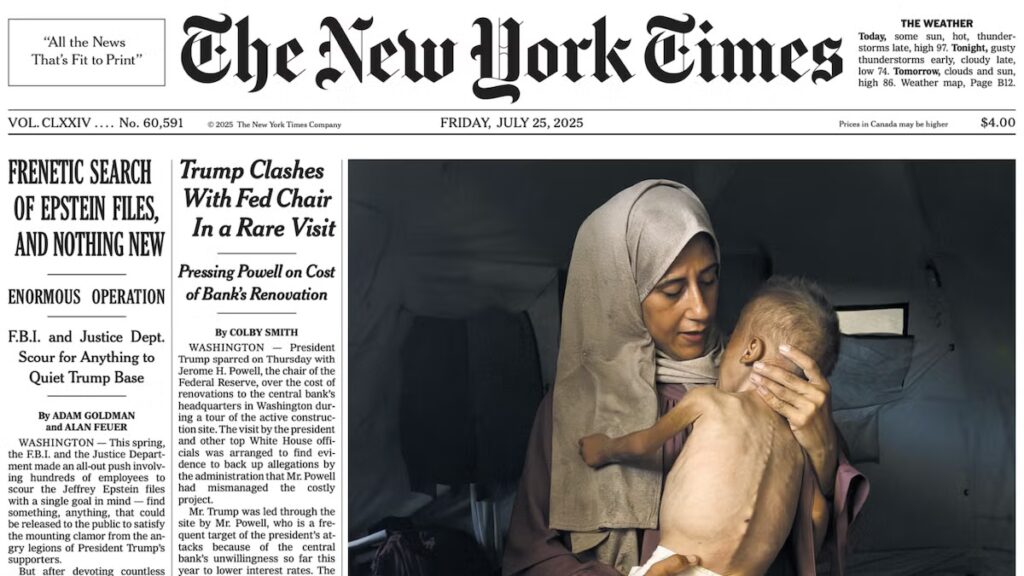
Alghorra won the 2026 Pulitzer for a series of images documenting widespread starvation of Gazans amid the Israel-Palestinian war. The win came after he and the Times came under fire last summer over a misleading photo of an emaciated child. The image was initially published in a report on Gaza’s food shortages without identifying that its subject, Mohammed Zakaria al-Mutawaq, suffered from pre-existing health problems that visibly protruded his spine and enunciated his thinness.
Critics of Israel said the picture, which showed the back of the 18-month-old boy, was a clear sign Israel was deliberately starving Gazans during its ongoing war against Hamas. The Times’ story, titled “Gazans Are Dying of Starvation” and the accompanying image was on the front page of the paper on July 25 after first being published July 24. The Times addressed the concerns five days later, well after the image had gone viral.
“This article has been updated to include information about Mohammed Zakaria al-Mutawaq, a child in Gaza suffering from severe malnutrition,” the editor’s note read. “After publication of the article, The Times learned from his doctor that Mohammed also had pre-existing health problems.”
Critics of Alghorra’s Pulitzer win this week cited this high-profile correction as a knock to his credibility as a photographer. Some have additionally questioned his work and raised concerns of pro-Hamas bias, though no evidence has been publicly substantiated linking Alghorra to militant groups.
HonestReporting, a prominent watchdog for anti-Israel bias in media, for instance, maintained Tuesday that Alghorra’s was “a prize built on staged scenes, a manufactured ‘famine’ narrative, and intimate access to Hamas terrorists.”
The Times’ responded directly to HonestReporting’s allegations, shown below.
1/ The @PulitzerPrizes just crowned @nytimes photographer Saher Alghorra for his Gaza photos – a prize built on staged scenes, a manufactured “famine” narrative, and intimate access to Hamas terrorists. Let’s look at what, exactly, made the Pulitzer cut.
pic.twitter.com/0aVyqEfEdD
— HonestReporting (@HonestReporting) May 5, 2026
“Saher Alghorra has documented hundreds of starving and malnourished children in Gaza, conducting intrepid photojournalism at personal risk so readers can see the consequences of war. This attack on his work is baseless,” the Times’ communications X account wrote, adding, “Jurors called Saher’s work a ‘distinguished example’ of breaking news photography for his spontaneous coverage of these scenes in Gaza.”
In a separate post Wednesday, the Times shared a quote from Alghorra — “We, the photojournalists and videographers, are among the few who can still show the world what is truly happening here.” — and doubled down on their defense of his Pulitzer recognition.
“Times contributor Saher Alghorra won the 2026 Pulitzer Prize in Breaking News Photography for his ‘haunting, sensitive series showing the devastation and starvation in Gaza resulting from the war with Israel.’ Read more about his work.”
The post NY Times Defends Pulitzer-Winning Gaza Photographer Amid ‘Baseless’ Claims of Staged Scenes, Links to Hamas appeared first on TheWrap.