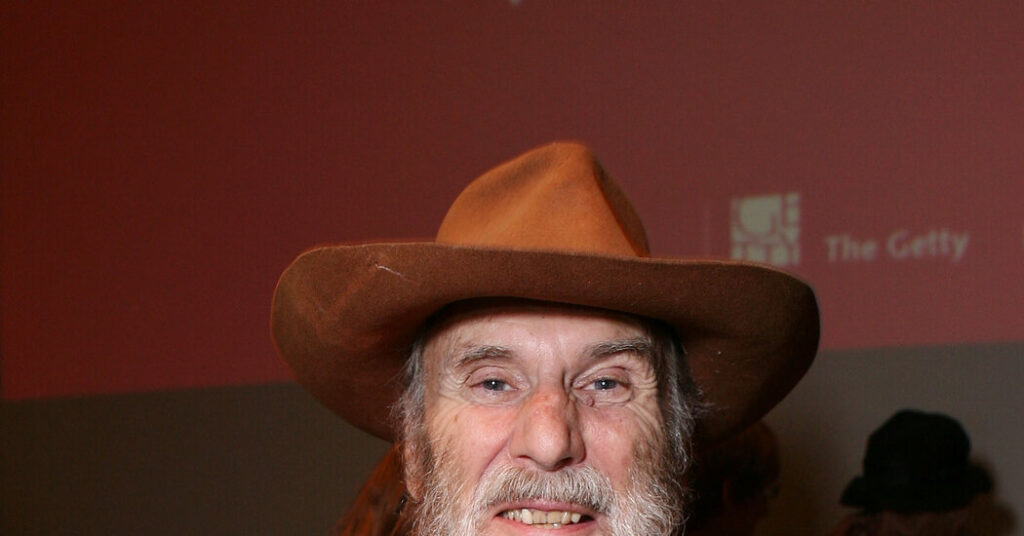
George Herms, one of the last Beat Generation artists, who rejected the trappings of post-World War II American consumer society by making lyrical, if not exactly beautiful, artwork from rusty junk and decaying objects, died on April 24 at his home in Irvine, Calif. He was 90.
His partner of 17 years, Sue Henger, confirmed the death.
Mr. Herms is widely celebrated, alongside the artists Edward Kienholz, Bruce Conner and Wallace Berman, as an early practitioner of California assemblage — an art form that embraced the messiness of everyday life by incorporating junkyard finds, broken car parts and other castoff materials.
“George could make such elegance of mess,” Neville Wakefield, a curator who paired him with artists half his age for a 2011 show at the Museum of Contemporary Art in Los Angeles, said in an interview. “This idea that you could make something of nothing was really resonant for a lot of younger artists, self-appointed rebels who were looking to use failure in compelling ways.”
California assemblage had its roots in the enlightenment-seeking, anti-materialist ethos of Beat culture, exemplified by writers like Jack Kerouac and Allen Ginsberg. Mr. Herms, who came of age creatively in San Francisco in the late 1950s, was swept up in the bohemian fervor, going to Lawrence Ferlinghetti’s City Lights bookstore to meet the poets and to jazz clubs to hear musicians like Miles Davis.
While Mr. Kienholz’s work skewed darkly political, Mr. Herms leaned toward the literary. He wrote poetry and used books as raw material for some of his early artwork. For his 1960 piece “The Librarian,” he rescued a mess of bloated, disintegrating books from the local dump and placed them in the extended arms of an abstract wood figure.
A related piece, “The Poet,” was featured in the seminal 1961 exhibition “The Art of Assemblage” at the Museum of Modern Art in New York, alongside work by East Coast counterparts like Lee Bontecou and Robert Rauschenberg.
Some of Mr. Herms’s later assemblages were eulogies of a sort for friends. “Donuts for Duncan,” his 1989 ode to the poet Robert Duncan, incorporated the ringed (and rusted) forms of a springform baking pan and a circular saw blade. His 1986 homage to Mr. Berman, “The Berman Peace,” used a weathered wood desk, resting on its side, to display worn leather shoes and other mementos imbued with personal history.
Starting around 1960, Mr. Herms stamped almost of all his artwork with the letters L-O-V-E. For decades, he also hand-printed poems, small books, invitations and other ephemera on an old printing press he called the Love Press.
His work could sometimes incite hostility. In 1962, the American Legion picketed the Pasadena Art Museum for showing one of his constructions built around a crumpled American flag. After someone broke into the museum at night and tore off the flag, Mr. Herms left the shell of the artwork on display, inserting a note that read, “Despite this degradation, the forces of creation will go on.”
Tensions rose again in 1988, when he was commissioned to install a large public artwork called “Moon Dial” in Beverly Hills, Calif. Inspired by astrolabes and other ancient astronomical devices, the work featured four massive, rusted buoys encircling a set of window frames positioned to track the movement of the moon. Hundreds of local residents petitioned for its removal. Mr. Herms, undeterred, spoke to detractors and solicited letters of support. After the work’s 18-month run was up, he unsuccessfully offered it as a gift to the city.
“Every generation has to kick open the doors of repression, but they’re like saloon doors — they swing closed again,” he said in a panel discussion about the controversy in 1989.
George Herbert Herms was born on July 5, 1935, in Woodland, Calif., near Sacramento, one of three children of Irene Lucille (Rieder) Herms and William Herms, who worked for Yolo County as an agricultural adviser.
George regarded his father’s job — which involved clocking into the same office day after day — as a fate to avoid at all costs and dropped out of the engineering school at the University of California, Berkeley after his first semester.
He was scared away from the field for good after few early jobs in the nascent computer industry; one, working for the business-machine manufacturer Remington Rand, involved feeding punch cards into a room-size Univac. He later recalled a lecture at the company that he found especially alarming, entitled “Electronic Brains Need Your Brains.”
As he wrote in a 1972 exhibition catalog, he was searching for a way to use his entire self — “to find a work, not just for my brain, but my soul, hands, heart, balls, spirit, senses.”
After leaving Berkeley, he traveled to Mexico on a spiritual quest, walking and fasting in Veracruz for 10 days with a typewriter on his back. (As he often said, all he ended up with was a broken typewriter and a sunburn.) Back in California, he lived in Topanga Canyon with a sandal-maker who called him Sid, for Siddhartha, and introduced him to Mr. Berman, who became a close friend and mentor.
Mr. Herms was soon creating his first works of what would become known as California assemblage. Living in Hermosa Beach in 1957, he made art from detritus he found on the beach and installed it on the foundations of some razed houses nearby. Mr. Berman, one of the few who saw it, described it as “courtyards of rust and decay — God’s night humor.”
Mr. Herms considered it his first show. He called it “The Secret Exhibition.”
Later that year, he was back in the Bay Area pursuing his art when he was arrested, charged with possession of marijuana and sent to prison for six months. After his release, he discovered the pleasures of peyote, though he resisted the stereotype that Beat values were fueled by drugs.
“Something surfaced in American international consciousness with what is now called the Beat Generation, and it’s never been driven back underground again,” he said in an oral history for the Archives of American Art in 1993. “And on this smorgasbord a few canapés are stimulants or sedatives, but what the main dishes are, are art and literature and music.”
Conspicuously missing from that menu was money for rent. In 1960, he found shelter in a derelict boathouse in Larkspur, north of San Francisco, near the art gallery that Mr. Berman operated on a houseboat.
To support himself, Mr. Herms took odd jobs like mopping the floors at City Lights bookstore. Whenever he was especially strapped for cash or faced with eviction, he would hold a raffle; participants paid a dollar to win the chance to spray him with a hose or take home an artwork of their choice.
Mr. Herms’s marriages to Polly Comstock Levee, Helen Louise Tacklind, Margaret Nielsen, Gaylyn Grace and Pixie Guerin ended in divorce. In addition to Ms. Henger, he is survived by two daughters from his second marriage, Nalota Herms and Lily Herms; two sons from his fourth marriage, Graeson Wilder and Aeryl; and a sister, Judith Du Bois.
Mr. Herms achieved a high point professionally in 1982, when he was granted a prestigious residency at the American Academy in Rome and was awarded a Guggenheim fellowship. He was represented at the time by the fast-growing gallery L.A. Louver.
Recently, a new generation of dealers and curators has discovered his work, thanks to a surge of interest in the history of Los Angeles culture. But he has never had — or cultivated — steady sales, said Sarah C. Bancroft, a curator who featured him in “Two Schools of Cool,” a show that opened in 2011 at the Orange County Museum of Art.
“He was unyoked from concerns of the everyday world — a true Beat,” she added. “He was not concerned with money or prestige or keeping pace with others. He just did his work, using commonplace materials in a way that transcended their banality.”
The post George Herms Dies at 90; Turned Castoff Objects Into Art appeared first on New York Times.