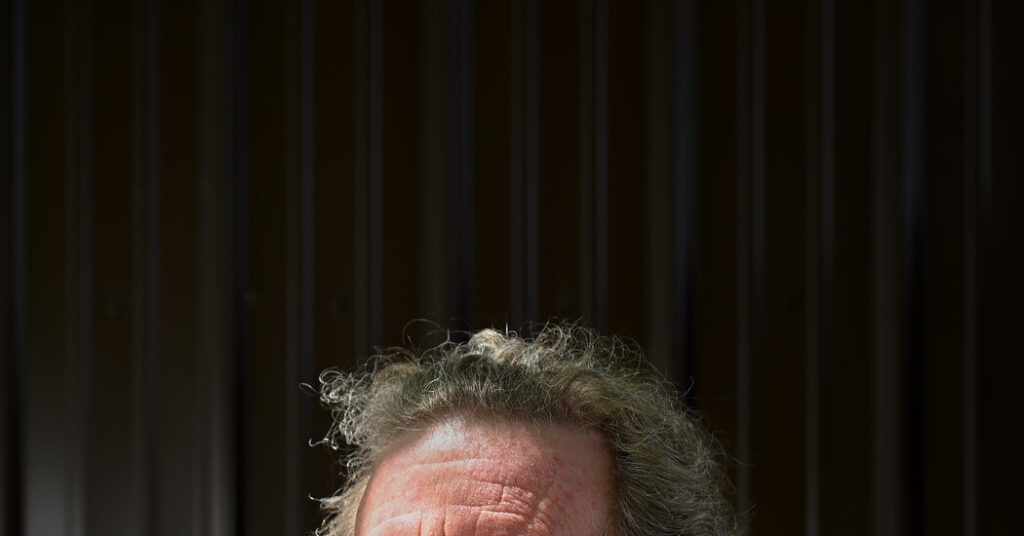
For Dana Briggs, a 71-year-old Air Force veteran, it was only natural that he would join a September demonstration outside a Chicago detention center. He has regularly protested the Department of Homeland Security’s actions for more than a decade.
But this time, he would find himself inside a federal prison hours later. He said that while at the demonstration, he had been knocked to the ground by agents, swarmed and arrested, and had been taken to a hospital, where he was handcuffed to a bed. He was then transferred to the federal facility, and read his rights, fingerprinted and photographed.
So by the time Mr. Briggs was ordered to take a cotton swab and rub it against the inside of his cheek, he complied.
“If you refuse to give a swab, you’re committing another crime,” Mr. Briggs said in an interview. “I was unaware of that. And I suspect that 99.9 percent of us in this country are unaware of that.”
This week, Mr. Briggs became the lead plaintiff in a lawsuit against the federal government’s DNA collection practice, arguing that his arrest and the collection of his sample violated his rights to protest and protections against the government conducting “warrantless, unreasonable intrusions” into his body.
The lawsuit, filed in the Northern District of Illinois, names three other people as plaintiffs, two of whom were arrested but never charged with a crime.
“The government’s chilling message is clear,” the suit says. “If you protest government policies, we will arrest you, file away your DNA and monitor you — and potentially your biological relatives — going forward.”
In Mr. Briggs’s case, he was released two days after his arrest, and the charges against him were dismissed two months later. The cases of four other protesters who were arrested that day were also dismissed. A federal judge found that the government “swung and missed — multiple times,” in charging Mr. Briggs.
But while Mr. Briggs was freed, his DNA sample remained in federal custody.
Last year, Georgetown Law’s Center on Privacy and Technology found that DNA samples were collected from about 2,000 U.S. citizens who were stopped at border checkpoints from October 2020 to December 2024. In some cases, the report found, the agency collected the DNA without stating a reason for doing so.
And that was before the Trump administration’s immigration crackdown.
During President Trump’s second term, federal deployments have swept through major cities, leading to a wave of protests and clashes between immigration agents and demonstrators. Many protesters have been arrested, and while some were not charged with a crime or have had their charges dismissed, their DNA samples have been collected and stored.
The lawsuit asks that the Homeland Security Department — the parent agency of Immigration and Customs Enforcement — be forced to follow a 2013 Supreme Court ruling that limited DNA collection to suspects arrested in connection with serious crimes.
“It puts you and your family in a surveillance state database of people who’ve criticized this administration,” said Carey R. Dunne, a founder of the Free + Fair Litigation Group, which represents Mr. Briggs. He called the government’s actions “a constellation of constitutional violations that needed to be challenged.”
Mr. Dunne and Mark F. Pomerantz, another founder of the litigation group, had led the Manhattan district attorney’s investigation into Mr. Trump’s business practices. They resigned in 2022 and, with a third founder, formed Free + Fair, a nonprofit law firm that aims to stem the tide of what it describes as anti-democratic policies in the United States.
The federal government’s DNA collection practice, on an “authoritarian scale of one to 10, this is a 10,” Mr. Dunne said.
Neither the Department of Homeland Security nor the Department of Justice responded immediately to a request for comment.
Over the span of about a month last year, the Trump administration launched a crackdown on illegal immigration in Chicago called Operation Midway Blitz. Throughout the operation, protesters gathered outside the Broadview ICE Detention Center facility, which had become the centerpiece of the administration’s crackdown.
On the morning of Sept. 27, Mr. Briggs left his home in Rockford, Ill., and traveled to Chicago to attend an Indigenous festival. On his way home, “appalled” by the administration’s actions, he stopped by the detention center.
About two hours after he arrived, a field commander yelled at the demonstrators to clear the streets, Mr. Briggs recalled. Seeing no people blocking the federal agents’ path, Mr. Briggs asked, “Why?”
“It was only about maybe eight to 10 seconds between the command to clear the streets and when I actually got knocked on the ground,” he said. “So even if I had wanted, I really didn’t have time or the energy at that point to actually get my butt off the streets.”
Video showed federal agents swarming Mr. Briggs and arresting him. He was taken inside the detention center for several hours before being transported to Loyola University Medical Center for medical treatment. At about 1 a.m., the agents took him to a federal facility, where he was read his Miranda rights, photographed, fingerprinted and ordered to provide a DNA sample.
The genetic material was sent to an F.B.I. database called CODIS that was created to gather information about convicted criminals and missing people and to assess evidence from crime scenes. According to the lawsuit, people who have been arrested are responsible for making sure their DNA is removed from the database when their charges are dismissed. Studies have shown that in most states, only a handful of DNA profiles added to the database have been expunged, the suit said.
The lawsuit asserts that federal officials could also use the DNA to draw inferences about suspects’ relatives, who did not consent or do anything wrong.
According to the lawsuit, the F.B.I. recently reported that the federal government had amassed about 27 million DNA profiles in a variety of cases and is collecting almost 150,000 DNA profiles monthly.
“I just find this to be abhorrent,” Mr. Briggs said. “If we don’t have a right to our own selves, everything is going to break down.”
Hurubie Meko is a Times reporter covering criminal justice in New York, with a focus on the Manhattan district attorney’s office and state courts.
The post His DNA Was Taken After His Arrest at an ICE Protest. Now, He’s Suing. appeared first on New York Times.